
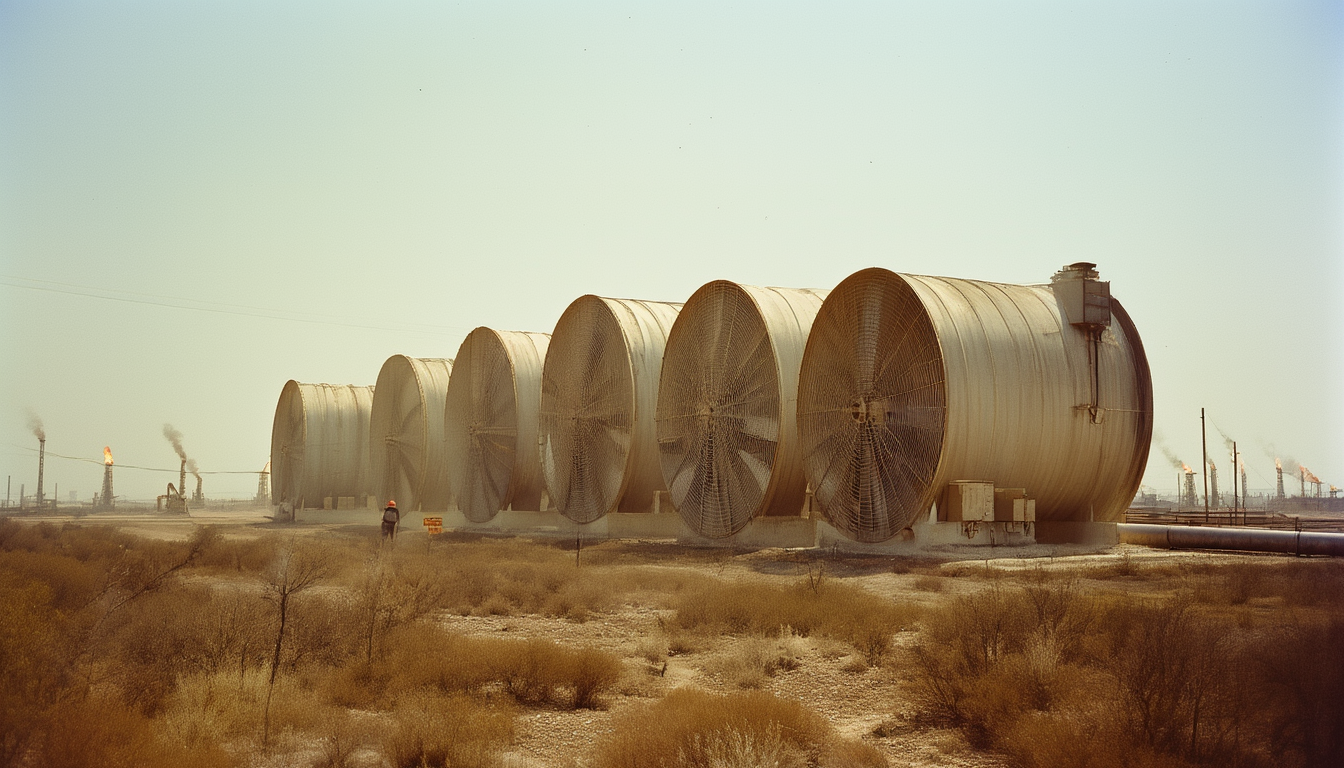
The first thing Maya Chen noticed in Pecos County was the sound. Not the wind, not the heat off the scrub — a low hum that came up through the floor of her trailer and into her molars at three in the morning. It was the fans. Forty acres of them, each the size of a house, pulling West Texas air through chemical filters that stripped out carbon dioxide one molecule at a time. The plant ran all night, every night, breathing in the sky and exhaling something cleaner. That was the pitch, anyway. It was a Tuesday in 2036, and she had been a systems operator there for three years.
She had taken the job to help. The orientation video used the word restoration. You could put a direct air capture plant anywhere, the trainer explained, because the atmosphere is one mixed bucket — a ton pulled down in Texas counts the same as a ton never emitted in Shanghai. So you build where energy and land are cheap and you clean the bucket from there. Maya liked that. It felt like plumbing for the planet.
The promise was real, and it was old. The technology worked. By the mid-2020s, the largest plant on Earth — Climeworks' Mammoth, in Iceland — was running on geothermal heat, designed to pull down as much as 36,000 tons of CO₂ a year and mineralize it into basalt.1 In Texas, Occidental's STRATOS plant was being built to capture up to half a million tons annually.2 The U.S. government put $3.5 billion behind a program of regional capture hubs, one in Texas, one in Louisiana.3 The engineering was sound. Maya never doubted the engineering.
What she came to doubt was the arithmetic.
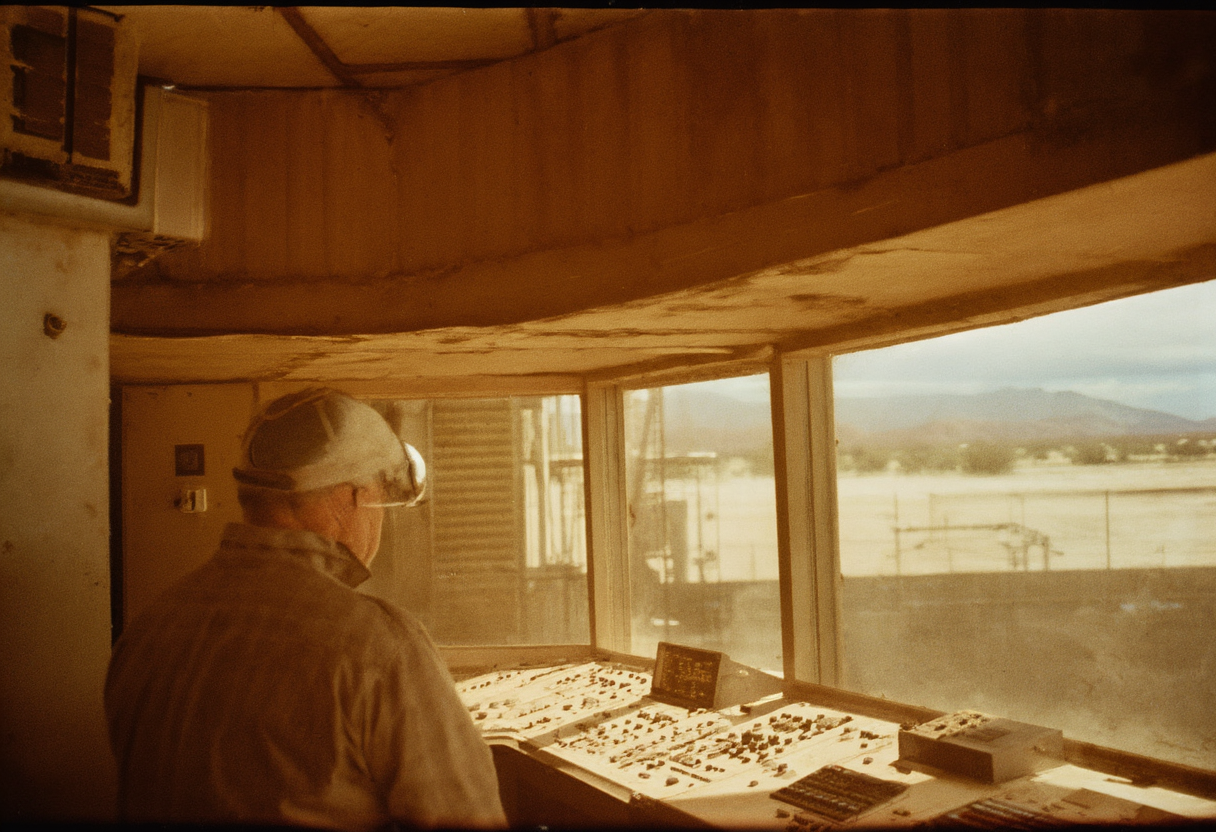
Here is how it actually worked, the part the video left out. The same company that built the capture plant also drilled the oil. Occidental had bought the firm that pioneered the technology for about $1.1 billion, the deal closing in late 2023, and began marketing what it called net-zero oil — crude you could burn guilt-free, because an equivalent amount of carbon would be sucked back out of the air somewhere.4 Some of the captured CO₂ went straight back underground to push more oil up. Critics had a name for the logic even before the first big plants switched on: a license to pollute.5
Maya's dashboard told the story in two columns she was not supposed to read together. One was capture — the tons her plant pulled down, the figure that became a credit, that became a line in a corporation's net-zero report. The other column she had to go looking for. The Permian oilfield she could see from the control-room window produced, when its oil was burned, something on the order of a hundred times what her fans removed. The gas plant that powered the fans added its own. Her whole facility, running flawlessly, twenty-four hours a day, was a rounding error against the hole it helped keep open.
That was the reversal, and it was the whole story. A machine built to undo emissions had become the reason the emissions continued. Researchers called it mitigation deterrence — the risk that the promise of future removal slows the actual cutting of carbon today.6 The technology that was supposed to buy time was being spent buying permission. By the mid-2020s, investigators had already shown that the broader market in carbon credits was riddled with offsets that removed little or nothing real, while the companies buying them kept emitting.7 Pull the lens back and the pattern was plain: net zero had quietly become an accounting category, not an atmospheric one.

The atmosphere does not do accounting. It does chemistry. Maya knew the two numbers that mattered and she could not unknow them. Global fossil CO₂ emissions had hit a record 37.4 billion tons in 2024 and barely flinched after.8 The concentration in the air — the only score that counts — kept climbing: a yearly average near 425 parts per million in 2024, with seasonal peaks pushing past 430 the next spring.9 Eleven years of fans, filters, hubs, and pledges, and the line on the chart still went the wrong way. Up. Not down. Up.
There were cracks in the logic, by 2036, that gave her something to hold. Europe had spent the mid-2020s building rules to separate genuine removal from greenwashing — a certification framework for carbon removals, and a directive barring companies from selling products as climate-neutral on the strength of offsets alone.10 It was not the firewall the activists wanted. But it was an admission, written into law, that a ton emitted and a ton promised-for-later are not the same ton. The accounting was starting to be told to grow up.
Maya stopped showing up for shifts in March 2036. She did not quit, exactly. She moved into her truck on public land forty miles out, close enough that on still nights, when the wind came from the east, she could still hear the hum. She had set up a solar panel and a laptop and she was doing the only thing that felt honest: writing the second column down. The capture figures were public. The emissions they offset were not. She was building the ledger nobody published.
She did not have a plan for the data. Maybe nothing. Maybe everything. But she had stopped lying to herself about the word on the orientation video. They were not restoring anything. They were janitors — sky janitors — mopping under a faucet that ran day and night, paid just enough to keep mopping, so that the people upstairs would never have to turn off the tap.
The open question is whether the next eleven years are the same as the last. The fans work. The science is real. A right-sized version of all this — removal doing the genuine, stubborn residue of emissions after the deep cuts, not standing in for the cuts — is still possible. It was always possible. The machine was never the problem. The question Maya kept writing into her notes, the one the atmosphere keeps asking, is whether we ever meant to stop making the mess, or only to look busy cleaning it.
You cannot engineer your way out of a problem while you are still engineering the problem.
Author's Note
This is speculative journalism, set in 2036 and reported backward from there. Maya Chen and the specific plant she operates are fictional composites; so is the corporate report in Figure 2. Everything underpinning them is real and sourced: the technology and the named plants (Mammoth, STRATOS), Occidental's acquisition and its net-zero-oil pitch, the U.S. capture-hub program, the documented critiques of moral hazard and offset markets, the emissions and concentration figures, and the early European moves to discipline carbon-removal claims. The far-future details — the year, Maya's choices, the exact scale of deployment by 2036 — are one plausible trajectory, not a prediction. The reversal at the center of the piece is not inevitable. It is what the current incentives point toward if nothing changes.