

The document that did most to govern corporate artificial intelligence in the 2020s was one page long, and optional. It was called CG 40 47. Its operative sentence defined its own subject in thirty-four words: a machine-based learning system or model that is trained on data with the ability to create content or responses, including but not limited to text, images, audio, video or code.1 Beneath that definition it removed general liability cover for bodily injury, property damage and personal and advertising injury arising out of generative artificial intelligence. Companion forms did the same for advertising injury alone and for products and completed operations. Verisk published them in the January 2026 edition of the standard commercial general liability forms, the same quiet annual release that adjusts pollution and lead paint wording.
It is worth staying with the object, because the form is where the period's real decision was made. An endorsement is not a prohibition. It tells a company nothing about what to build and carries no penalty. It withdraws something, which turns out to be the more efficient instrument. By mid-2026 a nationwide review of state filings found 2,369 generative-AI exclusion records in force across 49 states, filed by carriers including W.R. Berkley, Chubb, Travelers, Berkshire Hathaway and AIG. W.R. Berkley went furthest, with an absolute AI exclusion across its directors and officers, errors and omissions, and fiduciary lines. The same review could not find one admitted standalone product replacing what had been removed.2
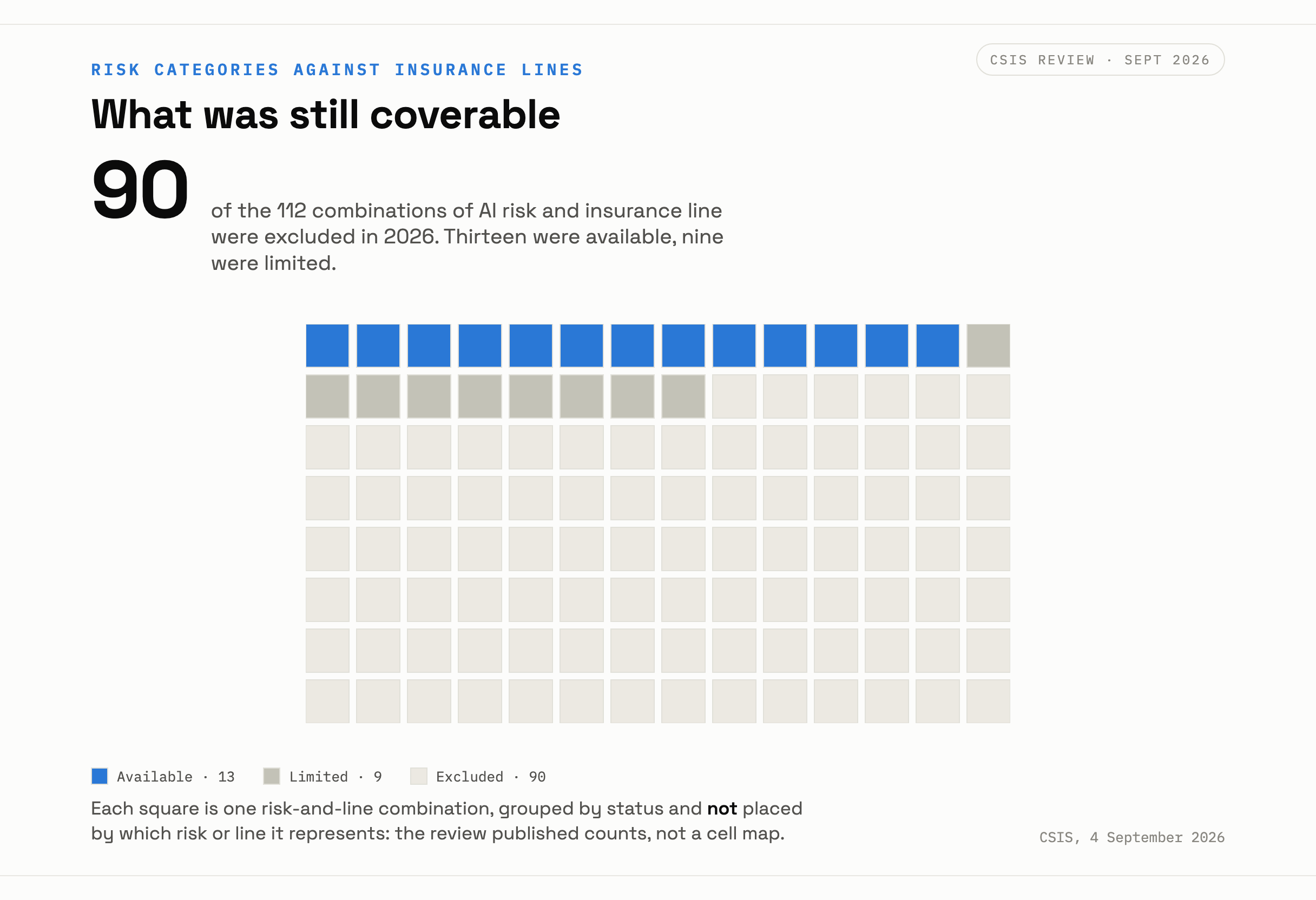
The regulators said yes. Commissioners approved better than eighty percent of carrier requests to exclude AI damages, and more than sixty property and casualty groups filed during 2026. W.R. Berkley's November 2025 filing would bar claims involving any actual or alleged use of AI, including products incorporating the technology, a category with no obvious floor in a 2026 software stack. AIG secured the option and reportedly had no immediate plan to use it, which is the most revealing fact in the sequence: the exclusion was being banked, not deployed. Mapped across eight lines of insurance, fourteen categories of AI risk produced 112 combinations. Thirteen were available, nine were limited, ninety were excluded.3
A specialty market grew in the space the standard forms vacated, and it was smaller than its announcements suggested. Munich Re had written AI performance cover since 2018 and in February 2026 put the product on Mosaic's platform with initial capacity up to fifteen million, settled against defined performance standards rather than through a liability investigation. Mosaic's head of AI underwriting was precise about the boundary: the question was not system uptime or a cyber incident, but whether the AI's outputs were actually accurate.4 Armilla, writing through Chaucer at Lloyd's from April 2025, raised its limit to twenty-five million per organisation across six covers, including defamation in model output.5 Against ninety excluded cells, limits in the low tens of millions are not a market. They are a hedge on the vendor's licence fee.
The retreat was not squeamishness. The risk failed the tests underwriters use to decide whether something is insurable at all. A Geneva Association study, built on a survey of six hundred businesses across six markets in February 2025, named three problems: limited historical data exists to guide calculations, losses can spread very quickly across insureds, and the market may experience serious information asymmetry. Its authors wrote that generative AI failures could resemble failures in critical infrastructure.6 That is the part that breaks the pool. Insurance works by writing many risks that fail independently. If ten thousand companies have built their customer handling on the same three foundation models, one bad update is not ten thousand risks. It is one risk sold ten thousand times. A broker at the centre of the market put it plainly: the industry could absorb a single four-hundred-million-dollar loss, but not ten thousand correlated claims from one provider's error.3
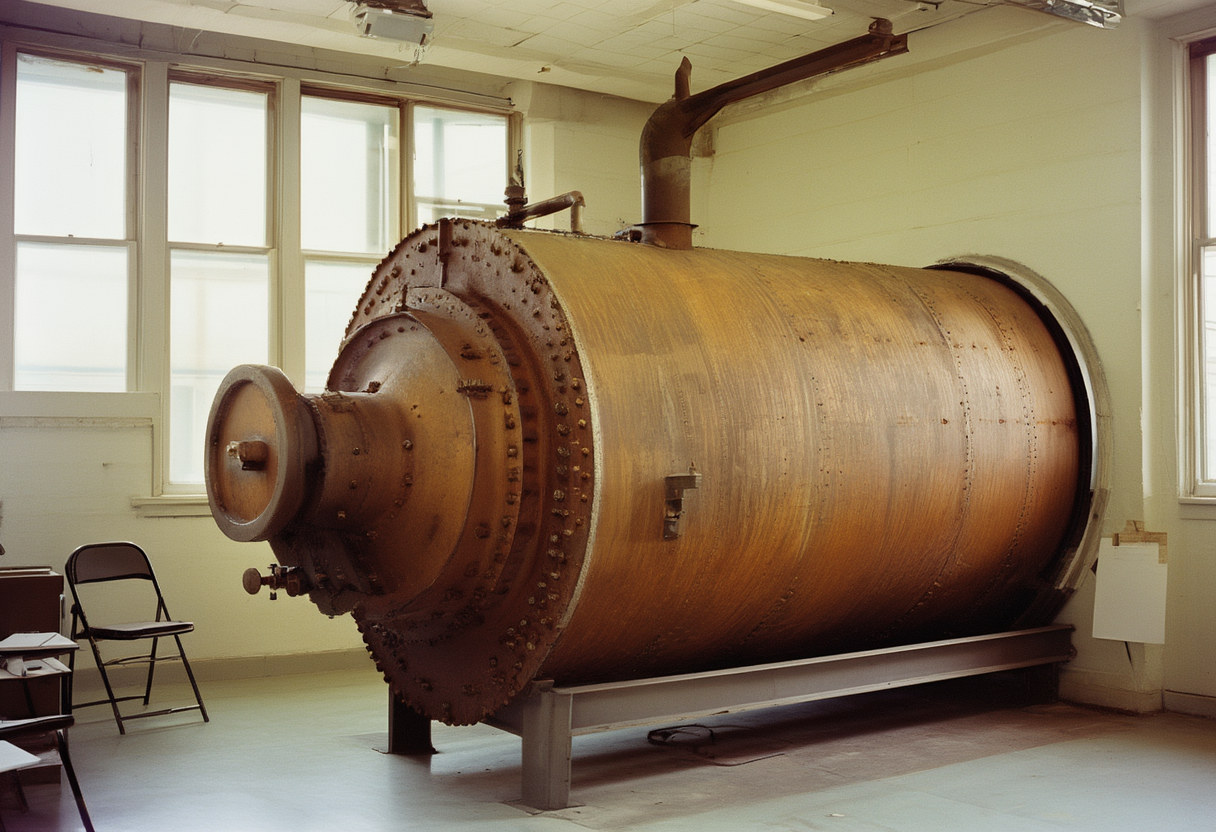
The opposing case deserves its strongest version, because insurance has been a working safety regulator before and was very good at it. The Hartford Steam Boiler Inspection and Insurance Company was incorporated in 1866 to sell inspection and indemnity together, in a country where early twentieth century boiler accidents still ran at three to four hundred violent explosions and four to five hundred deaths a year. In 1920 alone it performed 393,900 internal inspections, found 23,063 dangerous defects, and declared 1,139 boilers uninsurable.7 From 1919 it required a particular piping configuration on any boiler it covered, enforcing a technical standard by refusing to write anything else. Factory Mutual, founded in 1835 by a mill owner denied a lower premium after improving his own fire protection, set premiums by engineering analysis rather than loss history and returned surplus to members, who averaged roughly half the premiums of other insurers over the first fourteen years.8 Private capital wrote the safety code because it was paying for the failures.
Both models rested on two conditions that generative AI removes. The insurer could physically examine the risk, and one mill burning did not burn the others. In 2026 the industry conceded the first in its own words. Lloyd's mid-year survey of 144 market participants found eighty-six percent of underwriters expecting their insureds' use of AI to rise, while noting that the responses were informed by views and opinions rather than data in most cases, and that insurers are remote to insureds' use of AI. Lockton Re reported that general liability insurers do not currently model, underwrite or price AI risks.3 The audit industry that grew to close the gap, backed by forty million dollars of venture funding by September 2026, was a serious attempt at the inspection half.9 It was also an attempt to inspect something that changes under the inspector between the audit and the incident, which a boiler does not.

The second condition was conceded differently. The organisations carrying the largest AI liability in the world stopped buying insurance. OpenAI was reported to have secured up to three hundred million dollars of cover, a figure other sources put lower, against exposure everyone agreed ran to billions, and was discussing a captive insurer funded with investor money. Anthropic was partly self-funding settlements.10 A market the frontier labs have left is not pricing frontier risk.
The mandate everyone assumed was coming did not arrive. The European AI Act entered into force on 1 August 2024 with no insurance requirement in it. The AI Liability Directive, which would have created a rebuttable presumption of causality and let courts order disclosure of evidence about high-risk systems, was listed among the withdrawals when the Commission presented its 2025 work programme on 11 February 2025.11 Insurance obligations in the period were commercial, written into procurement contracts by customers rather than into statute by legislatures. The nuclear template kept being reached for and never fitted. Price-Anderson requires each reactor site to carry five hundred million dollars of private offsite cover, at an average 2025 premium near 1.1 million, over a retrospective pool of roughly 158 million a reactor across 95 reactors, for a total above sixteen billion.12 It works because reactor accidents are independent, there are ninety-five of them to spread across, and a reactor stands still long enough to be certified.
The courts, meanwhile, declined to produce the losses the premiums were being priced against. The decision everyone cited, in which a tribunal held an airline responsible for what its chatbot told a grieving customer about bereavement fares, awarded 812 Canadian dollars and two cents; the tribunal member noted the airline appeared to suggest the chatbot was a separate legal entity responsible for its own actions, and did not explain why it believed that was the case.13 A Georgia court threw out the period's most watched AI defamation suit in May 2025, reasoning in part that because the recipient did not believe the output, it did not communicate defamatory meaning as a matter of law. The warning that the model might be wrong had become the shield.14 The one settlement with a hard final number, 1.5 billion dollars at three thousand a book, concerned pirated training data rather than any system performing badly.15
Which brings the question back to the page in the in-tray. Nobody voted on CG 40 47. Its definition was not negotiated with industry or tested in court. It was drafted, filed, approved at better than four in five, and attached to policies by brokers who in many cases held no view on artificial intelligence at all. The liability it withdrew did not go anywhere. It stayed on the books of companies that had just been told by the only institution actually pricing their exposure that this was not a risk anyone would carry. As one researcher put it, the liability is real, it is growing, and it sits on nobody's books.3 That was not a gap in the regulation. It was the regulation.
Author's Note
This piece is speculative journalism written from the vantage of 2036. The forms, filings, court decisions, surveys and company announcements described here are real and sourced below, as are the historical figures on boiler inspection and factory mutual insurance. Reading the period as one in which private form drafting outran public rulemaking is the author's interpretation, not a sourced finding, and whether AI liability is ever made compulsory remained open when these sources were written.