
For two years I thought the force majeure clause was the trapdoor under the AI build-out. Hundreds of billions of dollars of twenty-year paper against machines on a four-year replacement cycle, and somewhere in the contract was the paragraph that let somebody walk. I was looking at it backwards. The clause was not the exit. It was the confession. Every risk those lawyers carefully wrote into the document was a risk they had, in writing, foreseen. I missed that for a long time.
Why the book looked like cover
Here is the optimistic case at full strength, and it is better than I expected when I went looking for it. The merchant power build-out of 1999 to 2002 collapsed because it sold into spot markets. This one sold forward. On 29 October 2025 Microsoft's chief financial officer told analysts that commercial remaining performance obligation had reached 392 billion dollars, up 51 percent year over year, with commercial bookings up 112 percent, against quarterly capital expenditure of 34.9 billion.1 That is the mechanism, and it is a real one: signed, contracted revenue converts a capital programme into a receivable, and a receivable can be financed cheaply. The same call put the economic life of those assets at fifteen years and beyond. On the demand side the revenue curves were not hypothetical either. Annualised revenue at the two largest model companies went from roughly three billion combined at the end of 2023 to twenty billion and fourteen billion respectively by early 2026, growth the companies themselves then guided down to between two and four times a year.2 That concedes a great deal, and I want to be plain about it. If you had told me in 2023 that a build-out this large would arrive with a signed book that size, I would have said the debt was the least interesting thing about it. The constraint being relieved was genuine, too. Compute was scarce, researchers were queuing for it, and the people hurt by that scarcity were not shareholders.
Then I read the next sentence in the same transcript. Weighted average duration of that book: approximately two years.1
What the clause actually buys
A two-year book against a fifteen-year asset is not fraud. It is a maturity mismatch, and the contract is where mismatches go to be argued about. So I went and read what force majeure has actually done to people, which is less than everyone assumes. In June 2020 a bankruptcy court in Illinois found a restaurant lease's clause genuinely triggered by the governor's shutdown order, and then granted roughly 75 percent relief rather than all of it, because about three quarters of the leased space was unusable. The court was explicit that the order, and not lack of money, had to be the proximate cause, and noted that nothing required the affected party to borrow money to counteract the effects.3 Partial. Proportional. Not an exit.
The harder case came the following year, when a retailer tried to escape a Manhattan lease. The court held that force majeure did not excuse rent, that the pandemic was not a casualty, and that frustration of purpose failed because the pandemic was not wholly unforeseeable. Its reason for that last finding is the one I cannot stop thinking about: the lease's own force majeure clause covered national and public emergencies, which proved the parties had contemplated exactly this.4 The clause was the evidence against the tenant. One law firm's client guidance put the general rule in a sentence that reads like a warning label: economic hardship does not amount to a force majeure unless explicitly included, and relying on the clause is unlikely to be a viable solution absent very specific contractual language.5
The notice arrives in New Mexico
On 24 September 2026 Oracle sent a force majeure notice on Project Jupiter, a 2.45 gigawatt, 1,400 acre campus near Santa Teresa, New Mexico, targeted to go live in 2028. The recipient was the Blue Owl Capital unit developing the site.6 The grounds are worth listing, because they are not weather. A proposed 2,462 megawatt fuel cell microgrid had no state construction permit, with the environment department's deadline sitting in late November. A 17.77 mile, 24 inch gas pipeline had no construction authorisation from the federal energy regulator, its in-service target having slipped from August 2026 to February 2027. The state land office had cancelled the pipeline subsidiaries' rights of way in March and refused reconsideration in July. The microgrid developer's attorney told the state it stood to lose 325 million dollars a month from November.7
Everyone involved was calm in public. Oracle's vice president said the project remained on its planned schedule and that such notices are common and do not, by themselves, establish a project delay. The developer said it, Blue Owl and Oracle remained fully aligned and that the notice did not change their financial commitments.6 Both statements are probably true and neither is reassuring, because what the notice preserves is the right to delay payments on a campus reported to have raised eighteen billion dollars in bank loans.8 Three months earlier a litigation firm had warned data centre clients that political turmoil, extreme weather and regulatory delays are considered foreseeable, if not routine, that contracts entered into after a risk became known face a stronger foreseeability challenge, and that whether relief preserves or excuses payment and minimum capacity obligations may matter more than whether a qualifying event occurred at all. The same note named interconnection queues and long equipment lead times as risks from which a party may have trouble claiming surprise.9
The promise that made it financeable
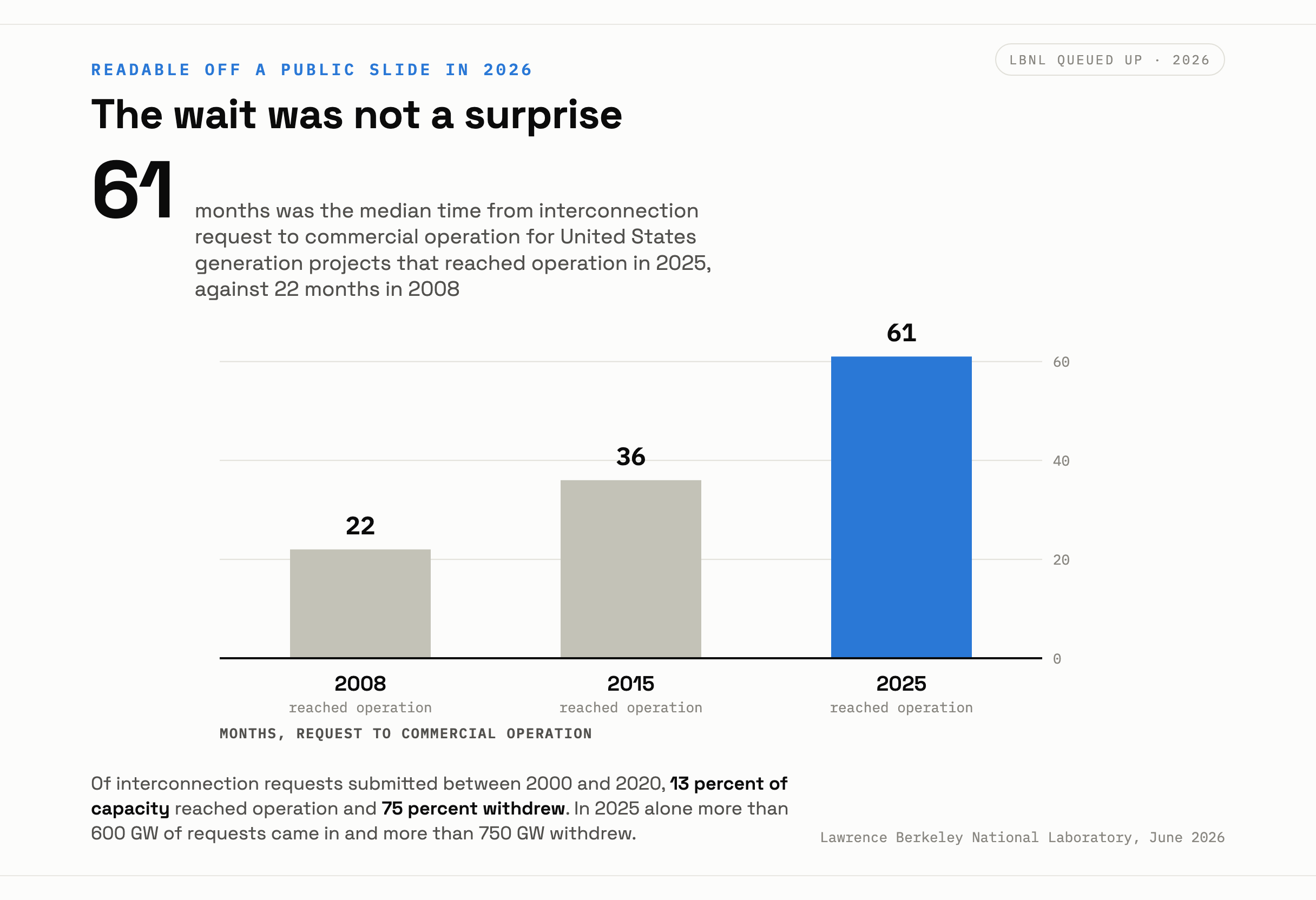
Now put the drawers side by side. A national laboratory publishes an annual slide deck on grid interconnection. For projects reaching commercial operation in 2025 the median wait from request to operation was 61 months, against 36 months in 2015 and 22 months in 2008. Of the requests submitted between 2000 and 2020, 13 percent of capacity reached operation and 75 percent withdrew. In 2025 alone more than 600 gigawatts of new requests came in and more than 750 gigawatts withdrew.10 In a separate file, a turbine maker expected to close 2025 with an 80 gigawatt backlog stretching into 2029, its chief executive expecting reservations sold out through 2030 by the end of 2026.11 In a third, the largest private credit sponsor of the whole build-out stopped letting investors request set amounts of money from the firm in February 2026.12 In a fourth, an equity research shop put the four biggest hyperscalers 600 billion dollars short of what their own operations would generate through 2028.13 Nobody filed those four things together at the time. There was no agreed phrase for it; the trade only later settled on calling it queue risk.
Which is why the escape hatch could not open. The queue figures were on a public slide. The turbine book was in an earnings call. A contract signed in 2026 against those numbers cannot claim surprise at a 2028 interconnection delay, and the better the clause enumerates the risk, the more clearly it shows the drafter knew. The lawyers were right to enumerate it. Enumeration is what makes the allocation enforceable. It just forecloses the common law behind it.
The clause that saves you is the clause that proves you saw it coming.
The precedent people reached for was the wrong one, and the right version is more unsettling. When the Washington Public Power Supply System collapsed in 1983, roughly 2.25 billion dollars of bonds rested on a promise that participants would pay whether or not the plants were ever finished, and the state supreme court held the participants had lacked the authority to make that promise at all.14 That was a defect in the capacity of public utility districts, not a force majeure ruling, and it does not transfer to a private special purpose vehicle borrowing from bond investors. What transfers is the shape of the failure. The promise that made the paper financeable was the one that broke, and it broke on a ground nobody had underwritten. In 2026 the financeable promise was a capacity commitment from a very large customer. The question was never whether a qualifying event would occur. Something always qualifies. The question was whether relief suspended the payment or excused it, and that single word was buried in a schedule nobody priced. Read the schedules.
Author's Note
This piece is speculative journalism written from the vantage of 2036. The contracts, filings, court decisions, earnings calls, notices and research reports described here are real and sourced below. The correspondent's first person marks the difference between what was knowable in 2026 and what is obvious from 2036; it records changes of mind, not events. The phrase queue risk is a retrospective naming and was not in contemporaneous use. Readers should note that an Anthropic registration statement was, at the time these sources were written, a confidential draft submission and not a public filing, so no language from it is quoted here.