

The commencement date was August 2036, and Oyin Adeyemi-Baptiste had been waiting on it for eleven years.
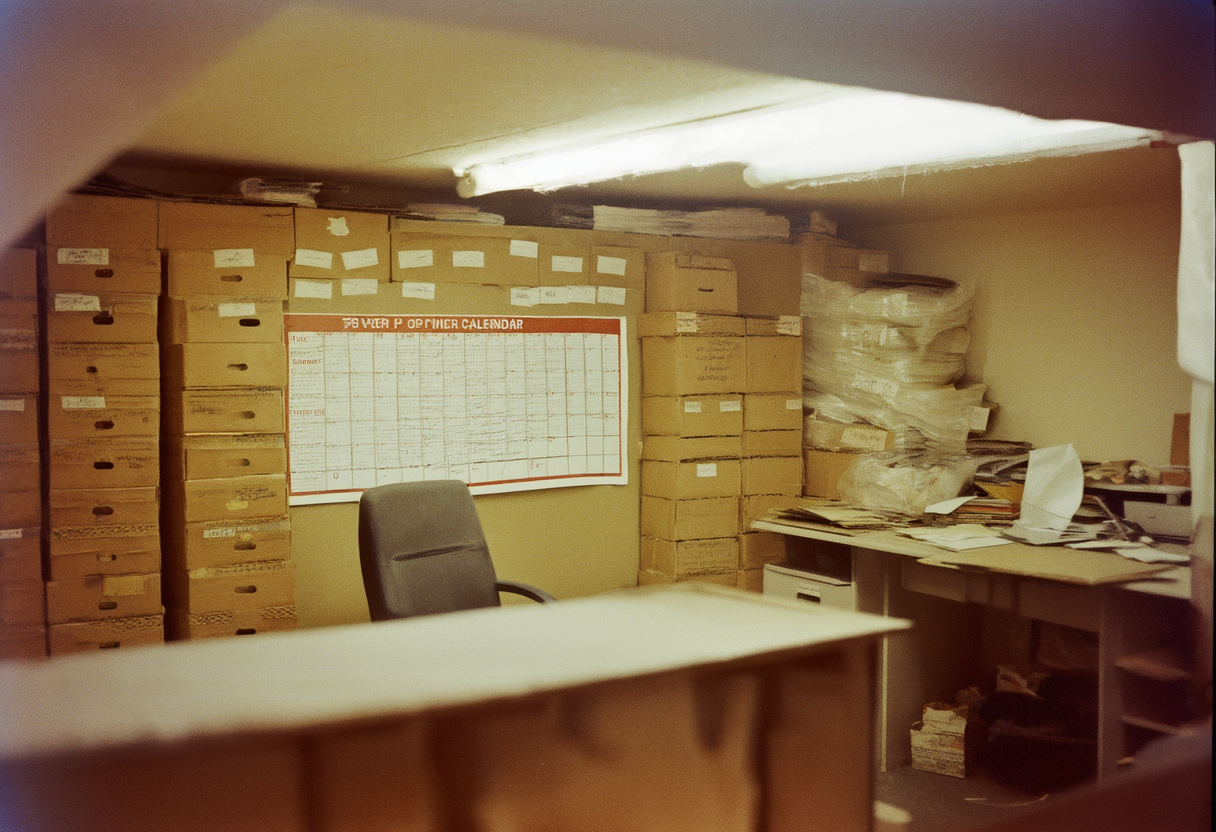
Her office sat over a tire shop on Florida Boulevard in Baton Rouge. Two desks, a window unit that stalled whenever the compressor downstairs kicked in, and banker's boxes the length of the wall, full of printed filings her clients paid to hold. On her screen was a quarterly report filed in July 2026. Note 9. Commitments and Contingencies.
Two hundred seventy-eight billion, nine hundred ninety million dollars of leases that had not yet begun.
The filing said the schedule ran from the remainder of 2026 through 2036.1 Ten years of rent, signed before the buildings existed, dated into a decade nobody in that room would still be working in.
The last of it starts this year.
Her invoices said commitments analyst. Her mother called her a reader.
The part everyone got wrong
Call it hidden debt and you have already lost the thread.
Nothing in Oyin's boxes was secret. Every figure she billed for came out of a public filing, submitted on time, audited, read by rating agencies, written up in the trade press, and raised in a letter from four United States senators. The obligations were disclosed with a thoroughness that embarrassed most of corporate history. That is what made them hard to see.
How the structures worked
The template was set in October 2025. Meta announced a joint venture with funds managed by Blue Owl Capital to build the Hyperion campus in Louisiana, about $27 billion of total development cost. Blue Owl's funds took 80 percent, Meta took 20. Blue Owl put in roughly $7 billion of cash, Meta contributed land and construction in progress and drew about $3 billion back out. Then it leased the finished buildings from the venture, in four-year non-cancellable terms with options to extend, and handed the venture a residual value guarantee covering the first sixteen years of operations.2
A residual value guarantee is a floor price: if the tenant stops renewing, the landlord still collects an agreed value for the building.
The borrowing happened in a vehicle called Beignet Investor: a $27.3 billion private bond, fully amortizing, secured on that one campus. S&P rated it one notch under Meta during construction.3
The accounting rested on two positions. Meta held that it was not the primary beneficiary of the venture, so the venture stayed unconsolidated. Its own words: "we are not the primary beneficiary and, therefore, do not consolidate the variable interest entity."1 And the leases were operating leases rather than finance leases, which keeps them off the balance sheet until they commence. The guarantee, capped at a threshold of roughly $28 billion that declines over time, carried no recorded liability, because payment was judged not probable.1
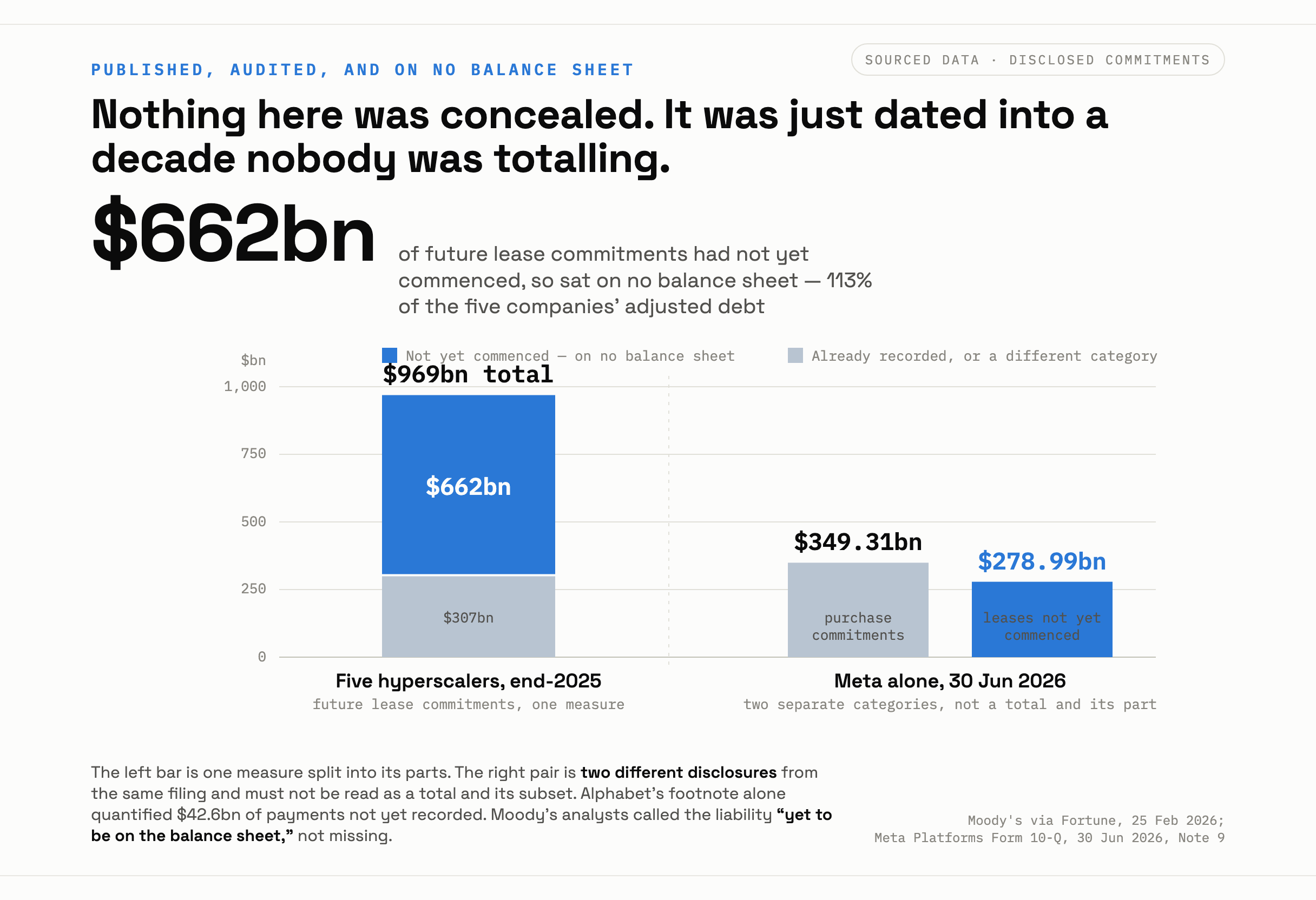
Copied across the industry, the totals arrived fast. Moody's added up Alphabet, Amazon, Meta, Microsoft and Oracle at the end of 2025: $969 billion of undiscounted future lease commitments, roughly double the year before. Of that, $662 billion had not yet commenced and so appeared on no balance sheet at all. It came to 113 percent of the five companies' adjusted debt. Alphabet's footnote alone quantified $42.6 billion of payments not yet recorded.4
The comparison everybody ran
The reflex was Enron, and the reflex had a point. A trade-press breakdown of the bond set the structure beside the rules written after 2001 and noted that the variable interest entity framework existed to stop companies moving economic risk into boxes they did not consolidate. Its verdict: "Beignet is Meta credit in project-finance clothing."3
In September 2026 Michael Burry put a number on the field. Writing on Substack, he estimated nearly $1.2 trillion of uncommenced leases and over $1.5 trillion of purchase commitments across the five, and more than $3 trillion once vehicles, guarantees and other backstops were counted. "When the music's over," he wrote, "these off-balance sheet commitments become real liabilities very quickly."5 The previous November he had called extending the useful life of two-year chips "one of the more common frauds of the modern era."6
That $3 trillion is a named analyst's estimate, not a measurement. The filings support his direction and his order of magnitude. Meta alone disclosed $349.31 billion of non-cancellable contractual commitments at mid-2026.1 The aggregate was his arithmetic, and nobody audited it.
The Enron frame breaks where it counts. Enron's vehicles worked because nobody knew. These worked in daylight. Meta's auditor flagged the Beignet accounting as a critical audit matter, and on 23 February 2026 Moody's published an opinion calling the disclosures "opaque" and forecasting "a material increase in adjusted debt and lease-related cash outflows for these companies in the coming years."7 Yet Moody's own analysts declined the concealment story. The liability was "yet to be on the balance sheet," not missing, and the companies had not used structuring to escape it.4 S&P went further: even if Hyperion had sat fully on Meta's balance sheet from day one, the rating would not have moved.3
Read that twice. The thing the structure was built to avoid would have cost nothing.
What actually bit
So the vehicles were mostly theater. The exposure was real, and simpler.
Every commitment was dated and non-cancellable. None of the revenue was. In January 2026 four senators asked the Financial Stability Oversight Council to open a formal investigation, and the arithmetic in their letter is the story: the sector spent around $400 billion in 2025 and might take in $60 billion. They projected a $1.6 trillion funding gap by 2028, with roughly $800 billion of it expected from private credit.8 The IMF, that April, put AI investment on a path that "could top $3.4 trillion by 2030" and flagged firms that had "increasingly relied on circular financing," while judging the hit to financial stability "modest currently."9
Modest currently. Two words carrying a lot of freight.
The depreciation fight never resolved cleanly. Servers were carried at about five to six years. Rental rates for older accelerators drifted down, which favored Burry. Operators reported the reverse: one said expiring contracts on older chips renewed within five percent of the original price.6 Nobody knew. A footnote cannot settle the working life of a chip.
What came back
Here is the part Oyin built a business on.
For a generation the balance sheet was the summary. You read a company's front page and knew what it owed. The buildout ended that, not by lying but by volume. The obligation dispersed into schedules, commencement tables, guarantee thresholds and consolidation judgments, each disclosed, none addable by eye.
So an old craft came back. Lease obligations used to live in footnotes by design, and credit analysts rebuilt the real balance sheet by hand, adding back what the statements left out. A rule change had retired that work, and the rule change had been overtaken. Moody's began talking about "non-standard" adjustments to debt.7 Shops like Oyin's sold reconstruction by the page.
The loop closes
Her client that August was a parish retirement board with eleven hundred members and a bond allocation it did not fully understand. She brought three commencements, two guarantee thresholds, and no reassurance.
The chair wanted to know if the campus up the road was going to default.
It was not, and never had been, the likely failure. She told him the duller, worse version. The buildings were full, the rent was paid, the credit was fine. What had changed was the price of choice. In 2026 the tenants signed four-year terms because four years was what the accounting asked them to show. Ten years on, renewal was not optional in any practical sense, and both sides knew it. The spread the bond buyers collected for taking Meta risk in project-finance clothing turned out to be the most honest figure in the document.

He asked what she would do differently. Read Note 9 before you buy, she said, and bill somebody for the reading.
The open question
The decade settled the narrow thing. Disclosure is not visibility. A footnote that takes a week to total has been published and not communicated. Nothing was concealed, and nothing was legible either.
What it did not settle is whether rules can close that gap, or whether every standard written to drag an obligation into the open just moves it to the next page nobody is paid to turn. The next buildout will disclose everything. The question is whether anyone reads it before the commencement dates arrive.
Author's Note
This article is speculative journalism written from 2036. Oyin Adeyemi-Baptiste, her practice and the parish retirement board are fictional composites. Every filing figure, deal term, rating action, agency opinion, analyst estimate and congressional letter cited below is real, published, and sourced. Michael Burry's trillion-dollar totals are his own published estimates, labeled as such. Projections past October 2026 are the author's.