
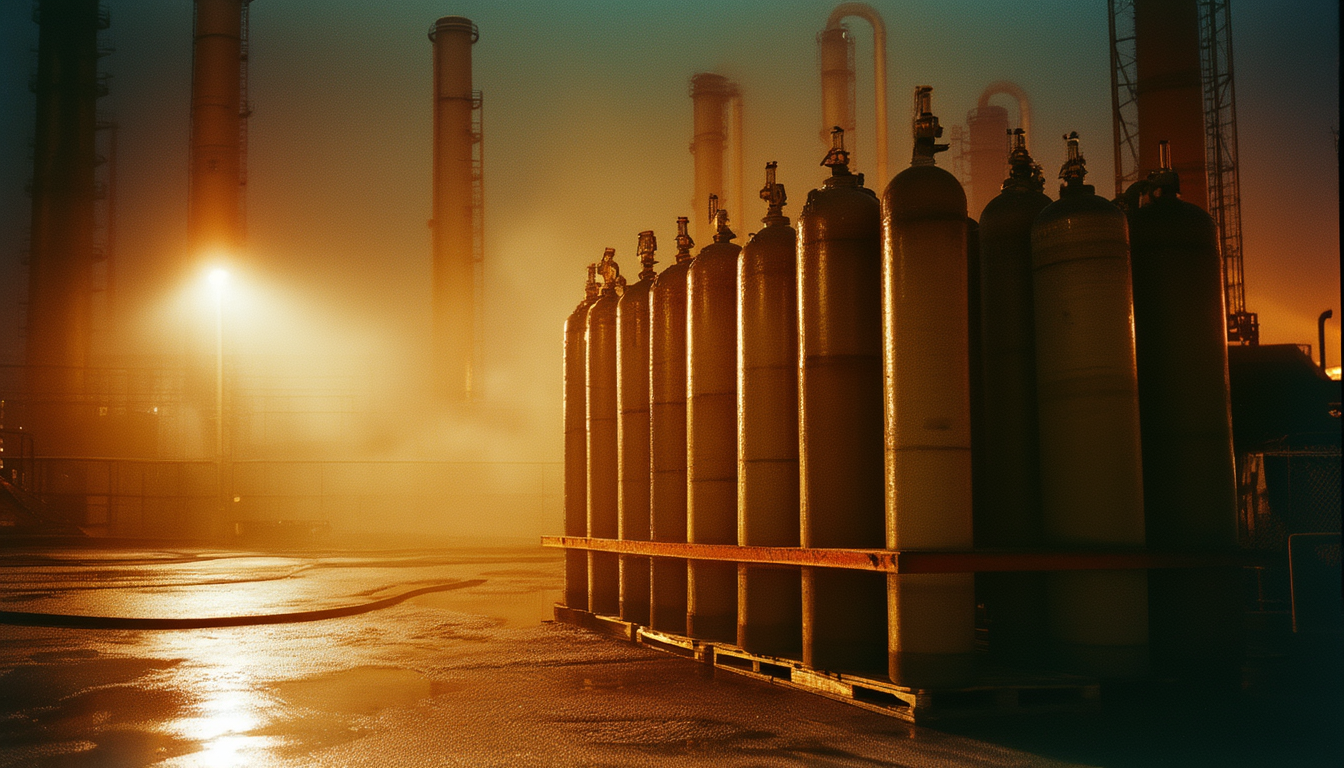
The notice reaches Ines Carbajal before the sun does.
Ten past five, the control room of Air Separation Unit 3, bolted to the flank of a steel works outside Gijon. Cold box columns on the left screen, the night's liquid oxygen draw on the right. Between them a flask manifest she has signed off four hundred times: twelve cylinders, krypton, research grade, palletised for a forwarder in Milton Keynes.
Then the bottom line changes colour. DEFER. BERTH 4471 RELEASED. ALLOCATION PENDING.
Nothing in her building has failed. She checks anyway, because that is the job. Column pressure nominal, oxygen off take nominal, the rare gas side running at the thin fraction it always runs at.
A few hundred kilometres above her, a cargo stack bound for Mars orbit has lost its place in a line, and the reason carries her plant number.
Carbajal is forty four, a cryogenics operator, nineteen years on this site. She has never watched a launch. The closest she gets to space is the chain she sits at the bottom of: the mill sets the oxygen schedule, the oxygen schedule sets how much krypton she can pull, and twice a year somebody in England tells her it was not enough.
What the first plasma actually was
The thing in her manifest traces back to one test in a town best known for codebreaking.
March 2026, a Wednesday afternoon in Bletchley, streamed live onto a conference stage in Ojai, California.1 What happened was precise and smaller than the headlines. Electric and magnetic fields confined a plasma inside the exhaust channel of a propulsion system called Sunbird and guided charged particles along it. Plasma, here, means a gas heated until electrons come away from their nuclei, so the whole of it answers to a magnet. The propellant was krypton, chosen because it ionises efficiently and behaves inertly at the low mass flow rates early testing needs.2
That was the whole of it. No fusion reaction. No thrust measured. Pulsar Fusion was validating a shape, confirming that the geometry it had built could hold a plasma where it wanted one and point it the right way. The instruments that would grade the engine came later: a thrust balance, E cross B probes that sort particles by velocity, a retarding potential analyser that reads their energy.23
It was a demonstration of the exhaust. The nozzle before the fire.
Read that way it stops being an anticlimax and starts being the tell. The company had been building hardware since 2023 and had the unglamorous furniture of a hardware business: backing from the UK Space Agency and the European Space Agency, a 10 kW Hall effect thruster line that sold in the present tense, and an agreement with the UK Atomic Energy Authority on how neutron radiation grinds down magnets and chamber walls.23 Everyone wanted to know when the fusion would arrive. Pulsar kept answering questions about plumbing.
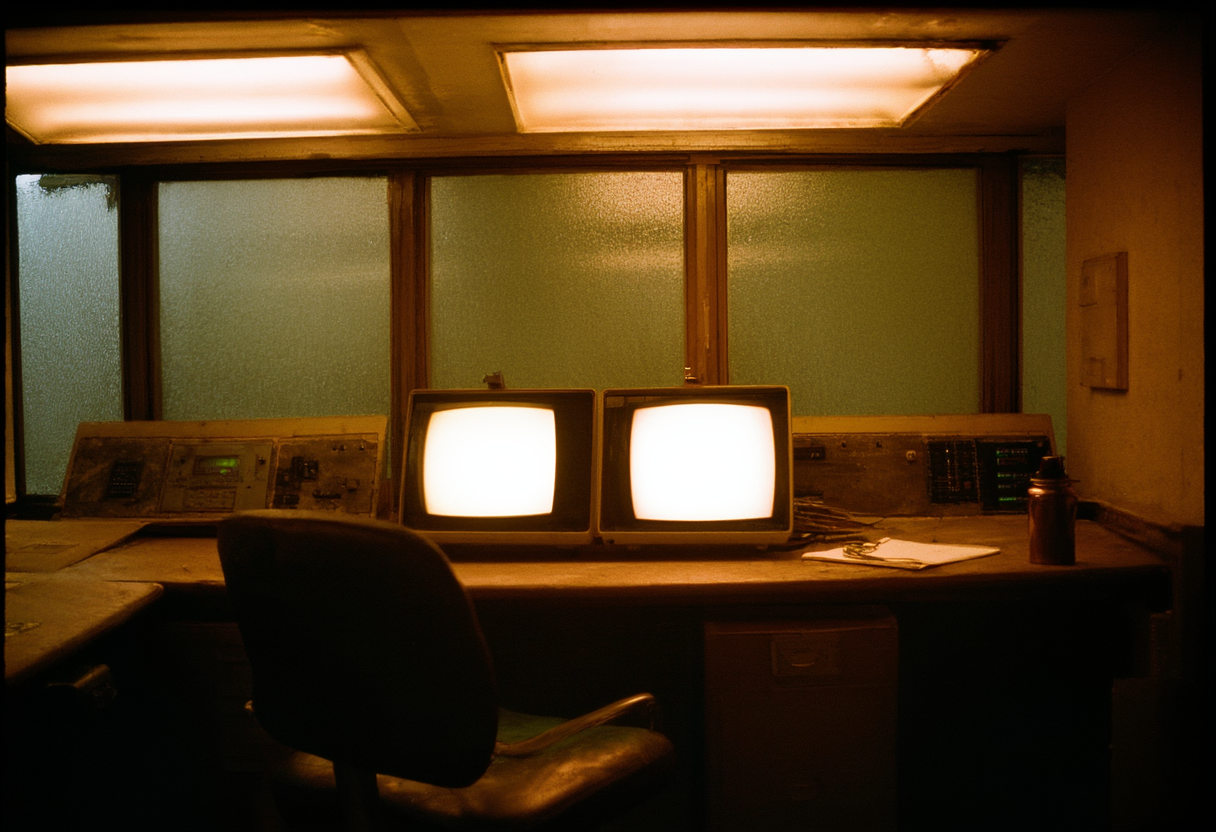
Figure 1. Night shift on the rare gas side of an air separation unit. The oxygen is the business; the krypton is a fraction of a percent of a side stream. Asturias, 2036.
The numbers worth queueing for
The reason anyone tolerated a decade of plumbing is one ratio.
Engines are judged partly on specific impulse, the seconds of thrust you get per unit of propellant burned. Chemical engines land around 450 seconds. Pulsar's Dual Direct Fusion Drive was designed for 10,000 to 15,000, an exhaust velocity near 100 kilometres per second, with the exhaust plasma also driving a coil to make two megawatts of electricity for whatever rides along.45
The catch is thrust. The design produces tens of newtons, and the 2026 test article pushed about a kilogram's worth.5 Useless for leaving Earth. Close to ideal for crossing a vacuum for months without stopping. On the company's own modelling that meant cargo to Mars orbit in roughly 150 days against 210 or more on chemical propulsion, and a thousand kilogram probe to Pluto in about four years.4
Which left an architectural question, and the answer to it is the part that mattered.
Sunbird was never a ship. Pulsar called it a Migratory Transfer Vehicle: a reusable stage that waits in low Earth orbit while your spacecraft launches chemically to meet it, docks, and borrows it for the rest of the journey. Housekeeping went to ordinary Hall effect thrusters so the fusion stage was never spent on station keeping. An in orbit demonstration of core components was targeted for 2027.4
Nobody in 2026 wrote that up as a business model. It was in the drawings the whole time.
Where the fuel comes from
A stage you dock with is a stage somebody else owns, and a stage somebody else owns runs on propellant somebody else buys.
Krypton is not manufactured. It is harvested. Air holds about 0.00011 percent of it, and the only economic way to capture that is inside the enormous air separation units built to make industrial oxygen, which have to be producing more than a thousand tonnes of oxygen a day before the rare gas fraction is worth collecting at all. Those units sit beside steel mills, because steelmaking is what consumes oxygen at that scale.6
So the gas is a byproduct of demand for steel, and concentrated in a way that was demonstrated to everyone's satisfaction in 2022. Ukraine alone accounted for something like 40 percent of the world's krypton, and the European Union took 47 percent of its rare gas imports from Russia and Ukraine in 2021. After February 2022, krypton and xenon prices rose about 50 percent.6
The other fuel is worse. The drive is designed around deuterium and helium 3, and terrestrial helium 3 is not mined. It is the decay product of tritium made for Cold War weapons stockpiles. United States production ran to roughly 8,000 to 10,000 litres a year, and one Princeton assessment concluded that sustained supply at that rate would barely suffice to power ten five megawatt reactors.7
None of that is a reason the engine does not work. It is the reason there are eleven of them.
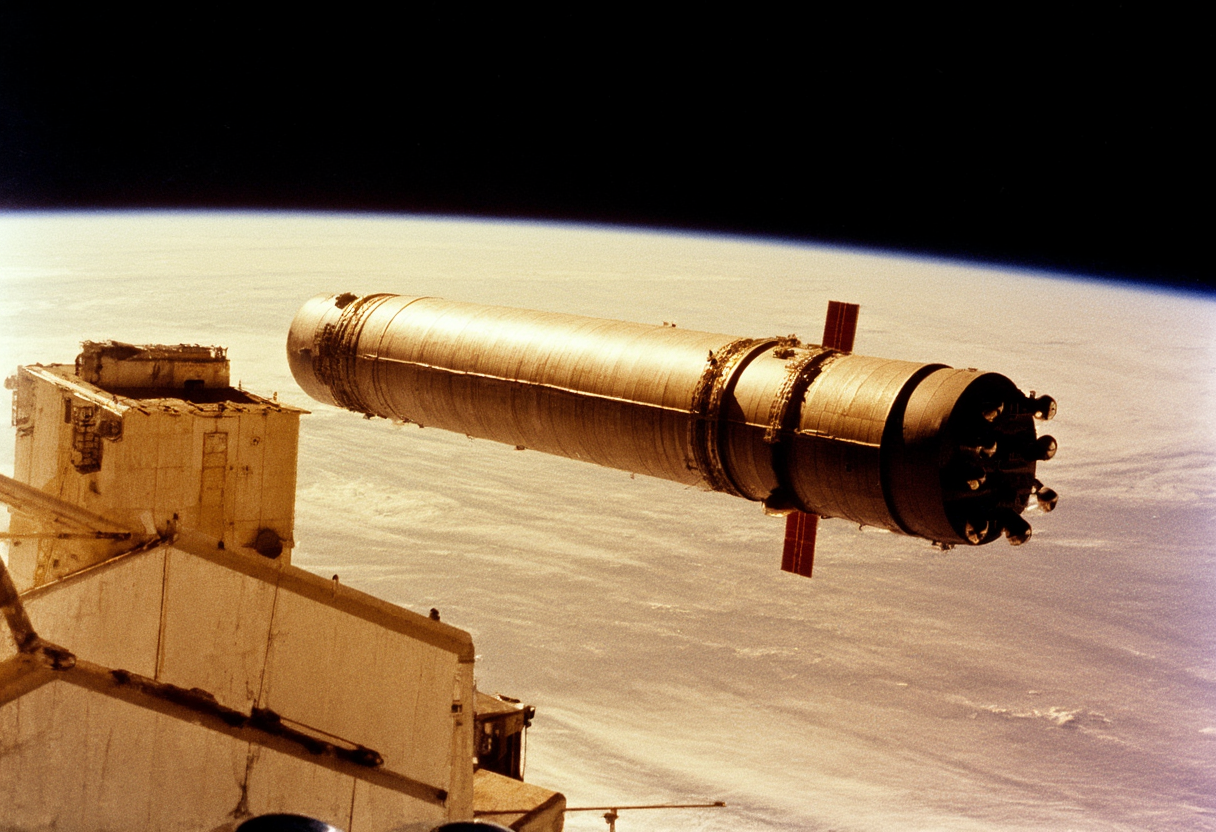
Figure 2. A transfer stage takes on a consolidated cargo stack at a commercial berth. The stage is leased by the burn, the slot sold by the window. Low Earth orbit, 2036.
What actually got sold
The promise was that distance would stop being expensive. What arrived was a small fleet of very good engines parked in a narrow band of orbit, and a market in the right to dock with one.
Cost per kilogram to Mars orbit did fall, steeply, as advertised. Access did not follow it down. A reusable stage is a fixed asset with a utilisation target, and a stage with a utilisation target sells berth windows in order of who can underwrite them. Institutional cargo and the two national programmes take the near windows. Everyone else consolidates, which means a university payload crosses the solar system as ballast in somebody else's stack and gets bumped when the gas allocation moves.
There is an older shape under this. Steam did not free shipping from geography. It chained it to coaling stations, and whoever owned the bunkers owned the route. Fusion propulsion rebuilt that arrangement in a higher place. The constraint moved off the vehicle and onto the depot, and from the depot down the chain to a cold box in Asturias.
Who won is not complicated: the operators who own the stages, and the trading houses that wrote long krypton contracts in the early 2030s, when the gas was still priced as a lighting feedstock. Who paid is the long tail of small payloads, and the people in the gas business, who now carry an interplanetary schedule inside an industrial one at the industrial rate.
Shift notes
Carbajal finishes the deferral paperwork at twenty to six and goes out onto the gantry for the air.
Below her the pallet sits under its wrap, twelve cylinders beaded with condensation, tagged for a forwarder who will hold them eleven days. She has an opinion about the allocation system and no field in which to record it. The form offers three reasons for a release: upstream, scheduling, commercial. She picks upstream, because her plant is upstream, although nothing here has gone wrong.
The second furnace went cold in 2031 and never came back. Since then the unit has run at a draw that keeps the rare gas side just barely economic, a sentence she has read in three consultant reports and never seen written on anything that would change it.
Somewhere up there is the fastest machine humans have ever flown, waiting on a flask from a mill that is half shut.
What is still open
Everything about the arrangement follows from scarcity at two points: the gas, and the number of stages. Both are solvable in principle. Krypton can be recovered from units serving chemical plants rather than steelworks, and roughly 40 percent of European steel capacity running large air separation units was never connected to rare gas recovery at all.6 Helium 3 could eventually be bred rather than inherited from warheads.
Neither has an owner whose interest is served by solving it. That is the part the physics does not decide.
Author's Note. This is speculative journalism written from 2036. Ines Carbajal, Air Separation Unit 3, berth 4471 and the allocation system are fictional composites. The underlying material is real and sourced: Pulsar Fusion's March 2026 first plasma in the Sunbird exhaust test system, the published Sunbird and Dual Direct Fusion Drive specifications, the Joint Research Centre assessment of rare gas supply security, and the Princeton evaluation of Earth's helium supply. The berth market, the furnace closure, the krypton contracts and the eleven stages are projection.
Works Cited
- Gizmodo. "Startup Successfully Ignites World's First Fusion Rocket." 26 March 2026. https://gizmodo.com/startup-successfully-ignites-worlds-first-fusion-rocket-2000738506
- Aerospace Testing International. "Pulsar Fusion achieves first plasma in nuclear fusion rocket test." 27 March 2026. https://www.aerospacetestinginternational.com/news/pulsar-fusion-achieves-first-plasma-in-nuclear-fusion-rocket-test.html
- Military & Aerospace Electronics. "Pulsar Fusion reaches first plasma milestone in Sunbird." 28 April 2026. https://www.militaryaerospace.com/uncrewed/news/55372912/pulsar-fusion-reaches-first-plasma-milestone-in-sunbird-fusion-propulsion-system
- Pulsar Fusion. "Sunbird Fusion Propulsion." Company technical page. https://pulsarfusion.com/sunbird-fusion-propulsion/
- New Atlas. "Sunbird fusion engine could drastically cut travel time to Mars." https://newatlas.com/space/pulsar-fusion-rocket-design-slash-space-travel-times/
- European Commission, Joint Research Centre. "Rare Gases: Impact assessment for supply security." 2022. https://rmis.jrc.ec.europa.eu/uploads/JRC130349_01_rare_gases.pdf
- Newbury, S., Cohen, S. and Gentile, C. "Evaluation of Earth's Helium Supply." Princeton Plasma Physics Laboratory. https://w3.pppl.gov/ppst/docs/newbury12.pdf