
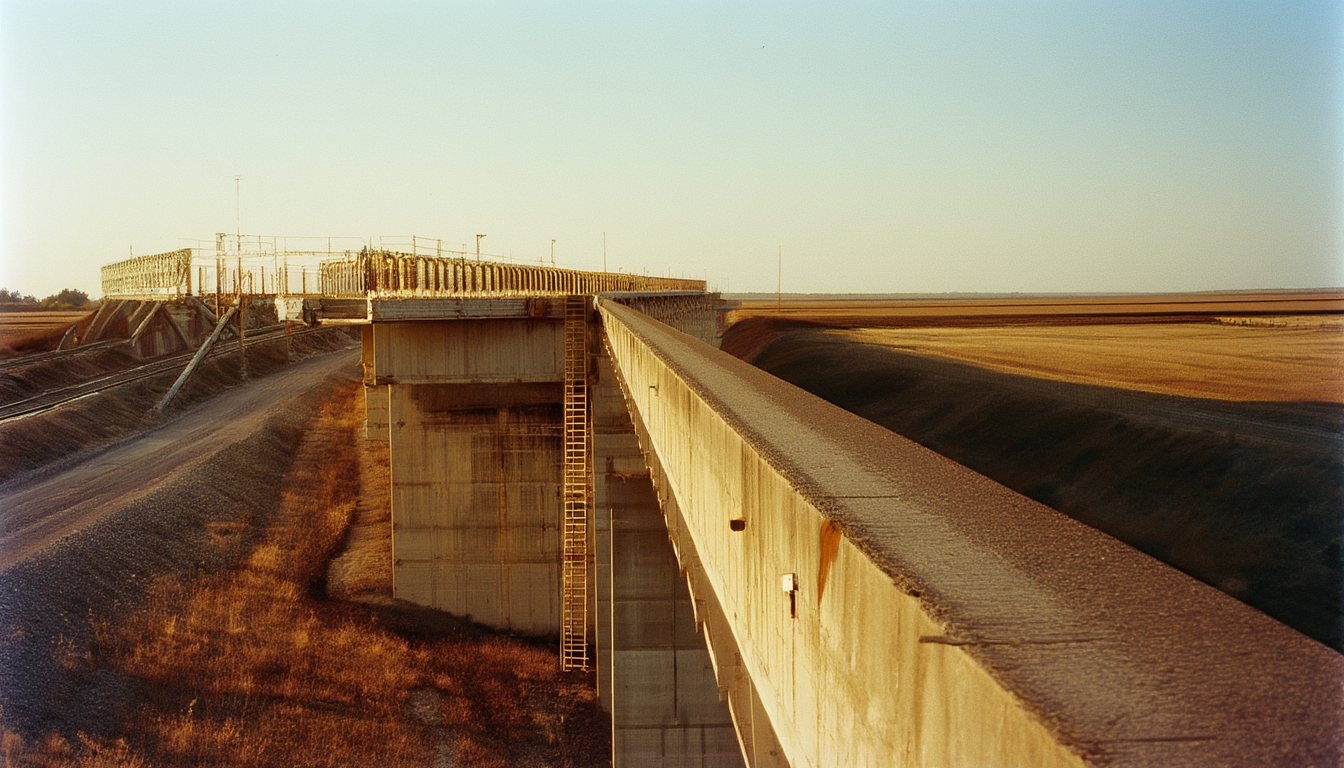
The Hanford Viaduct was finished in the second week of November 2026, and the honest description of it that month was that it held nothing up. It was the largest high-speed rail structure across the first 119 miles of construction in California's Central Valley, and the Authority cut a ribbon on it in Kings County on the twelfth. The release that followed counted what could be counted: more than seventy major structures complete, twenty-two more under construction across four counties, and twenty-one thousand and sixty-three construction jobs since the work began.1
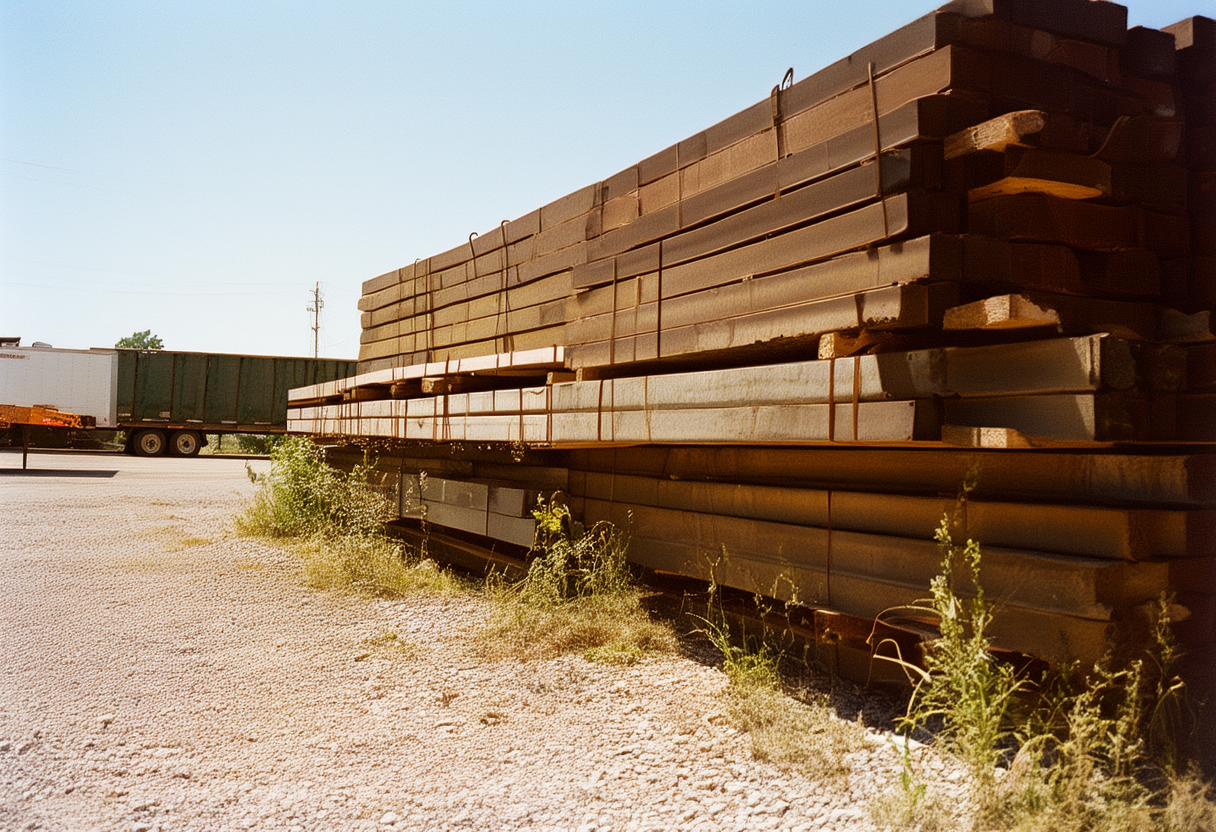
A viaduct is the part of a railway that looks like the hard part. It takes land, concrete, steel, a decade of environmental review and the willingness of four county governments to be inconvenienced. By the spring of 2026 the state had delivered eighty miles of guideway, relocated eighty-six per cent of the affected utilities, and taken possession of 99.7 per cent of the parcels it needed.2 What it had not done was lay a single mile of high-speed track. The materials were arriving that November and the board chair said track would go down in 2026, while another board member named the condition on it: tested, certified and ready, and then it gets laid.3
That was the week the project stopped being about engineering. On 28 October the board approved a Siemens Mobility contract worth up to $772.1 million for three trainsets, with priced options for nineteen more.4 Hours after that meeting the chief executive, Ian Choudri, resigned effective immediately, two years into the job, with an inspector general review of consultant travel expenses running against the agency and nearly $600,000 attached to it in the coverage.5 The next morning the board named his replacement. Joe Stephenshaw had run the California Department of Finance since 2022, and before that was a budget staff director in the state Senate.5
Asked in mid-November what he intended to do, Stephenshaw put accountability and transparency first and financing second, and then called financing the most significant issue facing the project. He said he would carry those conversations to the incoming administration and the legislature, and noted that the state general fund was contributing roughly a billion dollars a year.6 It is difficult now to read that list as anything but a precise description of what the organisation had become.
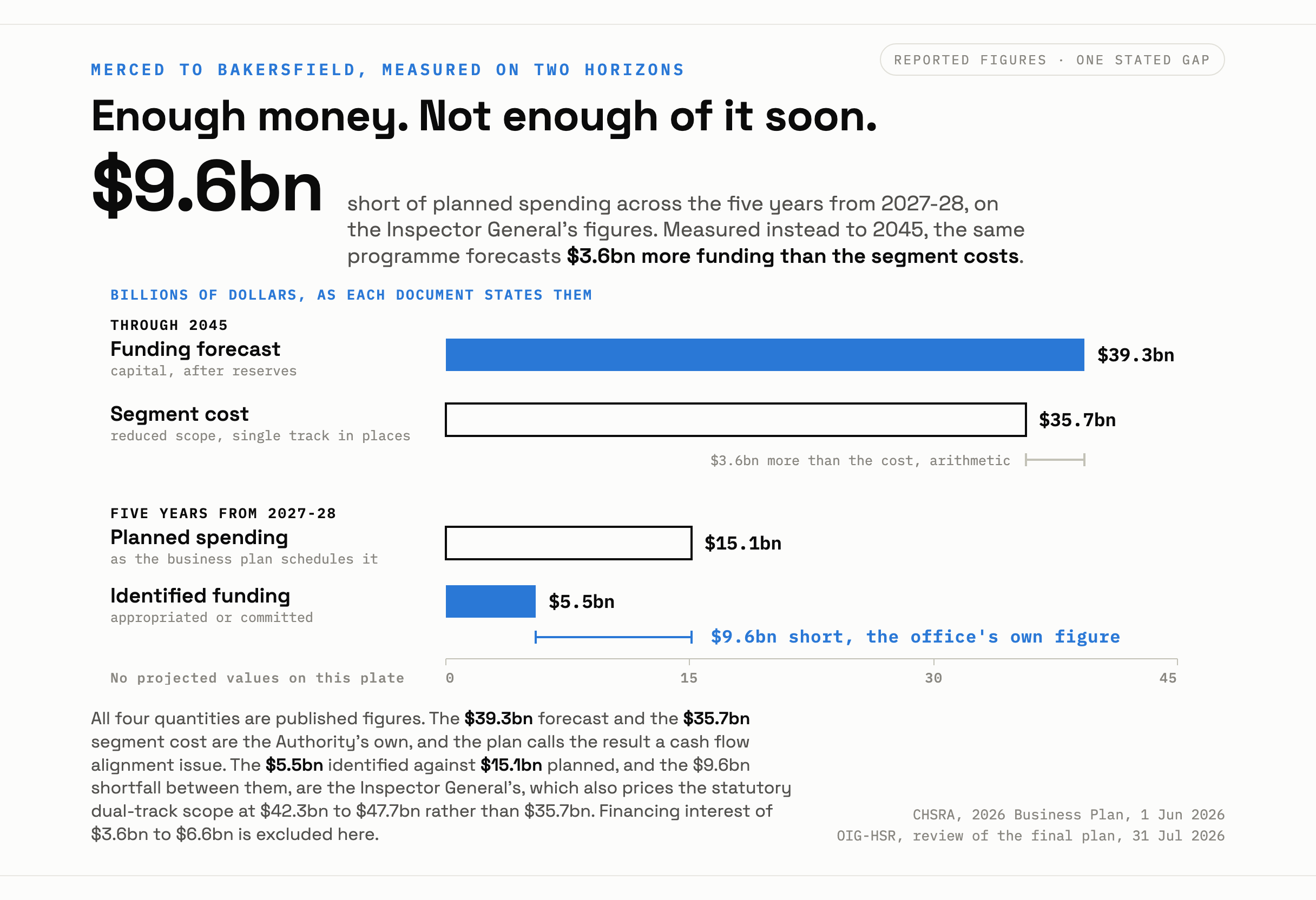
Two statements about the same railway were true at once in 2026, and the distance between them is the whole story. The Authority's own business plan, finalised on 1 June, put the Merced to Bakersfield segment at $35.7 billion and forecast $39.3 billion in capital funding through 2045. More money than cost. The plan named the resulting problem a cash flow alignment issue.7 Eight weeks later the Inspector General read the same document and reported that the Authority would exhaust its funding as soon as December 2027 if it did not secure financing. Across the five years from 2027-28, identified funding came to $5.5 billion against planned expenditures of $15.1 billion, a gap the office put at $9.6 billion, with financing interest of $3.6 billion to $6.6 billion on top.8
The money was real and it was slow. In September 2025 the legislature extended the state's carbon market and allocated a billion dollars a year to the project through 2045. The Authority called it the largest guaranteed infusion of funding in its history. The statute attached a condition the Authority's language did not. The money comes if funds are available, and high-speed rail sits in a second tier of claims, so some years can deliver less.2 The Legislative Analyst's Office said plainly that the fund might not support a billion dollars every year through 2045, and that borrowing would likely be needed in 2027-28.9 The two offices did not even agree on the total: the Authority booked twenty billion dollars from 2026-27, the analyst fifteen billion starting in 2030.79
None of this was a surprise built into the design. It was built into the ballot. In 2008 California voters authorised $9.95 billion in bonds, nine billion of it for the train, against an Authority estimate from 2006 that the whole system would cost about $45 billion. The measure capped bond money at half the construction cost of any segment and told the Authority to find private and other public money for the rest.10 That match was never a funding source. It was an assumption, and the state spent eighteen years learning what the debt outran the model found elsewhere: a financing plan resting on a counterparty who has not yet agreed is a schedule, not a plan.
The case for the state's position is stronger than the coverage allowed. Borrowing against a dedicated revenue stream to build now and pay over decades is ordinary public finance, not a trick, and it is how most of the infrastructure Californians used in 2026 had been built. The $231 billion figure that travelled furthest was the Authority's own bottom-up re-estimate of a scope it had stopped proposing. Its actual plan was $126.1 billion, the larger number was published as a high-end unoptimised scenario, and a state senator noted it excluded borrowing costs anyway.7 The honest caveat sat on the smaller number. The analyst called it premature, since $126.1 billion assumed scope changes the legislature had not yet approved, and put perhaps ten per cent on the cost if they did not come.9
Washington's withdrawal looks, from here, like the least of the shocks. The Federal Railroad Administration terminated roughly $4 billion in July 2025 on the finding that the Authority could not deliver a Merced to Bakersfield corridor by the end of 2033, and treated the slippage as a material change to the agreement.11 California sued within a day, withdrew the suit that December, and the case closed in January 2026.12 Federal money accounted for less than ten per cent of the programme budget by then.7 The rescission did not take much of the total. It took time, and time was the thing in short supply.
What the decade had actually done was make everything except money procurable. Land was bought, environmental clearance for the full 494-mile first phase came through that same October, concrete had a price, and trainsets had a contract with an option schedule. The scarce asset at the end of all that was the authority to spend money before it arrived. Nothing in fifteen years of project management had been organised to produce it. An agency staffed, measured and defended as a construction programme was by 2026 a financing programme with a construction site attached. Appointing a budget director to run it was the correct decision, which is a different thing from a reassuring one, and it handed the project to the same institutions whose rounding error had seniority over everything in the ledger.
The Inspector General's office is worth a second look in this light. It was overhead, the sort of function called duplication when a programme is under pressure, and it produced the only sentence in 2026 carrying both a number and a date. The agency's own plan held the same facts and arranged them so the problem read as a scheduling matter. It declined to round the calendar, much as the chip that would not depreciate refused to let an accounting convention stand in for a physical fact.
So the viaduct. It is still there, crossing the same farmland, still the most expensive thing in the frame. For years it was photographed as evidence of either progress or waste, depending on who held the camera, and both readings assumed that what was missing from the top of it was steel. The deck was the part the state knew how to buy. The thing it could not buy on a schedule was permission to be early.
Author's Note. This is speculative journalism written from 2036. Everything sourced below is real and ends in November 2026; the reading of what the funding structure meant is this piece's own, and no later event is reported here as fact. Three flags. The December 2027 cash warning is often attributed to an auditor. It is not one: the finding belongs to the Office of the Inspector General, High-Speed Rail, in its 31 July 2026 review, and it is conditional on the Authority not securing financing. The Central Valley segment is published at $35.7 billion by the Authority and at $42.3 billion to $47.7 billion by the Inspector General, which prices the dual-track scope the statute defines rather than the shortened single-track one the plan assumes. The travel expenses behind the resignation appear variously as $543,000, nearly $600,000 and $680,000; the middle figure is the one two independent reports attribute to the Inspector General.