
Here is the counterintuitive truth that the last fifteen years finally made obvious: the fastest market is the one in which speed stops being worth paying for. From the vantage of 2036, that sentence reads as common sense. In 2024 it read as heresy, because the entire infrastructure of modern trading had been built on the opposite faith. I spent a good part of the 2020s convinced that the latency arms race would end when one firm finally bought the last microsecond. I had the ending right and the mechanism backwards. It ended because winning stopped paying.
Why speed was worth buying
Begin with why anyone paid for speed in the first place, because the case was not stupid and it was not greed dressed up as engineering. A market maker quoting a two-sided price is exposed to the trader who knows something they do not. The faster the maker can see the market move and pull a stale quote, the less often they get picked off, and the less adverse selection they have to price into the spread they show everyone else. Speed, on this account, is not a tax on investors. It is what lets the quote be narrow. Slow the maker down and they widen out to protect themselves, and the widening is paid by every pension fund and retail order in the book.
That argument came with evidence. Using the NYSE's 2003 automated quote dissemination as an exogenous shock, Hendershott, Jones and Menkveld found that algorithmic trading narrowed spreads, reduced adverse selection, and made quotes more informative, particularly in large stocks.1 That is a causal estimate, not a correlation. And the direction of travel is not in dispute: the cost of getting a trade done fell, decade over decade, as the machines got faster. If you were arguing in 2015 that latency spending was straightforwardly destroying value, you had to explain why the people supposedly being robbed were paying less to trade every year.
What the nanosecond bought
The money followed the argument a long way. Begin, then, with what the speed race actually was. Economists had already measured it before the photonics money arrived. In a continuous limit order book, the kind of market nearly every major exchange runs, tiny mechanical advantages produce arbitrage opportunities that someone will always pay to capture first. Eric Budish, Peter Cramton, and John Shim called this what it was in 2015: a "socially wasteful arms race for speed," baked into the market's design rather than into any firm's cleverness.2
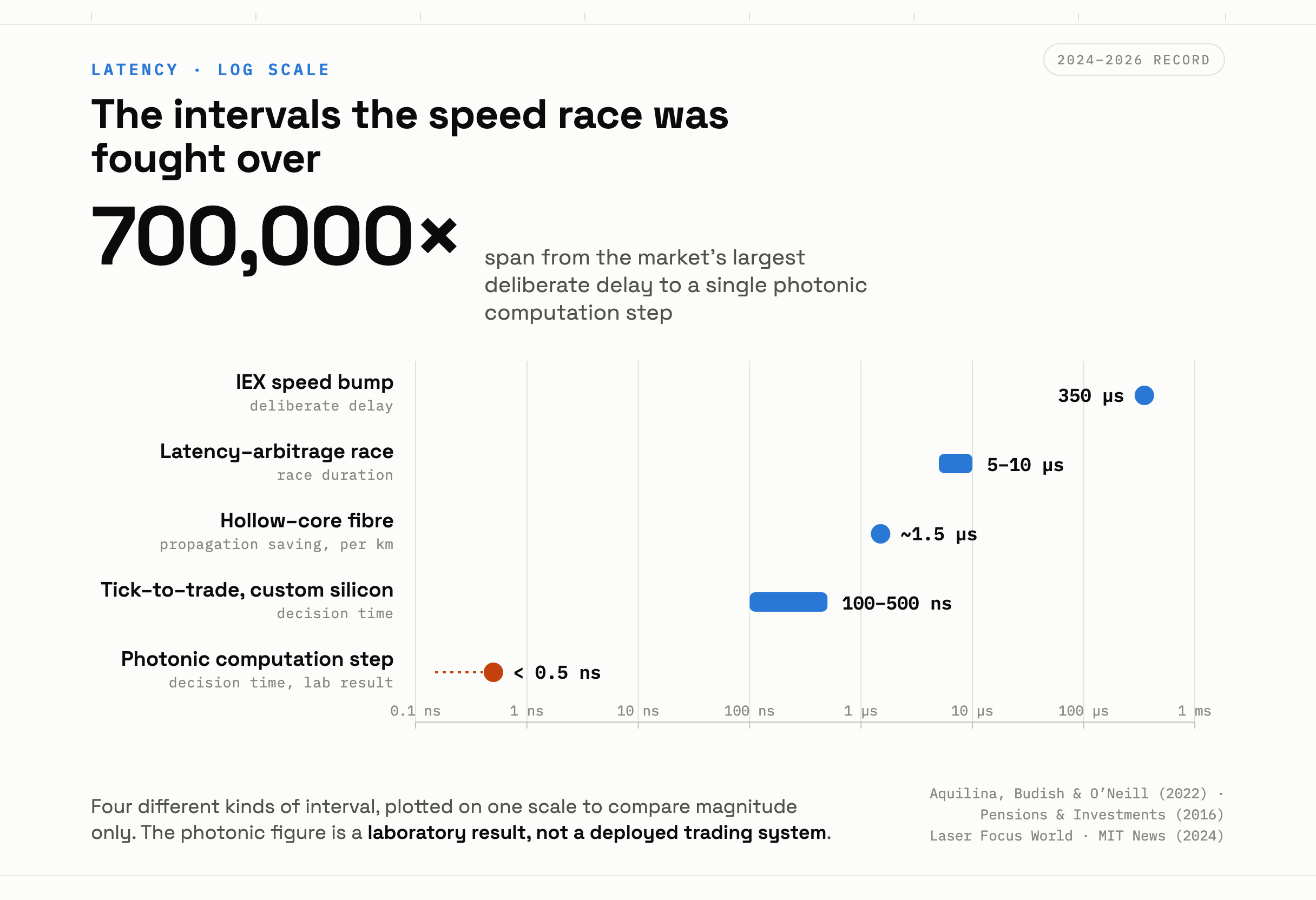
The follow-up study put numbers on the prize. Studying anonymized message data, Matteo Aquilina, Budish, and Peter O'Neill found that latency-arbitrage races happen roughly once per minute per stock. The typical race is over in five to ten millionths of a second. In an anonymized dataset, the top six firms won more than 80 percent of them.3 The races were a tax of about half a basis point on trading. Remove them, the authors estimated, and the cost of liquidity falls by around 17 percent, a global prize on the order of five billion dollars a year.3
Five billion dollars is real money. It is also, for a financial system that moves trillions, a strikingly small thing to spend a decade rebuilding the planet over.
The spend was not metaphorical. Spread Networks laid an 827-mile straight-line fiber from Chicago to New Jersey around 2010, reportedly near 300 million dollars, to shave milliseconds off a one-way trip.4 Microwave towers then beat the fiber, because light moves faster through air than glass, and Spread's advantage evaporated.4 Inside the colocation centers, firms pushed tick-to-trade times into the 100-to-500-nanosecond range with custom silicon, and bought hollow-core fiber to claw back roughly 1.5 microseconds per kilometer.5
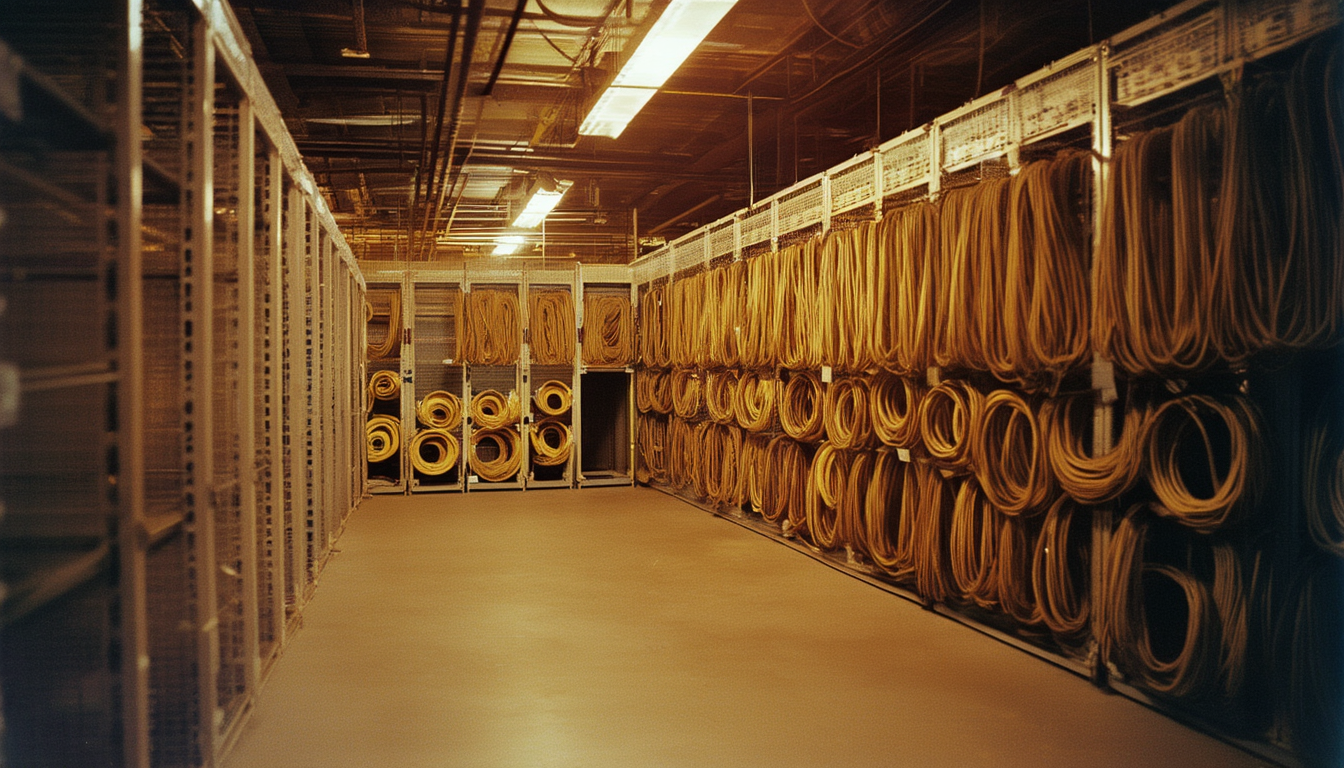
Each purchase amplified one quantity: decision speed. Each pushed something else aside. Patient capital, the resting limit order from an investor willing to wait, became prey. That is precisely what IEX was built to protect, with 38 miles of coiled fiber adding a 350-microsecond delay, approved as an exchange by the SEC in 2016.6

The race also revived something genuinely old: the medieval logic of the toll road. Whoever controls the shortest path between two markets collects a fee from everyone who must cross. The technology was exotic. The business model was a turnpike.
The most expensive escalation
Then came the light. Through 2024 and 2025, startups moved computation off electrons and into photons. In December 2024, MIT's Englund group reported a fully integrated photonic processor running both the linear and nonlinear parts of a neural network on one chip, above 92 percent accuracy, key computations under half a nanosecond, in standard manufacturing.7 The principle was older: a 2017 result had shown optical matrix multiplication at under a thousandth of the energy per operation of its electronic equivalent.8
The money followed the physics. Lightmatter raised a 400-million-dollar Series D in October 2024 at a 4.4-billion valuation, reporting 114 terabits per second of optical bandwidth.9 Celestial AI raised 250 million in March 2025 near a 2.5-billion valuation and later agreed to be acquired by Marvell.10 On the brain-inspired side, Intel's Hala Point packed 1,152 Loihi 2 chips into a system with 1.15 billion neurons, claiming roughly 50 times the speed and 100 times the energy efficiency on certain workloads.11 Lightelligence reported its optical engine beating high-end GPUs by more than 800 times on some optimization problems.12
Read those figures with care. They are company-reported, not independently audited, and certainly not measured inside a live trading system. That distinction is the spine of this story.
Because here is what the record does not contain: as of 2026, no verified primary source showed photonic or neuromorphic hardware in live production high-frequency trading. The venture money chased the AI data-center buildout, not the trading pit. Energy made it so: the IEA put data-center electricity use near 415 terawatt-hours in 2024, about 1.5 percent of global demand, and projected roughly 945 by 2030.13 Light promised the same math for less power. That was the sell, and it had nothing to do with markets.
The connection between the two races was physics, plus a vendor's wink, not deployment. But physics points one direction, and trading desks read physics.
The reversal
Now the turn the whole arc was bending toward.
Speed on the wire was always capped. Light is the hard floor: no signal beats it between two points, and the microwave era had already pushed the physical link close to that limit. So the remaining edge moved inside the box, into how fast a machine could decide. Photonic compute attacked exactly that frontier, collapsing decision latency toward the picosecond.
And that is where the prize destroys itself. When everyone decides at the speed of light, the gap between the fastest firm and the next shrinks toward zero. The arbitrage race was already over in five to ten millionths of a second.3 Compress the deciding step to a rounding error against light itself, and the head start that justified fifteen years of spending stops existing. The most expensive escalation ever mounted bought an edge approaching nothing.
The rule-writers had been walking toward the same end from the other side. In September 2024 the SEC overhauled Reg NMS: a half-cent minimum tick for tight-spread stocks and an access-fee cap cut from 0.30 to 0.10 cents per share. The D.C. Circuit upheld it in October 2025.14 IEX had already won approval in 2020 for an order type that pulls back when its model senses a quote about to move.15 Physics squeezed the margin from one side; regulation squeezed it from the other.

So who won, and who paid? The firms that won the most races collected the half-basis-point tax for years.3 The vendors sold picks and shovels twice, first in fiber and microwave, then in light. The investors who paid the tax got a roughly 17-percent cheaper market only once economics and rules closed the gap.3 The deepest irony belongs to the speed merchants: they funded the compute that drove their own advantage to zero.
The durable lesson is the one Budish's group priced a decade ago and the photon finally proved. When an entire industry races to win something the market's design manufactured rather than the economy produced, the finish line is not victory. It is the moment the prize is worth nothing, reached at maximum cost.
Author's Note. This piece is written from 2036 and looks back at 2024–2026. The correspondent's first person marks the difference between what was knowable in 2026 and what is obvious from 2036; it records changes of mind, not events. The economics of latency arbitrage, the hardware results, the funding rounds, the energy figures, and the regulatory actions are real and sourced below. Three cautions. Vendor performance numbers are company-reported and were not independently audited for trading use. No verified source shows photonic or neuromorphic compute in live production high-frequency trading as of 2026; the trading application here is an extrapolation from physics and vendor positioning, not a documented deployment. And the 2036 end-state, in which decision-speed advantage approaches zero, is informed speculation rather than established fact. No real firm is named in connection with the anonymized race statistics.