
The cooler came in at 6:40 on a Tuesday morning, taped shut, a phone number written on the lid in marker. Four hours on the road from a county hospital that does not own a bioprinter and never will. Yolanda Serrano signed for it, cut the orange tape, and lifted out a tube the size of her thumb.
Inside: roughly two grams of colorectal tumor, taken out of a body the previous afternoon. On the label, a barcode and a case number. No name. Yoli has run the functional oncology lab in the basement of a large academic cancer center for eleven years, and she has never learned a patient's name on purpose.
By 10:00 the tissue was minced, digested, counted, and loaded into the printer.
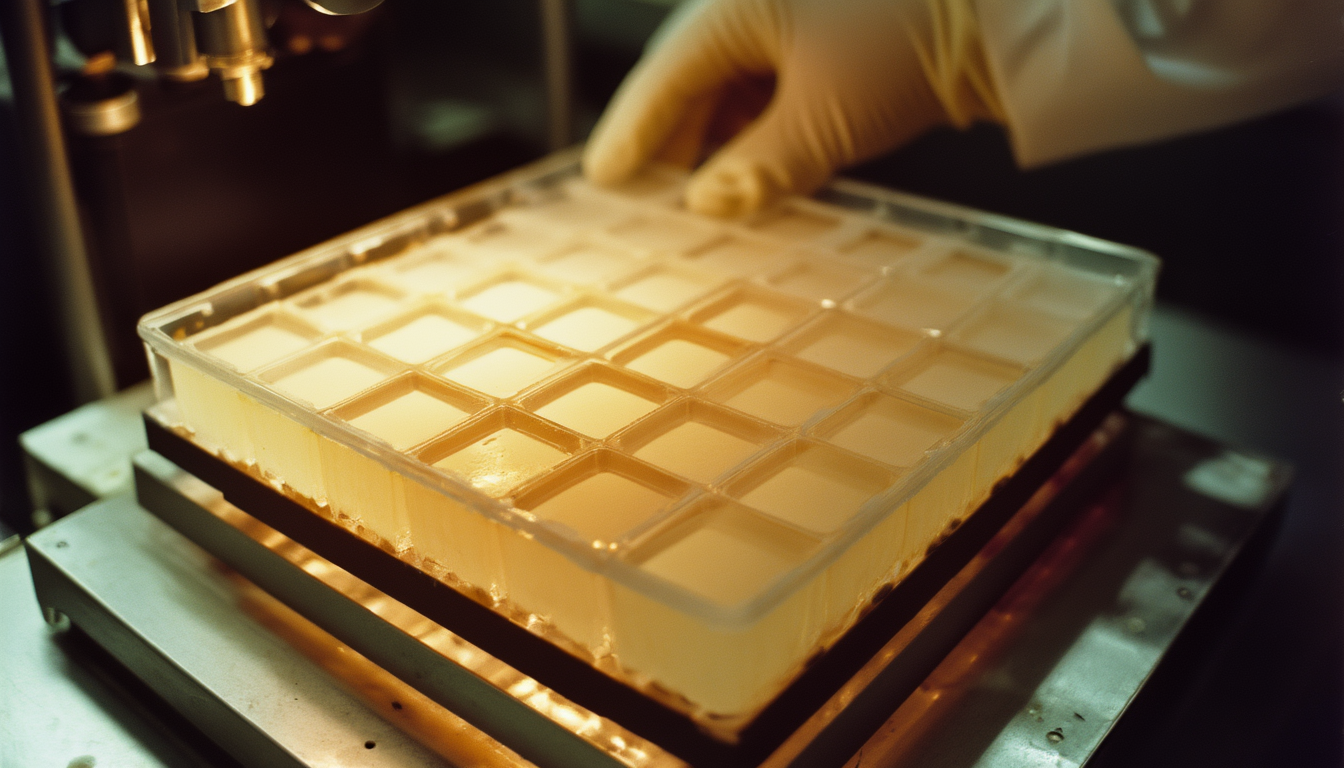
The machine is not dramatic. A nozzle on a gantry, laying down living cells mixed with gel into a 96-well plate, one thin flat square per well. That is what bioprinting means here: living cells deposited in a defined pattern, an inkjet loaded with tissue instead of ink. The gel, a basement-membrane extract drawn from mouse sarcoma and sold under Corning's Matrigel trademark, gives the cells something to hold onto so they grow in three dimensions instead of flat across plastic.11
Left in a warm incubator for a few days, they assemble themselves into organoids: three-dimensional clumps a few hundred micrometers across that keep the architecture and much of the gene expression of the tumor they came from.1
Yoli's job is to watch them die on purpose.
What the genome promised
For most of the 2010s, the plan was to read the answer off the DNA. Sequence the tumor, find the driver mutation, match it to a drug built for that mutation. It worked, for some people. In 2018, researchers estimated how many. About 4.90% of US patients with advanced or metastatic cancer were expected to actually benefit from a genome-targeted therapy that year.2
Not 4.90% got tested. 4.90% benefited.
So a second approach was built underneath it, almost rude in its simplicity. Stop inferring the drug from the mutation. Take the tumor out, keep it alive, put the drugs on it, and look. The field started calling this functional precision medicine. In a 2022 study of 56 patients with advanced blood cancers, 54% of those treated by a functional test held their disease off at least 1.3 times as long as their own previous therapy had.3
The problem was throughput: slow, hand-built, unreproducible between labs.
How you weigh a tumor with light
The engineering fix arrived in June 2023, in a paper describing drug screening at single-organoid resolution.1 Print the cells as a thin flat layer so the whole well sits in one focal plane. Then image it without touching it.
Light slows down slightly when it passes through dense material. An interferometer measures that delay across the whole field and converts it into dry mass, meaning the weight of the cells with the water taken out, clump by clump.1 This is label-free imaging: no fluorescent dye, no stain, nothing killed to produce the reading. The same organoid can be weighed on day one, day three, and day six.
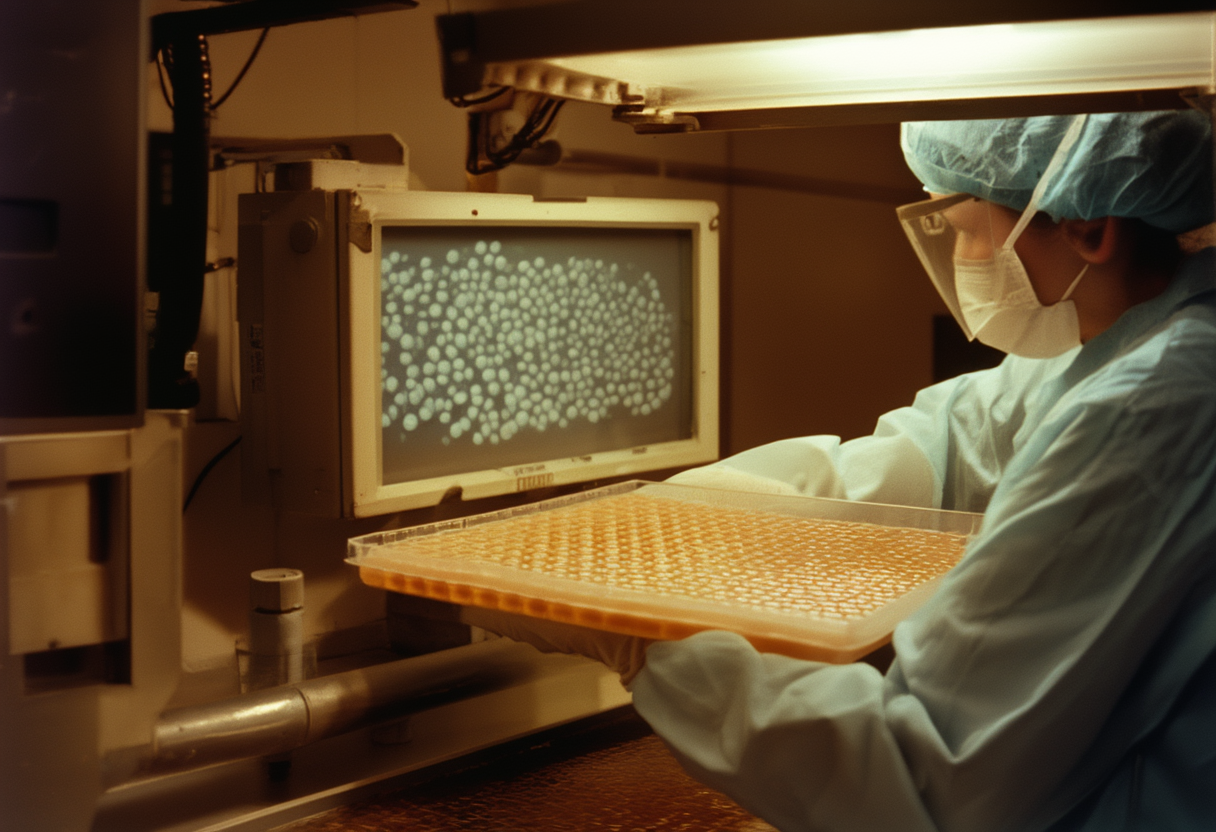
Figure 1. A functional oncology lab during a routine overnight read, 2034. The stage moves; the plate is never opened.
In June 2026 the method was published again as a formal protocol: step counts, reagent volumes, failure modes, written so another lab could run it and get the same answer.4 Quieter news than a discovery, and more consequential. Standardization is what a technology does immediately before it scales.
And it did scale. Thousands of individual organoids per experiment, each tracked separately.14 Not one average across a well, the way earlier assays worked, but a distribution: the ones that shrank, the ones that held, and the stubborn minority that kept growing with the drug on them. That minority is the point. Resistance is often not a tumor changing its mind later. It is a subpopulation that was already there.1 Earlier work had run a panel of 240 kinase inhibitors, drugs that block the signaling enzymes many cancers depend on, against a patient's own organoids, and returned an answer within a week of surgery.5
A week. Against a tumor that is still growing in someone.
The number that is hard to argue with
Here is the part Yoli watches people get wrong. In 2018, a study of patient-derived organoids from metastatic gastrointestinal cancers reported a positive predictive value of 88%.6 Positive predictive value, in plain terms: when the test says a drug will work, how often is it actually right. Eighty-eight percent is a very good number, measured in a small, carefully selected group of patients.
By 2023, a systematic review pooling colorectal organoid studies put the same figure at 68%, with a negative predictive value (when the test says a drug will not work, how often it is right) of 78%.7 The gap between 88 and 68 is not a scandal. It is what happens when a promising result meets a wider, messier population. But it means roughly one time in three, a drug the platform ranks first will not do what it says.
The predictions are also uneven by drug. A 2019 trial predicted response in more than 80% of metastatic colorectal patients treated with irinotecan-based regimens, without wrongly ruling out anyone who did benefit, then failed entirely on a standard 5-FU and oxaliplatin regimen.8 The technology is not accurate. It is accurate at certain things.
Then there is what is absent from the dish. A tumor organoid has no blood vessels, no immune infiltrate, and no surrounding stroma, the connective scaffolding and signaling cells a real tumor lives inside.9 So it cannot evaluate an immunotherapy: there is nothing in the well for the drug to recruit. It cannot tell you whether the dose that killed the organoid is survivable in a person with kidneys. It has no patient in it.
What it produces, in the end, is a ranked list. Drug names, sorted, a confidence figure beside each.
That is where the trouble sits. In 2024, researchers ran 28 pathology experts through AI-assisted decisions and measured a 7% automation-bias rate: correct human judgments overturned by wrong machine advice. Time pressure did not make it happen more often, but it appeared to deepen the reliance when it did.10 Seven percent, among 28 people, sounds small. Run the same reflex across a national tumor board schedule and it is not.

Figure 2. A community oncology office reviewing an outside functional report, 2036. The list arrives already sorted.
A technology built to replace guessing with measurement now produces a number so finely resolved, so visibly earned, that it becomes hard to argue with at precisely the moment it is wrong.
Day six
Yoli pulled the plate for case 4412 on the sixth day and read the grid before the software finished.
No growth. Not a partial take, not a slow one. The cells never assembled. It happens often enough that Yoli stopped being surprised by it, for reasons nobody has fully pinned down: how long the tissue sat, how much of it arrived necrotic, meaning already dead before it left the body, how long it took to reach a courier. She logged it, filed the plate, and typed the four words that go back up the chain: culture did not establish.
No list. No ranking. Nothing sorted.
Somewhere four hours away, an oncologist would open that report, see nothing to defer to, and decide out of judgment, the literature, and whatever the patient said about what they wanted their year to look like. Which is the thing the platform was built to replace.
Yoli has noticed something over eleven years. When the list comes back, nobody calls the lab to argue with it. When it does not come back, sometimes they call twice.
She has never found out which patients did better.
Author's Note. This is speculative journalism, written from a projected vantage in 2036. Yolanda Serrano, her laboratory, the county hospital, and case 4412 are fictional composites; no real patient or clinician is depicted, and the 2036 clinical scenes are speculation. The research, papers, and figures cited below are real and sourced, and the citations describe what those studies reported at the time of publication. Three points deserve emphasis. First, as of the 2026 literature cited below, no large randomized clinical trial has shown that organoid-guided therapy makes patients live longer than a physician's own choice of treatment; the accuracy figures quoted here are prediction statistics, not survival evidence. Second, organoid platforms cannot currently evaluate immunotherapies, and organoid cultures do not always establish, in which case the test simply never runs. Third, nothing here is medical advice, and nothing in it is a reason to change, delay, or decline treatment. Anyone facing these decisions should have them with their own oncologist.