

Oleg Dvorkin has cut hair on Montague Street in Brooklyn Heights for twenty-nine years, most of it for people whose offices are two stops into Manhattan. He keeps a tally of what gets talked about in the chair, pencilled on the back of his appointment book. He gave me the rule in October 2035, sweeping up.
"The day I'm the one handing out the tip, you're already late."
He was not quoting anyone. A customer who ran settlements at a brokerage told him something close to it in 1998, and the stock talk arrives in his shop in clusters three or four months long. He has counted the clusters. He has not kept the record well enough to tell me how many ended badly, and said so before I asked.
What would have to be true
The rule's pedigree is thinner than its reputation. The best-known version has Joseph P. Kennedy quitting the market in 1929 after a Wall Street shoeshine boy gave him a forecast, and no contemporaneous citation for it has been located. The earliest printed source is William J. Duncliffe's The Life and Times of Joseph P. Kennedy, Macfadden-Bartell, 1965, where the saying does not appear in its short form. The familiar wording turns up first in a Gary Blonston column in the San Jose Mercury News of 25 October 1987, six days after Black Monday, speaker unnamed. Fortune credited a similar line to Bernard Baruch in 1996.1
So the rule stands on its mechanism rather than on Kennedy, and the mechanism is serious. Participation in an asset diffuses through a population the way anything else does, outward from people paid to hold an opinion to people who are not. A barber holding a view on a stock is real evidence that the diffusion has run a long way, because the barber sits near the end of the chain. And a price is set by the marginal buyer, so when the pool of people who have not yet bought runs down, the bid runs down with it.
The rule carries a correct instruction on top of that: check the composition of demand, not only its size. Dvorkin's chair samples exactly that, because the sample walks in and he did not choose it.
So the question is what the tally counts.
What the rule is measuring
What the rule detects is the number of people who have already bought, taken at the moment the last of them finishes, and what it is read as is the number still to come.
A tip is the end of a conversion, not the beginning of one. By the time a man in the chair holds an opinion firm enough to pass along, he has read, decided and usually bought. The rule treats that count as a reading on the buyers not yet converted, and gets there by subtraction: if the barber has bought, the pool must be nearly empty.

That subtraction needs a denominator and neither shop has one. A count of arrivals gives the size of the crowd still outside only if the size of the room is known.
Which way it points, and against what
Backward at the level of a single stock, and at the market level, at nothing.
Retail orders can be identified in the tape, so the scoring work exists. Ekkehart Boehmer, Charles M. Jones and Xiaoyan Zhang separated retail order flow in about 3,000 US common stocks a day from January 2010 to December 2015.
In individual stocks, retail buying predicted higher subsequent returns, not lower. The interquartile difference in retail order imbalance was worth about 10.9 basis points over the following week, roughly 5.7 percent annualised, strongest in small, low-priced, low-turnover names. The coefficients reached zero over six to eight weeks.2
In the market as a whole, aggregate retail order imbalance did not predict returns at all.2
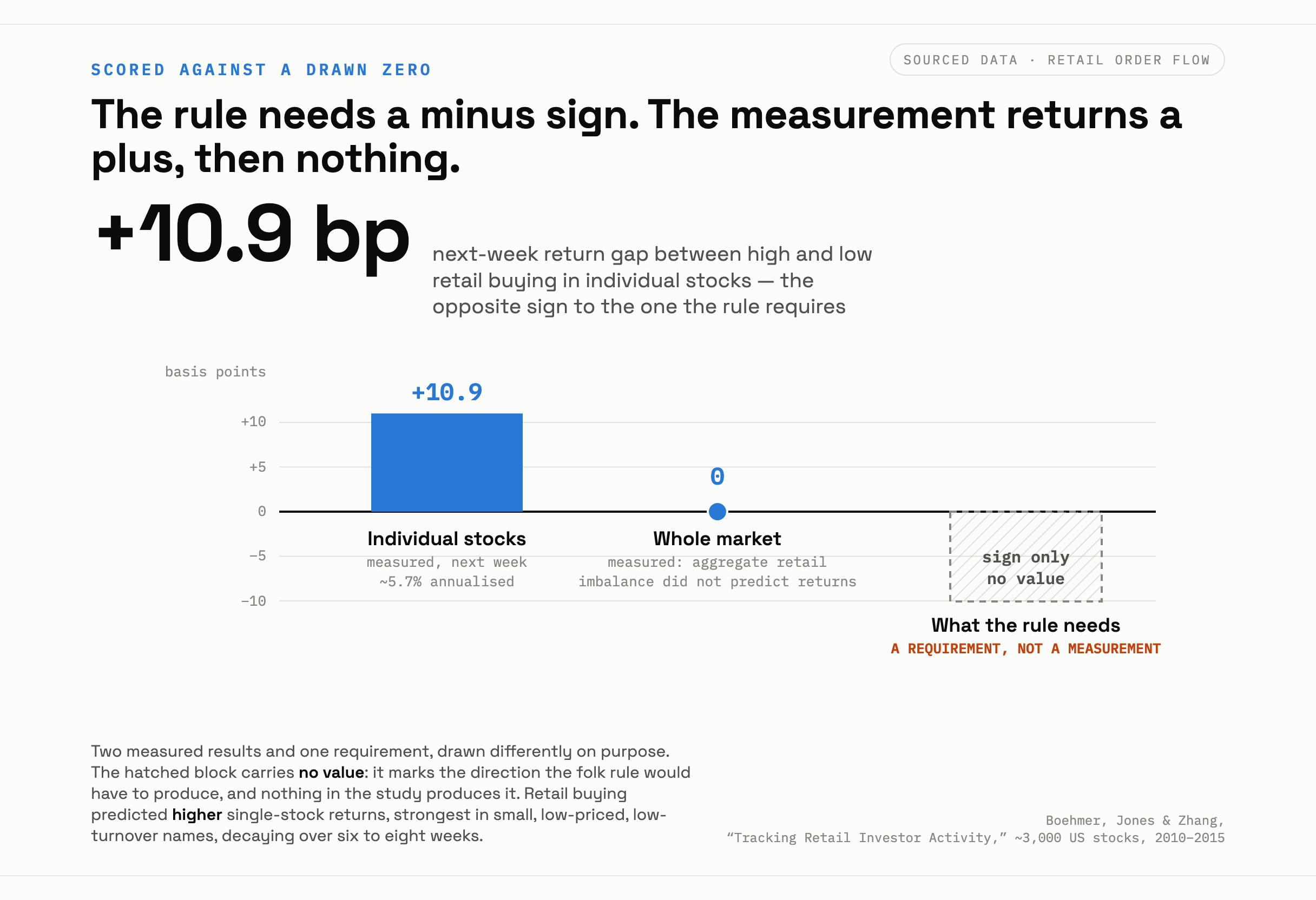
Two baselines, failed two ways. As a stock signal the sign is reversed. As a market-timing signal, which is how it is always used, the rule is scored against a flat line and does not clear it.
Dvorkin had the instrument right. The barber shop is a real sampling station and the clusters were real. The step after the count is the one that failed, and that step is the forecast.
The live one
Same arrow, running now, in statute.
The One Big Beautiful Bill Act, Public Law 119-21, signed 4 July 2025, created the accounts at section 530A. Treasury deposits $1,000 for a child born in calendar years 2025 through 2028 who is a US citizen with a Social Security number. It sits until 31 December of the year before the child turns eighteen, and through that period may only be held in eligible investments, which the statute defines as broad-based US equity funds charging 0.10 percent or less.3 Treasury's default is the SPDR Portfolio S&P 500 ETF.4
There were 3,606,400 births in the United States in 2025, provisionally.5 A thousand dollars each is $3.6 billion, the figure in circulation, and it is a ceiling rather than a measurement. The deposit requires an election, on Form 4547 or through the Treasury portal,3 and at the July 2026 launch about 1.4 million children were reported eligible for it.4
Where it lands is cap-weighted. The seven largest companies in the S&P 500 were about 34 percent of its market capitalisation in August 2026, roughly $24 trillion of about $70 trillion.6 S&P Dow Jones Indices puts the ten largest at almost 40 percent as of 30 June 2025.7
Then the second channel. Section 530A is silent on the form a contribution has to take, and that silence is the gap the stock proposal went through. Brad Gerstner, chief executive of Altimeter Capital and a principal architect of the programme, confirmed that the administration was weighing contributions of cash or shares. A May 2026 analysis set out the claimed tax position: no gain recognised on appreciated shares handed over, and a section 170 deduction at fair market value if routed through a 501(c)(3), a double benefit it called purported.8
Authority arrived on 30 September 2026. Treasury Decision 10056 and the reproposed regulations define qualified stock as publicly traded, issued by a domestic corporation and free of pre-existing transfer restrictions.9 Contributed shares are generally held five years. Parents cannot pick them and donations cannot be refused.10 Comments are open for sixty days, including on exceptions where continued ownership would create a legal or ethics conflict.11
The reading being made of all this, by the people selling it and the people alarmed by it, is that locked shares are supply withdrawn and withdrawn supply holds a price up.
That is the barber's subtraction with a larger denominator, and it has been measured. Robin Greenwood and Marco Sammon tracked what happens when index funds must buy a stock. The total effect of joining the S&P 500 ran about 3.4 percent in the 1980s, peaked near 7.6 percent in the 1990s, and fell to about 0.8 percent across 2010 to 2020, which they report as statistically indistinguishable from zero. Index-tracker ownership grew the whole time. They found no apparent relationship between net purchases by trackers and the size of the effect, with regression R-squared around 2 percent for additions.12 Their Table 2 marks the same window as significant while the text calls it near zero. I don't have a good answer for that.
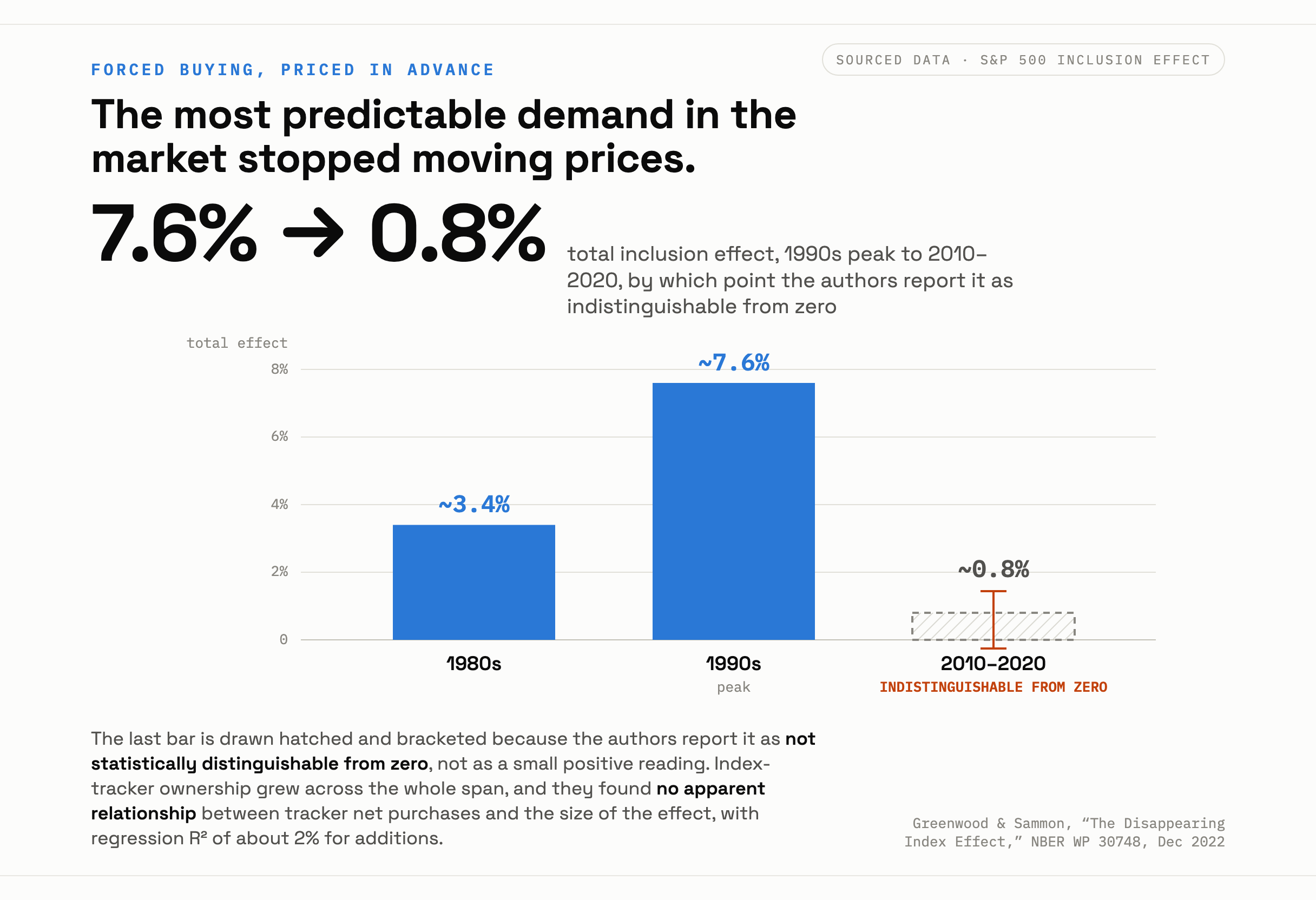
A statutory flow is the most predictable demand in the market. Written down in 2025, with the birth years named and a default fund. A foreseeable purchase gets absorbed, because the people who supply liquidity to it can see it coming.
The $3.6 billion is a real number, honestly reported, and it is about five thousandths of one percent of the index it buys.
A tip is a receipt. So is a lockup.
Editor's note. Category: wrong arrow. Street material, filed under the Almanac byline because the Street desk has no correspondent yet. Oleg Dvorkin and the Montague Street shop are a composite drawn from the trade, and the rule as quoted is composite phrasing rather than a transcription from a single named source. The topic as filed asserted that a hedge fund manager promoting the stock-contribution channel holds the stocks that benefit. Gerstner's role and his confirmation that shares were under discussion are sourced; his firm's holdings are not, so that claim does not run and the structural incentive is reported without it. Ray Dalio, the one hedge fund manager in the record making a contribution, pledged about $75 million for Connecticut children on 17 December 2025, in a form the reporting does not give and with no stated connection to the stock rule.13 The $3.6 billion assumes universal enrolment, which has not happened.