
Manny Botelho has mixed paint on South Main Street in Fall River for thirty-one years. The store is independent, two aisles wide, and he works the tint machine at the back. In September 2035 I asked him which exterior acrylic holds up on a north-facing clapboard wall, and he answered it, then gave me the rule.
"Ask the one who gets paid the same either way."
He did not invent it. His father ran the same counter before him and said it about doctors. Botelho says it about paint and he means himself. His hourly does not move with the gallon. The $68 gallon and the $41 gallon sit on the same shelf and he is paid the same for either. He told me the $41 gallon wants three coats on bare clapboard at roughly 350 square feet a gallon, which makes it the expensive one.
What would have to be true
The rule is doing something harder than it sounds, and it is not a claim about anybody's character.
Two conditions have to hold: the person has to know the answer, and nobody has to have found it worth money to change what the person says. The second condition carries the whole thing, and Botelho's wage is the evidence for it, because a wage that does not move with the item is a fact you can check. You can ask a man what he is paid. You cannot ask him what he believes.
That is a better test than most. It swaps a question about integrity, unanswerable at a counter, for a question about a compensation structure, answerable in one sentence.
What the rule is measuring
What the rule detects is the price of the answer. What it is read as is the quality of the person giving it.
A paint counter in a two-aisle store is cheap to influence and not worth influencing. A coatings manufacturer that wanted Botelho's recommendation could have it for the cost of a spiff on a display order. Nobody offers, because the shop moves under a thousand gallons of exterior a year. The counter is clean because it is small.
So the reading is a reading on the channel's advertising value, and it is taken in the past tense.
Which way it points, and against what
Backward, and against a measured record that exists for advice markets with money in them.
There is no dataset on paint counters; the nearest measured advice markets are financial, and the test has been run from both ends. Sendhil Mullainathan, Markus Noeth and Antoinette Schoar sent trained auditors into retail advisers' offices carrying portfolios whose errors either suited the adviser's compensation or cut against it. The advisers reinforced the errors that paid them and pushed higher-fee active funds at clients already holding diversified low-cost index funds.1 The incentive predicted the advice, which is the rule working.
Then the other end. Daylian Cain, George Loewenstein and Don Moore disclosed the conflict to the people receiving the advice, which is the correction the rule implies. The advisees did not discount the advice enough. The advisers, having disclosed, pushed harder.2
The instrument reads the incentive correctly and the obvious repair does not hold. The failure is in the tense. The rule reports a price that was true at the moment the answer was given and gets used as a forecast about the next answer, and prices move.
The live one
Same reading, on a channel where the price moved inside eighteen months.
People had started asking a model instead of a counter. The Reuters Institute surveyed 97,520 people across 48 markets and found 10 percent using an AI chatbot for news in a given week in 2026, up from 7 percent a year earlier. Trust in what the chatbots said ran at 20 percent against 37 percent for news generally, and 42 percent of those users always or often clicked through to an original source.3 Low trust, rising use, checking behaviour. They were using it the way Botelho's customers use Botelho.
The commercial reading of that came from a party with a position. Adobe agreed in November 2025 to buy Semrush for about $1.9 billion at $12 a share, and said brands now needed generative engine optimisation alongside search engine optimisation.4 Semrush sells the measurement of brand visibility in AI answers, so its figures are the seller's. The company claimed in July 2025 that visitors from AI platforms converted at 4.4 times the rate of organic search visitors, and that AI traffic would pass organic search by early 2028.5 Adobe's analytics arm reported in August 2026 that AI-referred retail visitors converted 60 percent better than non-AI traffic and produced 53 percent more revenue per visit.6
Those are vendor numbers and very likely honest ones. They are also a reading on the shopper rather than on the channel. Somebody who lands on a retailer's site out of an AI answer has already done the research the answer compressed. The conversion rate measures how near the end of deciding they were when they got there.
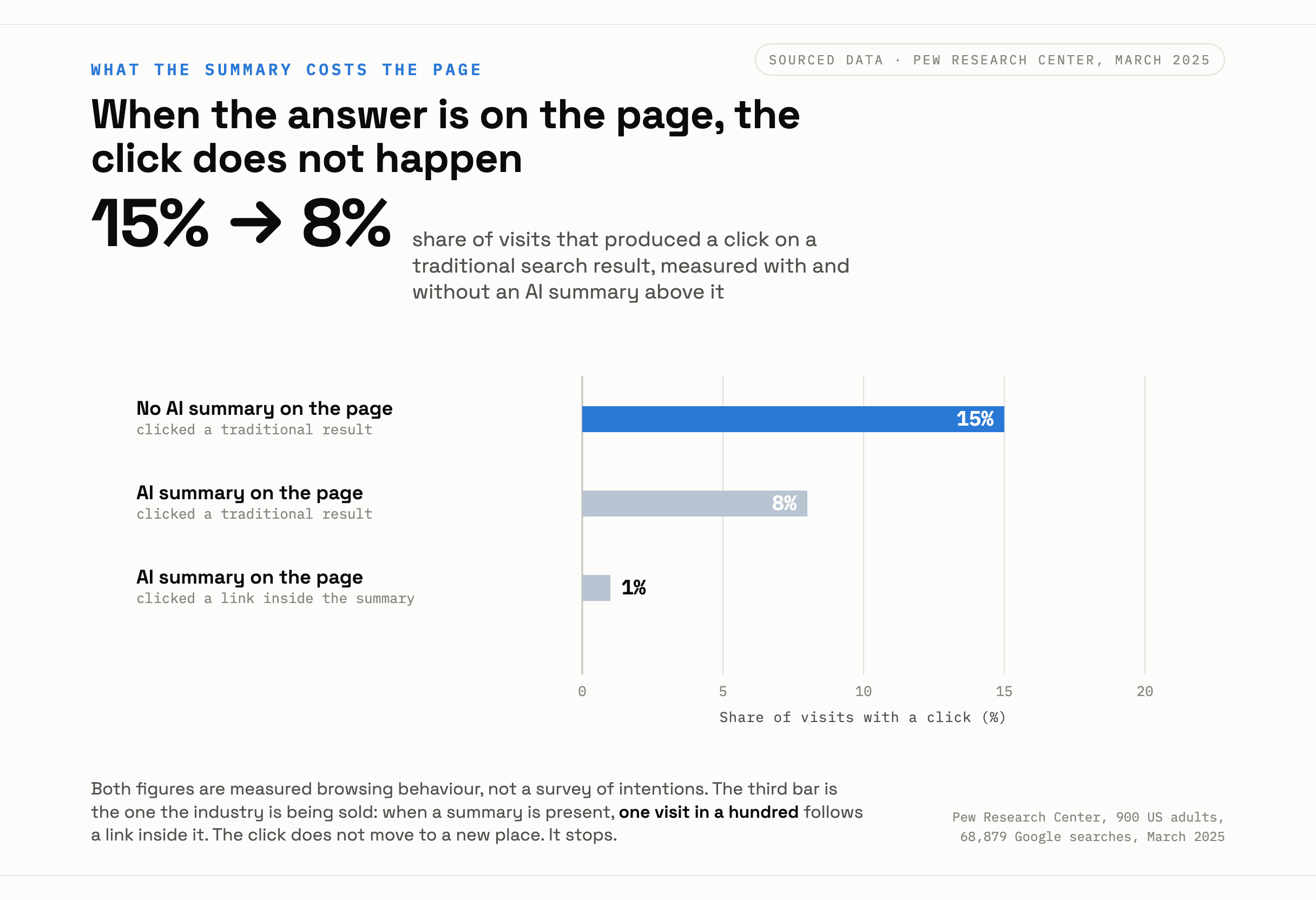
Independent measurement of the channel is thinner. Pew Research Center tracked 900 US adults across 68,879 Google searches in March 2025. On result pages carrying an AI summary, users clicked a traditional result in 8 percent of visits against 15 percent where no summary appeared, and clicked a link inside the summary in 1 percent. Twenty-six percent of summary visits ended the session.7
Cloudflare's crawl-to-refer ratio, published from July 2025, divides a platform's crawler page requests by the requests arriving with its referral. Anthropic's crawlers read about 70,900 pages per referral returned in late June 2025, a figure Cloudflare said may overstate the real ratio.8 Journalists at 22 public service broadcasters scored more than 3,000 assistant answers in 14 languages, of which 45 percent carried a significant problem and 31 percent a sourcing error.9
The optimisation industry arrived before the traffic did. A method for rewriting a page to raise its standing in generated answers was published in November 2023 with measured gains up to 40 percent.10 In April 2024 Aounon Kumar and Himabindu Lakkaraju appended an optimised text string to one page in a catalogue of ten fictitious coffee machines and moved a machine the model almost never recommended into first place.11
The platforms wrote the boundary down themselves. OpenAI opened purchasing inside ChatGPT in September 2025, said merchants pay a small fee on completed purchases, and stated that "Product results are organic and unsponsored, ranked purely on relevance to the user."12 It began testing labelled advertising on the US free tiers in February 2026, and wrote that "Ads do not influence the answers ChatGPT gives you."13
Federal Trade Commission staff had set out in June 2002 what such a sentence has to carry: consumers may reasonably expect search results to be ranked by impartial criteria, so paid rank needs clear and conspicuous labelling.14 In 2023 the agency applied the same requirement to generated output, which "should distinguish clearly between what is organic and what is paid."15
Who could reach the answer moved faster than who could audit it. OpenAI said in December 2025 that prompt injection, instructions hidden in the pages an agent reads, "is unlikely to ever be fully 'solved'."16 Amazon sued Perplexity in San Francisco federal court in November 2025 over its Comet agent transacting on Amazon's site after being blocked, and Perplexity answered that "Your AI assistant must be indistinguishable from you."17
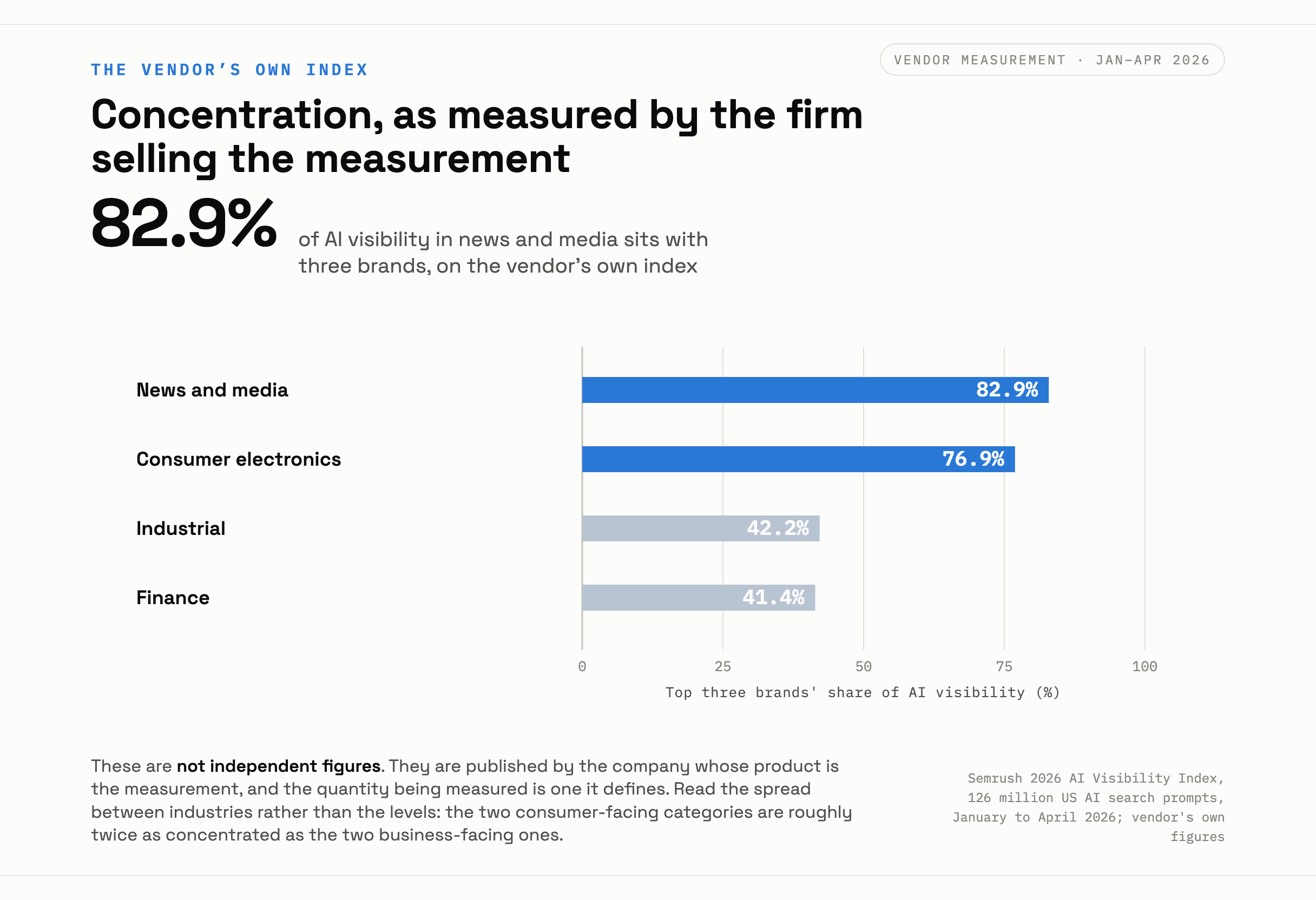
Semrush's own June 2026 index, built on 126 million US prompts, put the top three brands at 82.9 percent of visibility in news and media and 76.9 percent in consumer electronics, and found 45 percent of marketing leaders unable to measure their own brand's visibility accurately.18
Botelho had the instrument right. The cleanliness was real and he was reading it off a number anybody could check, and the number was his wage.
His wage was flat because nobody had bid on his counter.
A clean answer is a price nobody has met yet.
Author's note. Category: wrong arrow. Manny Botelho, the South Main Street store, the wage, the gallon prices and the September 2035 exchange are a fictional composite drawn from independent hardware and coatings retail, and the rule as quoted is composite phrasing, not a transcription from one named source. The paint counter has no dataset; the financial-advice results are the nearest measured analogue, not evidence about paint.
The topic as filed placed Andrew Warden at the 2026 Forbes CMO Summit explaining a new opportunity for brands in agentic search. The summit is real, held 15 to 17 September 2026 in Aspen, and its published roster does not list him, Semrush or Adobe, though the roster is incomplete.19 No remark by him there could be verified, so none is quoted. His employer gives his title inconsistently across 2026 releases: Global Vice President of Marketing and CMO of Semrush, An Adobe Company in October,20 Vice President of Marketing at Adobe and former CMO of Semrush in June.18 The Semrush and Adobe figures are the vendor's own measurements of a market it sells into, marked as such throughout. Any outcome after 2026 is projection.