
Arlen Medrano had four pressure tanks in the truck bed by Thursday, all of them out of basements inside eleven miles of Nelsonville, Ohio, and all four full of water. He has serviced well pumps in Athens County since 2011. The call that brings him out is nearly always the same call, and the homeowner nearly always says the same thing first.
"If the pump's kicking on all day, the well's going dry."
Medrano writes down the switch setting, the air pressure at the valve with the system drained, and how many seconds the pump ran. In fourteen years he has not needed the depth of the water to close out one of these tickets.
What would have to be true
The inference has a mechanism available to it. A well that is being drawn down past the pump intake does change how the pump behaves: it breaks suction, moves air, loses pressure, and never reaches the switch's cut-out, and the protective gear then stops and restarts it. Weather is in that chain too. Water levels in a well are measured, not inferred, and the wellcare program's guidance is that static water level is "the level of water in a well under normal, undisturbed, no-pumping conditions" and is best read after the well has rested several hours, because a reading taken straight after pumping is false.1
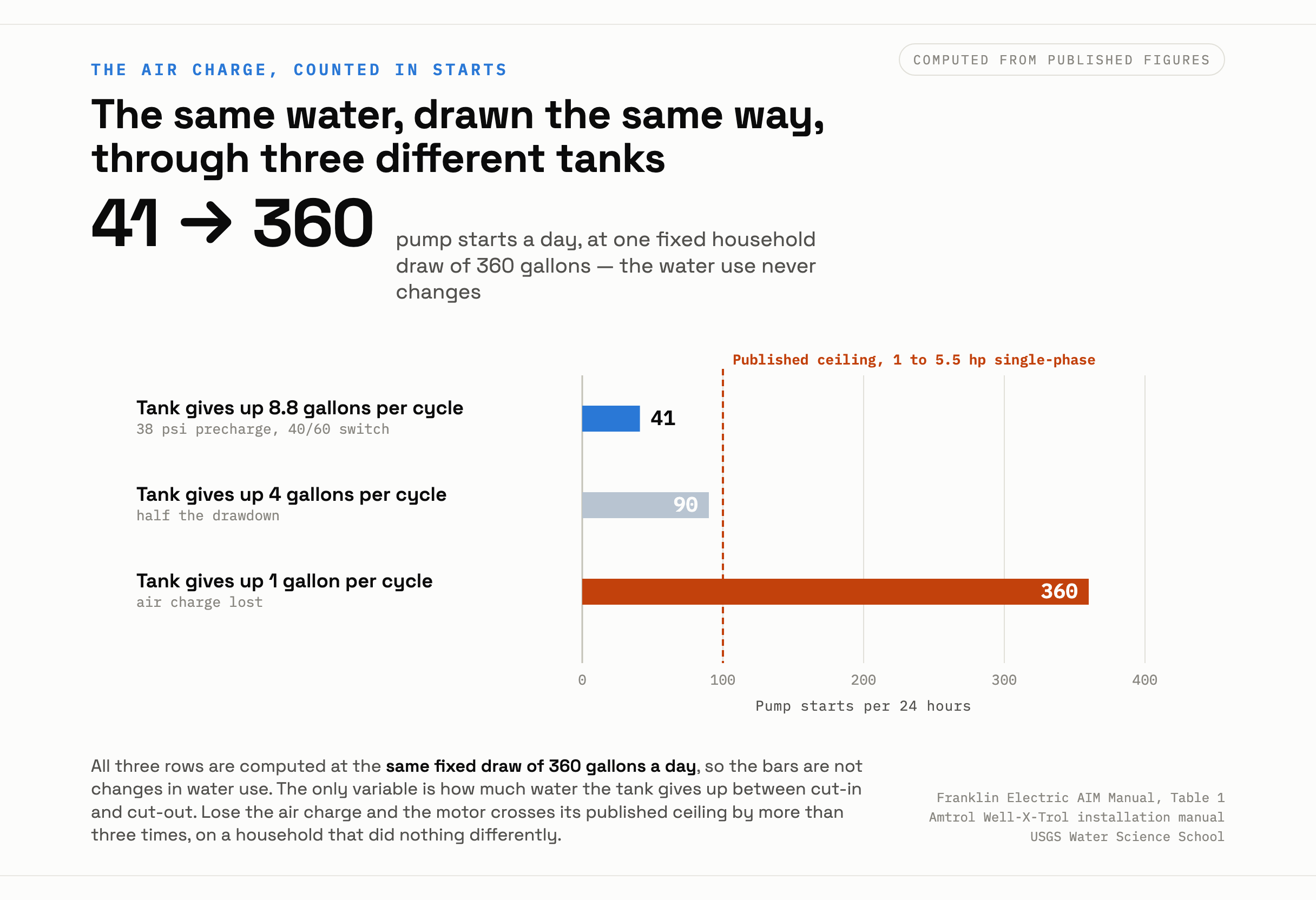
The start count is also not an idle number. It is a maintenance quantity with a published ceiling. Franklin Electric's application manual caps single-phase encapsulated motors of 1 to 5.5 horsepower at 100 starts per 24 hours, puts motors up to 0.75 horsepower at 300, and drops 7.5 to 30 horsepower single-phase units to 50. The same section says to "run motors a minimum of one minute to dissipate heat build up from starting current."2
So a homeowner counting starts is counting something the manufacturer counts, against a limit the manufacturer printed. The counting is sound.
What the rule is measuring
The start count measures the drawdown of the pressure tank: the volume of water the shell gives up between the switch's cut-in and its cut-out. It does not measure what is in the ground, and it does not measure how much water left the house.
Amtrol's installation manual names it in those terms. "The amount of water delivered between pump cycles is called drawdown," and "the larger the well tank, the greater the drawdown capacity, the less the pump needs to run." The quantity is set by air. The installer is told to "set the pre-charge pressure 2 psig below the pressure switch pump cut-in setting," with the worked example "38 psig precharge for a 40/60 pressure."3
Run that precharge against absolute pressure and a 32-gallon shell yields a little under nine gallons before the switch closes again, because the air occupying it compresses from 54.7 to 74.7 psia, about 27 percent of the shell. Let the air out through a failed bladder and the same steel gives up a quart. Amtrol's own caution is printed in capitals: "reduction in pump cycle time can result from loss of tank air pressure." Its FAQ lists rapid cycling as a symptom of a tank that needs replacing, and the diagnostic is the air, not the aquifer: "if your tank has low or no air, your tank may need to be replaced."4
That is what Medrano has in the truck bed. Four shells with no air in them.
Which way it points, and against what
Backward, at the tank, and it can treble while nothing in the well moves.
The USGS puts indoor household use at about 80 to 100 gallons per person per day.5 Take four people at the low end and the house draws 320 gallons a day. On a tank giving up 8.8 gallons a cycle that is 36 starts. On a tank down to one gallon it is 320, which is more than three times Franklin's ceiling for the motor most likely to be hanging in that well.2 Same house, same showers, same laundry. The count moved by a factor of nine and the water did not move at all.
Scored against a measurement of the ground, the start count carries nothing. Los Angeles County's well yield procedure for rock formations runs at least 24 hours, takes the pumping level every 15 minutes for the first hour, hourly for the next nine, and again at 23, 23 and a half, and 24 hours, then divides total gallons pumped by 1,440 minutes to get gallons per minute. Recovery is tracked afterward, and a well that has not come back within five days is recorded as a non-sustainable source.6
Gallons over minutes. Nobody counts starts.
A start count can also be halved by fitting a bigger tank, and not one gallon is saved.
The live one
Same arrow, running on a bigger number. Headless Platform Interactions.
Salesforce published the design on 17 September 2026. AIforce, it says, "decouples the Salesforce platform from the browser, allowing agents to build, act, and deliver on any surface." Administrators register each external agent under Agentic Identity, which "carves out a discrete identity for each agent" and can be given a narrower permission set than a human user's. Then the meter: each "successful call a registered agent makes to Salesforce" over MCP or the direct API is counted as one Headless Platform Interaction, tracked in Digital Wallet, filed under the Customer 360 Platform line of the Flex Credits rate card. Customers buying from that date register within three months of notice, existing API customers at renewal, and anyone using a Salesforce MCP server within three months. Multipliers were listed as TBA, with 30 days' notice before metering began, and sandboxes and Developer Edition orgs were exempt.7
There are two instruments in that document and they are not in the same category. Registration measures what it claims to measure: which identity called, holding which scope. The count is the tank.
A call is a round trip, and how many round trips a job takes is a property of the client. The MCPMark benchmark, published in 2025, put it in numbers: across its task set, models required on average 16.2 execution turns and 17.4 tool calls per task, while qwen3-max averaged 23.02 tool calls and kimi-k2-instruct 26.22 on the same work. The paper records kimi-k2-instruct entering what it calls an overcalling mode, "exceeding 30 turns with diminishing success rates," and reports that successful runs "tend to involve fewer, more targeted tool calls."8
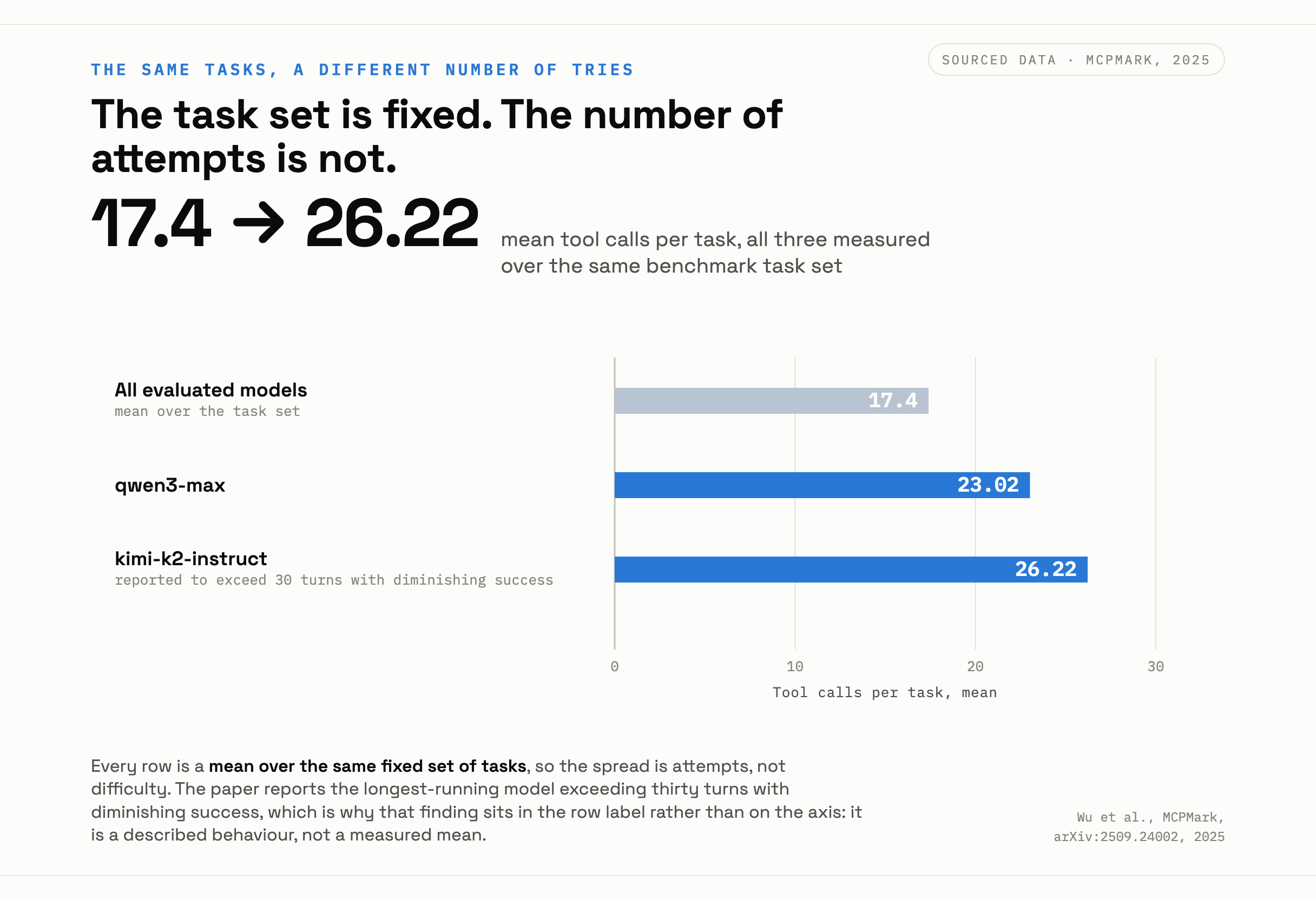
Half again the calls for the same tasks, and the heaviest caller finished least often.
The practitioners said so within the month, in the register of people who had already done the arithmetic. Amnon Kruvi, a Salesforce architect, argued that an agent billed for every action will perform fewer actions, combining calls or building alternatives around the platform, and that the exact multiplier mattered less than the friction: "it's going to scare businesses away just because they need to tell their CFO how much this is going to cost us." Tom Bassett asked who else in the market was charging for agentic API usage. Pablo Gonzalez of dX0 expected the policy to be backtracked or heavily changed, on the grounds that "Salesforce doesn't have the resources to enforce this at scale." A reader asked how a single interaction is defined when an agent retries, or chains one call into the next.9
Combining calls is a bigger tank.
Medrano's ticket has a line for the air pressure and no line for the water table. Fourteen years in, he has not needed one.
A start is a measurement of the tank. A gallon is a measurement of the well.
Author's note. Category: wrong arrow. Arlen Medrano, Athens County and the four tanks are a composite drawn from pump service and well owner literature rather than from any one person, and the rule as quoted is composite phrasing rather than a transcription from a named speaker; the 2036 dates are fictional furniture. Everything else is sourced. The nine gallons of drawdown is my own calculation from Amtrol's precharge instruction and the absolute pressures at a 40/60 switch, not a figure copied out of a tank chart, and a real shell will differ with its bladder geometry and its actual precharge. Amtrol does not use the word waterlogged; it describes loss of air charge, and that is the term carried here. MCPMark measures general MCP task performance in 2025 and is not a measurement of traffic into Salesforce, so it is evidence that call counts vary for fixed work, not evidence about any one platform's meter. The topic reached this desk through The Information's trailer for Laura Bratton's reporting on the registration plan. That article is not readable from here, so nothing is attributed to her and no words are put in her mouth; the Salesforce documentation and the partner reaction carry the facts instead. Whether the Flex Credit multiplier was ever set, and at what, is outside the record available for this piece, and nothing after October 2026 is asserted.