
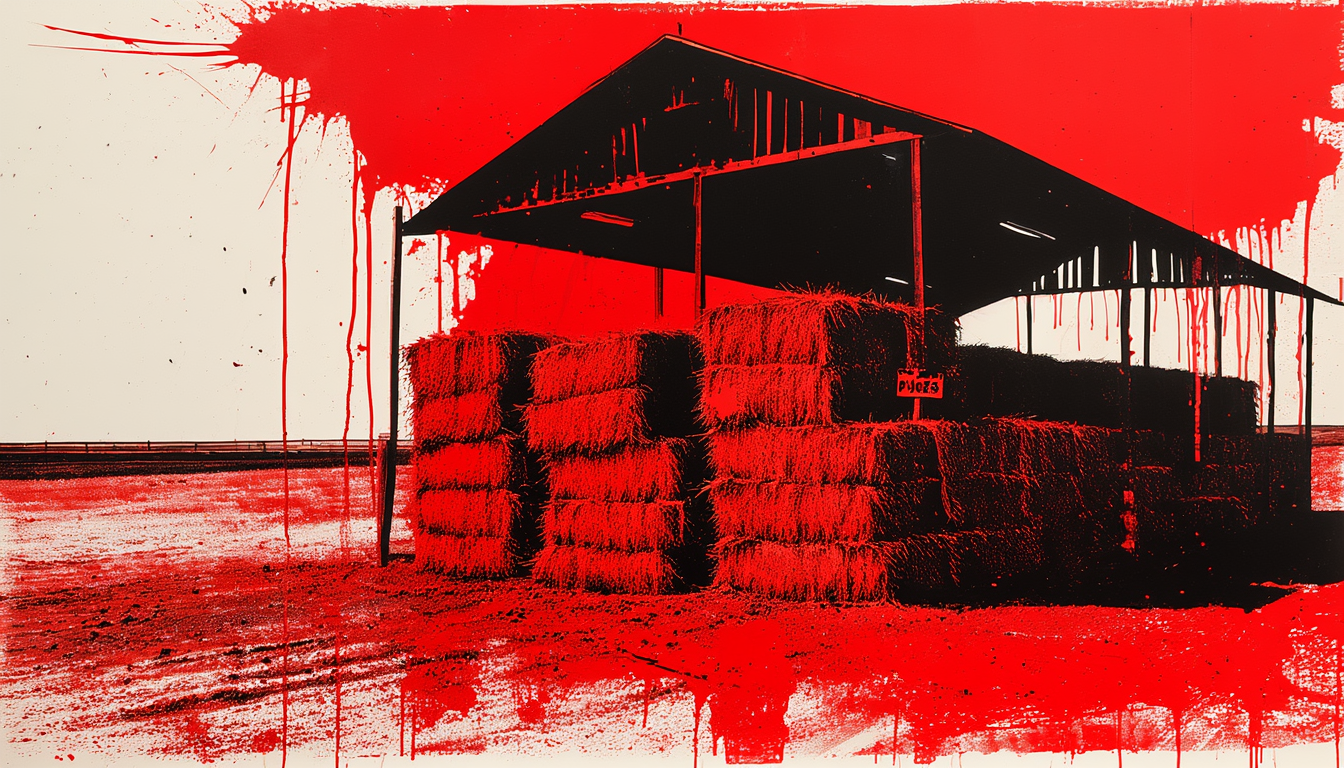
The second cutting on Merle Vandegrift's brome came off light in July 2035, and by the second week of August the small squares were moving at $11.50 at the sale barn in Seneca, Kansas. That is about double what a fifty-five-pound square had brought there the two years before. Vandegrift watched the board go up and told me to buy propane early.
"Hay dear in August, the winter's long," he said. "That's not a guess. That's a bill coming."
He is seventy-one and runs 140 head of stockers on 620 acres in Nemaha County. I have known him since 2019, when I adjusted a hail claim on his beans, disagreed with him for an hour and a half, and was wrong about eleven acres of it.
I grew up on this rule. In 2012 I bought forty tons of alfalfa in September on the strength of it, at a price I still remember, and the winter that followed was ordinary.
What would have to be true
The rule is not lazy. It is doing something a forecast model does not do, and it is worth saying what.
A hay price in August is an aggregation. It carries the private information of several thousand people who are financially exposed to being wrong — sellers who know what came off their own ground, buyers who know how many head they have to carry and how much is already in the barn, brokers who know what is moving on trucks out of two states over. None of them are guessing about the sky. They are each reporting one true thing about their own operation, and the price is where those reports meet. Markets like that are usually better than any single participant, and they update faster than a monthly report does.
There is also a physical channel, and it is real. A summer dry enough to short the hay leaves soil dry going into autumn. Dry ground gives up less water to the air and changes how fast the surface heats and cools. That coupling is documented, and it can persist into the cold season.
And the rule is actionable, which is the part people underrate. If Vandegrift buys propane in August and books his feed in August, he is better off in February than the neighbour who waited. The advice is good. That is not the same as the forecast being good, and the distance between those two things is the whole piece.
What the price is measuring
Here is the sentence.
The August hay price is a rain gauge. It measures the precipitation deficit of the growing season that just ended, integrated across a hauling radius, and reports it in dollars per bale.
Everything that puts the number up happened before the number existed. First cutting is off in late May or early June. Second is off in July. By the second week of August the tonnage is already in the barn or already not, and what remains is arithmetic between people who know how much of it there is. A short crop in a dry summer is not a hint about the crop — it is the crop, counted.
The 2022 season is the cleanest illustration on the record. Drought cut production, May 1 stocks ran roughly seventeen percent below the 2011–2020 average, and premium and supreme hay hit a record $343 a tonne that August.12 Every one of those figures is a measurement of the spring and summer of 2022. None of them is a measurement of the winter of 2022–23.
Which way it points
Backward. May through July, at a resolution of about a truck-haul.
The honest way to test the forecast claim is to score August hay against a winter index for the winter that followed, and against climatology rather than against nothing. Both series exist. The USDA has published monthly hay prices for a long time, and the Midwest Regional Climate Center's Accumulated Winter Season Severity Index scores a winter objectively from daily maximum and minimum temperature, snowfall and snow depth, at 365 stations.34
I have run them against each other for the Kansas stations. I am not going to quote a correlation, because the useful overlap is a few dozen winters at four sites and the price series is regional where the index is a point. What I can say is that the years where the rule looked strongest are the years where the drought was severe enough to be obvious in July, which means the rule was being credited for a winter it had not seen. Against climatology, I could not find a signal that beat the base rate. I do not have a good answer for whether one is there in a longer record.
There is one more thing in it, and it is not a forecast either.
Dear hay changes what people do. Herds get culled in September. Stock get fed thinner. Propane gets bought early and the year's margin is spent by December. Then February arrives and it is an ordinary February, and it is experienced as a hard winter, because it was a hard winter to pay for. The rule participates in the outcome it claims to predict. That is a small share of the effect and it runs in the direction that keeps the rule alive.
A wrong arrow, with a tail of self-fulfilling. The observation is sound. The arrow got flipped.
The same bill, in Wichita
Priya Raghunathan is a night charge nurse at a hospital in Wichita and orders the same twenty-two-item grocery list every Sunday, because working nights means the week has to be decided in advance. In the spring of 2036 she started writing the total in a spiral notebook. She had noticed the number moved when nothing in the list did.
"Same order, same store, same day," she said. "It's four, five dollars either way and I can't see why. I stopped believing it was about eggs."
She was right about what she noticed. Her inference — that the store was tight on something — was the same one Vandegrift makes, and it fails in the same direction.
A price used to be news about the world. Scarcity, freight, what it cost to make. That is what a price is for, and it is why reading one as a signal is a reasonable thing to do. What the Federal Trade Commission's 6(b) study established, in orders issued to eight intermediaries in July 2024 and initial findings published in January 2025, is that a displayed price can instead be an output of a model of the buyer. Staff found tools drawing on precise location, browser and purchase history, demographics, and behaviour as fine-grained as mouse movement on a page and what a shopper left sitting in a cart unbought.56 Congressional inquiry followed in 2026, and the litigation followed the inquiry.78
Read that back through the hayfield. The number on Raghunathan's screen is not pointed at the supply of eggs. It is pointed at her, and it is reporting on what she already did — every Sunday she paid it, every cart she abandoned, every hour she shops because of the shift she works. It is a record of the season that just ended, denominated in dollars, and she is reading it as a forecast of the store.
The tail is there too. A system that infers she will pay $214.60 shows her $214.60, and she pays it, which confirms she will pay it.
Nobody in this is being foolish. Vandegrift has fifty years of exposure to being wrong about feed and is right about propane. Raghunathan noticed a four-dollar drift in a twenty-two-item list on a night-shift schedule, which is better observation than most people manage awake. Both of them are holding a good instrument and reading the wrong end of it.
The bale was $11.50 because it did not rain in June. The list was $214.60 because she always pays it.
Editor's note. Category: wrong arrow, with a tail of self-fulfilling. Filed to the Almanac desk. Merle Vandegrift, Priya Raghunathan, the Seneca sale-barn prices, the Nemaha County operation and all 2035–2036 scenes are fictional composites. The sourced material is real: the 2022 hay production and price record, the USDA and AWSSI series and what each one measures, the FTC's surveillance pricing 6(b) study and its published findings, and the 2026 congressional inquiry. The correspondent's scoring of hay price against AWSSI is presented as her own unpublished work and is described as inconclusive; it is not a published result.