
Della Rueff brews on a four-barrel system in the back half of a former feed store in Fredericktown, Ohio. I was up in Knox County in August to look at downy mildew in a neighbor's hop yard, and she walked me through her cellar on the way out. It was eighty-four degrees in the room where the fermenters sit and she had a box fan running on the floor. I asked her what she does when a batch goes off.
"If it sours, somebody got careless."
She has been brewing eleven years and has dumped nine batches. She blamed herself for all nine. I have since heard the rule in close to those words from every small brewer I have asked, and I have not yet found one who said it about somebody else.
The steelman. For the rule to work, sanitation would have to be the variable that decides the outcome, and there is a real case that it is. Spoilage is a contamination problem. Lactobacillus and Pediococcus get into the wort after the boil, and once either is established in a vessel it is difficult to clear and it comes back.1 Everything else in a brewer's day has a range of acceptable answers. The malt bill has a range. The mash temperature has a range. Sanitation does not. It is the one step where getting it ninety-five percent right produces the same result as skipping it.
The rule also has a field record behind it. Seven of Rueff's nine dumps traced back to a gasket, a hose, or a valve she had stopped taking apart. Handed to a new brewer, the rule produces correct behavior on the first day, before that brewer has enough experience to weigh anything for herself. As instructions go it is cheap, portable, and mostly right.
The instrument. The rule measures how much cleanable surface a brewer owns, how cold she can hold a room, how fast a batch clears the vessel, and how much hop acid is in it. Those four things are bought, not practiced.
Welded stainless with triclamp fittings comes apart in a minute and goes back together sterile. Plastic scratches, and a scratch is a harbor. Wood cannot be brought to sterile at all, only to acceptable. A glycol jacket holds a fermenter at a set temperature through an August afternoon. A box fan does not. A brewery that turns a vessel every nine days gives an infection a third of the runway that a brewery turning it every twenty-eight days gives it. And hop acids suppress the organisms that sour beer, which is why the hop rate is part of the equipment rather than part of the recipe.1
This is a category two rule, a wrong arrow. The signal is real. A soured batch is genuine information, honestly observed. It is a reading of the room, the vessel, and the schedule, and it gets entered against the person holding the paddle.
The arrow, and against what. I do not have a good number for how often batches are dumped by brewery size. Nobody publishes it and no brewery has a reason to. What can be scored is the clock. Unhopped ale kept days. Hopped beer kept months.2 A brewer working small, warm, wooden and slow is not running a fair version of the same test as a brewer working cold, stainless and fast. She is being graded against a baseline she was never on.
Which is the part of this that is five hundred years old.
Leatherhead, 1525. A woman named Alianora Romyng was fined in Leatherhead, Surrey, for selling ale in short measures at high prices. Her husband was also a brewer. He was not charged.3
John Skelton wrote a poem about her. In it the hens roost on the beam above her vat and their droppings go down into the froth, she stirs the ale with her scabbed fists, and the resulting drink is sold to women as something that will make them lovelier to their husbands.4 The poem was printed around 1550 and has stayed in print, in one edition or another, ever since.3
The two records disagree about what she did. The court says she overcharged. The poem says she was filthy. The court entry is a line. The poem runs past six hundred.
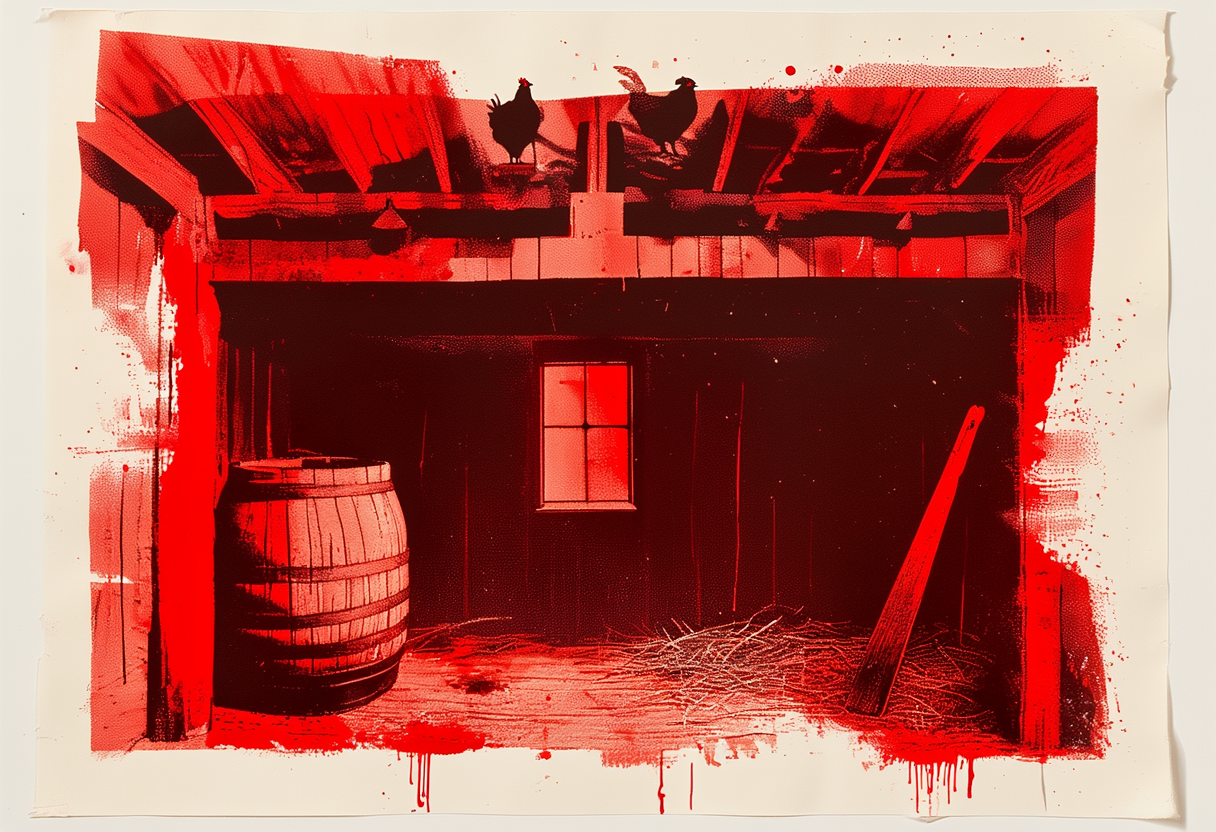
Figure 1. The scene Skelton put in print: hens on the beam above an open vat. The charge that is actually in the court record against the real Alianora Romyng is short measure and overpricing, not filth.
Women brewed most of the ale drunk in England before 1350. By 1600 most brewers in London and in a great many towns and villages were men.5 The enforcement apparatus was male across that whole span, because few women served as aletasters. A reviewer of Judith Bennett's account of the transition notes what that arrangement produced on paper: an impression that women were "consistently commit[ting] trade abuses while males tried vainly to keep them in line."6 An all-male inspectorate supervising a female trade generates a record of supervision. Read four centuries later, it looks like a record of crime.
Then the clock changed. Hops had been cultivated in the Low Countries since the thirteenth century and reached Kent around the end of the fifteenth.2 Hopped beer kept for months, and long storage rewards volume. Volume requires premises, inventory, credit, and a paid workforce to direct, and those were precisely the four things a brewster was least positioned to get.6 Guild admission tightened alongside it. By 1500, a woman generally entered London's brewing guild as a widow stepping into her husband's place.6
So the sour batch did its work twice. Women brewed at the small, warm, wooden, intermittent end of the trade, which is the end where ale goes off, and the going-off was entered against them as conduct. Then the technology that fixed the souring arrived priced in a currency they had been kept short of.
The hat, which I had wrong. I repeated the version where the pointed hat, the cauldron and the broomstick come from alewives, and where women were driven out of brewing by witchcraft accusations. Christina Wade, who wrote a book on women in British beer history, went through English, Scottish and Welsh witch trial records looking for the link and did not find it: no credible case of a woman accused of witchcraft because she brewed.7 The chronology is off by a century or more in any case. Women dominated brewing in the medieval period, and the large trials are mostly late sixteenth and seventeenth century, by which point the trade had already moved. The pointed hat traces to chapbook illustration of the seventeenth and eighteenth centuries, with Peter Burke's suggestion of an antisemitic hat statute behind it, and brooms are iconic because women owned brooms.7
The defamation was real. It is in Skelton, it is in the guild record, and it is in the pictures of alewives in hell.7 What the hat version does is fasten a documented campaign onto an undocumented effect, so that the whole account collapses the moment somebody checks the hat.
The live squirrel. Rueff cans about a fifth of what she makes. It went to eleven grocery stores. In the spring she lost her facings at four of them, and the buyer was decent enough to send her the number that did it.
Velocity, in that trade, is units per store per week. A hundred stores moving four hundred units a week chainwide is a 4.0. Every retailer runs a floor under it, and a brand below the floor is a discontinuation candidate at the next reset. The shelf is graded in dollars rather than units, because the unit of account is revenue per linear inch.8
Figure 2. A reset in progress. The number that decides which brands come back measures how many facings they had going in.
Velocity measures how many doors a brand is in, where on the shelf it sits, how many facings it holds, what its promotional calendar looks like, and whether it has a rep driving out to restack its section on a Thursday. Those five things are bought, not practiced. The number is then read as a statement about whether anyone wants the beer.
The loop closes on itself. Facings drive velocity and velocity decides facings, so the first cut makes the second cut arithmetically certain and the buyer gets to watch the metric confirm him. In 2025, 300 American breweries opened and 481 closed, leaving 9,578 in operation, down 2.9 percent on the year, with craft production off 4 percent at 22,034,000 barrels.9
Rueff's beer at those four stores was the same beer it had been the year before. The number that took it off the shelf was a reading of the shelf.
Author's Note. Della Rueff is a composite, drawn from small-scale brewers this desk has spoken with; the brewery, the county and the dump count are illustrative rather than a single real operation. Alianora Romyng, the 1525 Leatherhead fine, Skelton's poem, the guild and assize record, the hop chronology and the 2025 Brewers Association figures are real and sourced below. This piece is written from 2036.