
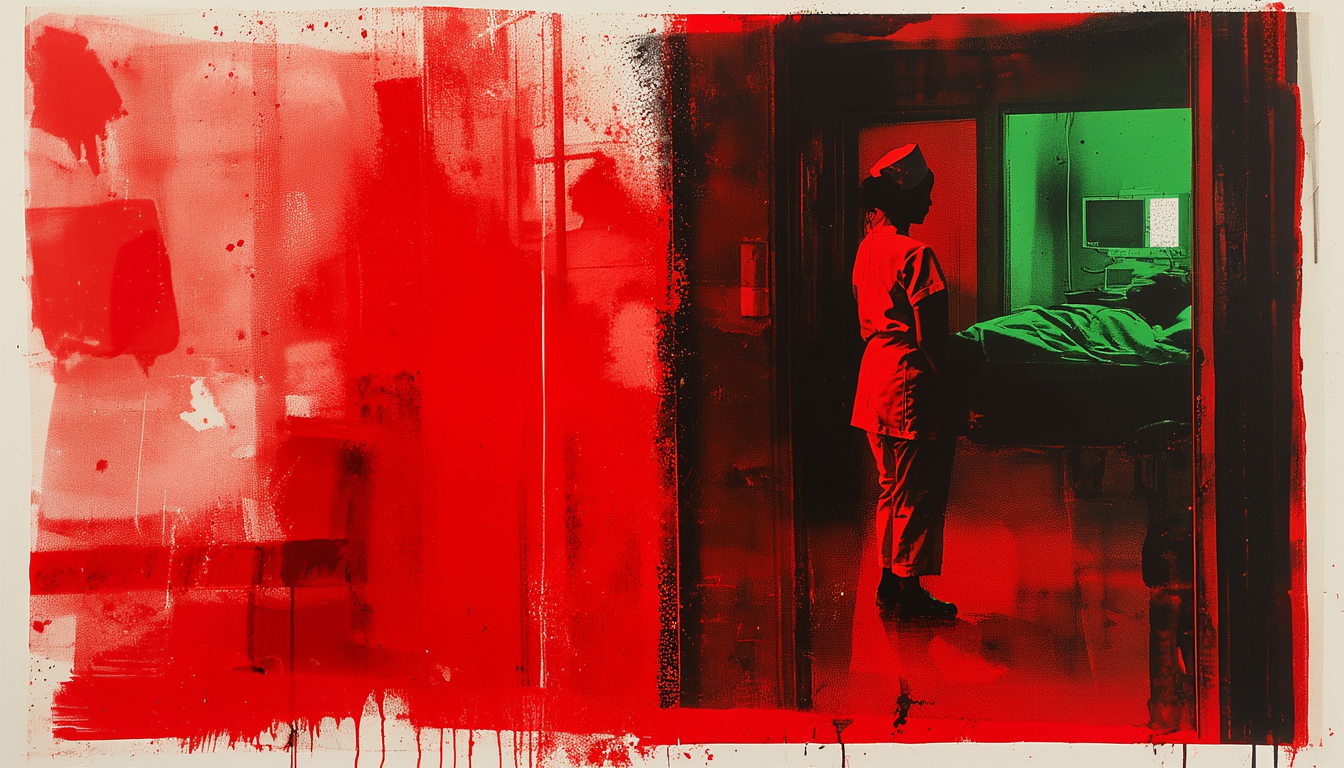
Denise Okafor has worked nights on a medical-surgical floor outside Dayton, Ohio, for nineteen years, and the rule she was taught by a charge nurse in her first year has never once let her down: if a patient looks wrong, the patient is wrong, whatever the monitor says. She described it to this correspondent the way she says she'd describe it to a new hire: you walk in, you glance at the numbers out of habit, and then you look at the person, and sometimes the person is telling you something the numbers haven't caught up to yet. She has learned to act on that gap before it closes.
The rule sounds like folklore. It is closer to an instrument reading, and the instrument has been tested. A prospective study of Dutch surgical wards found that a nurse's stated "worry" about a patient predicted an unplanned ICU admission or death independent of the patient's actual vital signs.1 A broader review of the same literature found the same pattern across multiple hospitals: nurses were picking up something real, hours before the standard vital-sign thresholds crossed into alarm territory.2
The steelman. For the rule to work, a nurse would need to be integrating far more information than a chart column holds: skin color, breath sound, the particular way someone shifts in bed, how quickly they answer a question, whether the answer makes sense. Okafor can't list everything she's weighing when she says a patient looks wrong. Neither can most nurses who are good at it. That is not evidence the feeling is empty. It is evidence the feeling is running on more inputs than the monitor is wired to record.
The instrument. The gut feeling is not a supernatural sense. It is a pattern-matching instrument, built out of thousands of hours of exposure to what dying looks like before it fully arrives, that fuses a wide, informal set of subclinical cues into a single fast judgment faster than any one of those cues could be individually charted, timed, and scored.
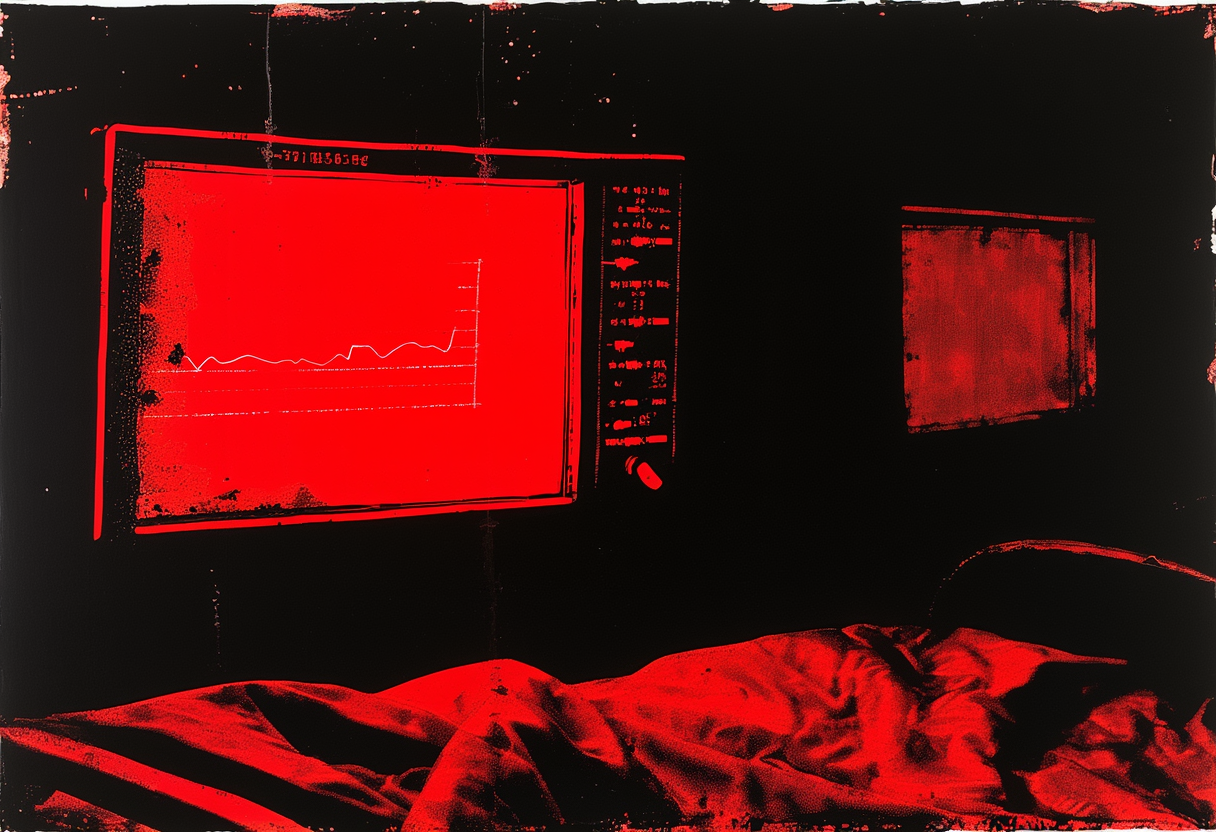
Figure 1. A bedside monitor, steady and unremarkable, the night the numbers hadn't caught up yet.
The arrow. Against the actual baseline, worry holds up. It is not beating a coin flip; it is beating the specific, narrow instrument it gets compared to, which only watches four or five numbers on a fixed schedule. Where the arrow bends is in the explanation people reach for once the prediction lands. The feeling gets treated as ineffable; something outside ordinary information processing, a sixth sense, a gift some nurses have and others don't. That is the wrong-arrow move. The signal is real. The claim that it must be uncomputable, rather than merely uninstrumented, is pointed at the wrong culprit.
The tell is what happens once someone builds the missing instrument. Machine-learning sepsis models trained on the same electronic health record data a nurse is informally weighing, vitals trends, notes, lab draws, nursing flowsheet entries, now outperform the standard scoring tools nurses were being measured against. One such model beat the National Early Warning Score on both timing and accuracy, and in a separate evaluation, half of confirmed sepsis cases were flagged by the algorithm at least two full days before clinical diagnosis.3 Nothing about the underlying signal changed between the era of "she just knows" and the era of the model. What changed is that somebody finally wrote the instrument down.
That is the live version of the same directional error, currently running at much higher prestige and much better funding. Roger Penrose has long argued that human mathematical insight does things no algorithm can do, and that the explanation must lie outside classical computation entirely, in quantum processes inside neurons. The standard objection has been thermal: the brain is warm and wet, and any quantum coherence inside it should collapse in roughly a tenth of a trillionth of a second, far too fast to matter to a neuron.4 Proponents have pushed back that the calculation assumes the wrong physical model and that a more realistic one, accounting for the microtubule's own internal shielding, gives coherence times many orders of magnitude longer.5 The neuroscientist Mike Wiest has more recently pointed to a 2024 finding of a laser-like quantum effect in microtubules that got stronger, not weaker, as more of them were bundled together at room temperature, and has argued the evidence is worth taking seriously again.6
Nobody in that debate is lying, and nobody is stupid. The observation both sides are responding to is the same one Okafor is responding to on the ward: there is something the mind is doing that the instruments on hand cannot yet fully account for. The dispute is entirely about where the missing account belongs. One answer is that it belongs in physics not yet built, a substrate below classical neuron firing that computation in principle cannot reach. The other is that it belongs in a model not yet written, the way the sepsis algorithm eventually got written, folding a wide informal set of pattern cues into something explicit enough to test against a baseline. A gap in the current instrument is not, by itself, evidence about which kind of gap it is.

Figure 2. The chart, and the pause before the note gets written.
Okafor has been asked more than once whether she thinks the machines will eventually make her worry redundant. She says the sepsis dashboard on her floor already flags patients before she'd have flagged them herself, on the cases where the flag turns out to be right. On the cases where it doesn't, she still trusts the walk to the bedside more than the screen. Both things are true on the same floor, on the same shift, about the same gap.
Author's Note: Denise Okafor is a composite drawn from published nursing research on clinical worry and intuition, not a single reported individual, and her ward is not a specific real hospital. The Dutch-Early-Nurse-Worry-Indicator-Score findings, the sepsis-model performance figures, and the Penrose/Tegmark/Hagan/Wiest physics debate are real and sourced below, current through 2026. This magazine takes no position on whether Orch-OR is correct; the piece's claim is only about the shape of the argument being made on both sides of that debate.