
The twenty reports were the part that nobody photographed. In September 2026 Anthropic published an account of something one of its programs had noticed in the DNA of bacteriophages, the viruses that infect bacteria, and the account came with a number that was meant to impress: a set of software agents had gone through genomic data and produced twenty human-readable reports on the most promising things they found.1 Twenty documents. A reader could hold the whole output of the exercise in one hand.
What one of those documents described was an enzyme called a reverse transcriptase sitting next to a long array of evenly spaced repeated sequences, with a third gene beside it that nobody could assign a job to. Reverse transcriptases copy RNA back into DNA, which is the trick retroviruses use. Evenly spaced repeat arrays are the structural signature of CRISPR, the bacterial immune system that became the standard laboratory tool for editing genes. The two features had rarely been seen together. Anthropic named the arrangement ART, for array-associated reverse transcriptases, and said plainly in the same post that it did not know what the thing did.1
That sentence is the one worth keeping. "Although we don't yet know its function," the announcement read, the system had a combination of characteristics found together in only a handful of others.1 Dario Amodei, posting the same day, wrote that the company suspected it could represent a new gene editing mechanism and that its precise function, biotechnological utility if any, and level of significance were not yet clear.2
What the search actually cost
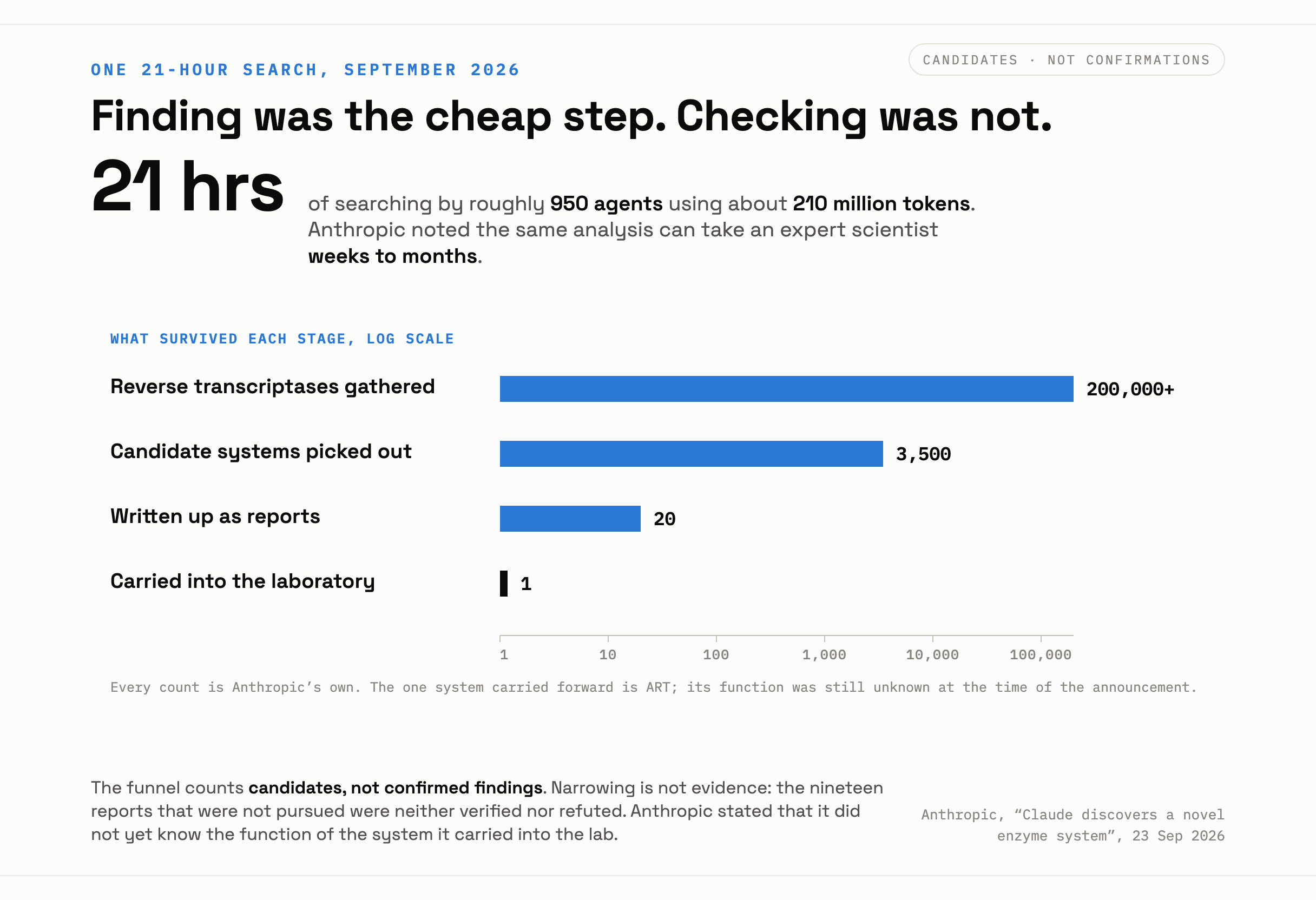
The headline figures were real and they were striking. Roughly 950 agents spent 21 hours working through genomic data, consuming about 210 million tokens.1 They gathered more than 200,000 reverse transcriptases, picked out around 3,500 candidate systems, and narrowed those to the twenty that got written up.1 Anthropic noted, reasonably, that for an expert scientist this kind of analysis can take weeks to months.1

Two details complicate the picture, and both were in the coverage from the start. The reverse transcriptase itself was not new. Earlier work had already identified that enzyme in a jumbo phage; what had gone unnoticed was the repeat array beside it.2 And the finding arrived as a preprint that had not been peer reviewed, alongside a company announcement, rather than through a journal.3 Feng Zhang of MIT and the Broad Institute, who had as much standing to judge as anyone, called the identification of RNA-repeat arrays associated with reverse transcriptases genuinely intriguing and said it merited further investigation.1 That is a careful sentence from a careful person, and it is not the same sentence as "this works."
The lab was the slow half, and it was deliberate
The company had also been running a wet laboratory in the Bay Area since the spring of 2026, quietly, at biosafety levels one and two, staffed by people.3 All of the laboratory work was performed by human scientists.1 Eric Kauderer-Abrams, describing the setup to Reuters, said the company believed that to do biology, the final test is still and will be for a while in real lab work.3
This is the part that got lost in the argument about whether a machine can discover anything. Nobody at the company claimed the search had settled the question. The search produced a shortlist. The shortlist went to a bench, where six named human scientists did the slow work, and the first experimental result was modest and specific: the repeat array was expressed as a set of distinct short RNAs, which is the behaviour you would want to see if the system were doing something CRISPR-like.1 Suggestive. Not conclusive. Further experiments were underway.1
The invoice that was supposed to close the gap
By November the obvious business had formed around that gap. If the expensive step was no longer finding a candidate but testing one, then whoever could make testing fast and purchasable owned the bottleneck. Ginkgo Bioworks had been building exactly that: a cloud laboratory selling autonomous protocols on demand, cell-free protein expression, purification, mass spectrometry, binder screening, bookable from anywhere.4
In mid-November the company said it had pointed that service at ART. By its account, scientists at Ginkgo wrapped a frontier model in a harness, handed it the preprint and a catalogue of validated laboratory workflows, and asked it to generate executable work orders. The company reported first evidence of biochemical activity thirteen days after experimental design, for about fourteen thousand dollars of cloud laboratory services.
Those two numbers deserve a flag rather than a flourish. They come from the company that sold the service, in a post on its own site, and this piece was not able to retrieve that post or find any independent account of the experiment. The underlying service is real and documented.4 The result is a vendor's claim about a vendor's product, and as of this writing it had not been checked by anyone outside the transaction. A thirteen-day turnaround on a question that had been open since September would be a genuinely important number if it held. That is precisely why somebody other than the seller needs to establish it.
What got scarce
The pattern underneath all of this is older than any of the software involved. When a step in a process becomes cheap, the constraint does not disappear. It moves, usually to whichever adjacent step was already slow and unglamorous and therefore under-resourced.
Biology had spent two decades making sequence data abundant. By 2026 the generating step collapsed again, and what the collapse exposed was that the discipline had never had enough of the other thing: people and instruments and time to decide whether a given candidate was real. Three and a half thousand candidate systems were identified in that one survey. Twenty were written up. One went to a bench. The remaining reports were not refuted, and they were not confirmed. They simply sat there, which is a condition the scientific literature has no category for and no mechanism to clear. The same squeeze had already been visible in the automated laboratories that removed the technician who could look at a run and say it was odd, and the shape of the problem was identical: the system got faster at producing results and no faster at deserving confidence in them.
The institutions took the strain in a predictable place. Peer review had always been slow, and slowness was usually filed as inefficiency. It turned out to have been doing a second job: rationing claims to the rate at which the community could actually evaluate them. Once announcements could be published at the speed of a company blog post and candidates generated at the speed of a weekend, that rationing function had nothing left to ration. Priority disputes followed, as they had in the fights over who owned a novel phage sequence, and for the same reason: credit systems assume that noticing something is hard, and the assumption had stopped being true.
It would be wrong to read this as a story about a machine overreaching. It mostly is not. The agents did what they were asked. The company said, repeatedly and in writing, that it did not know what it had found. The caution was all there in the original text, stated plainly and more than once. What the caution could not do was travel as fast as the headline, and no amount of care in a methods section has ever solved that.
Twenty reports came out of that first survey. One of them turned into a line of experiments that was still running years later. The other nineteen are the actual artefact of the period: carefully written, internally consistent, probably containing something real, and unread. The scarce thing was never the finding. It was somebody with the time to decide whether a finding was worth having.
Author's Note
This piece is speculative journalism written from 2036. The September 2026 announcement, the search figures, the laboratory arrangements, the quoted assessments and the preprint are real and sourced below. The Ginkgo Cloud Lab result described here, specifically the thirteen-day timeline and the approximately fourteen-thousand-dollar cost, is reported as the company's own account: the post making the claim could not be retrieved during reporting, and no independent confirmation of it was found, so it is carried as a vendor statement and not as an established result. Readers should treat it accordingly. Forward-looking passages about priority disputes and the fate of unreviewed candidates are interpretation, not reporting.