
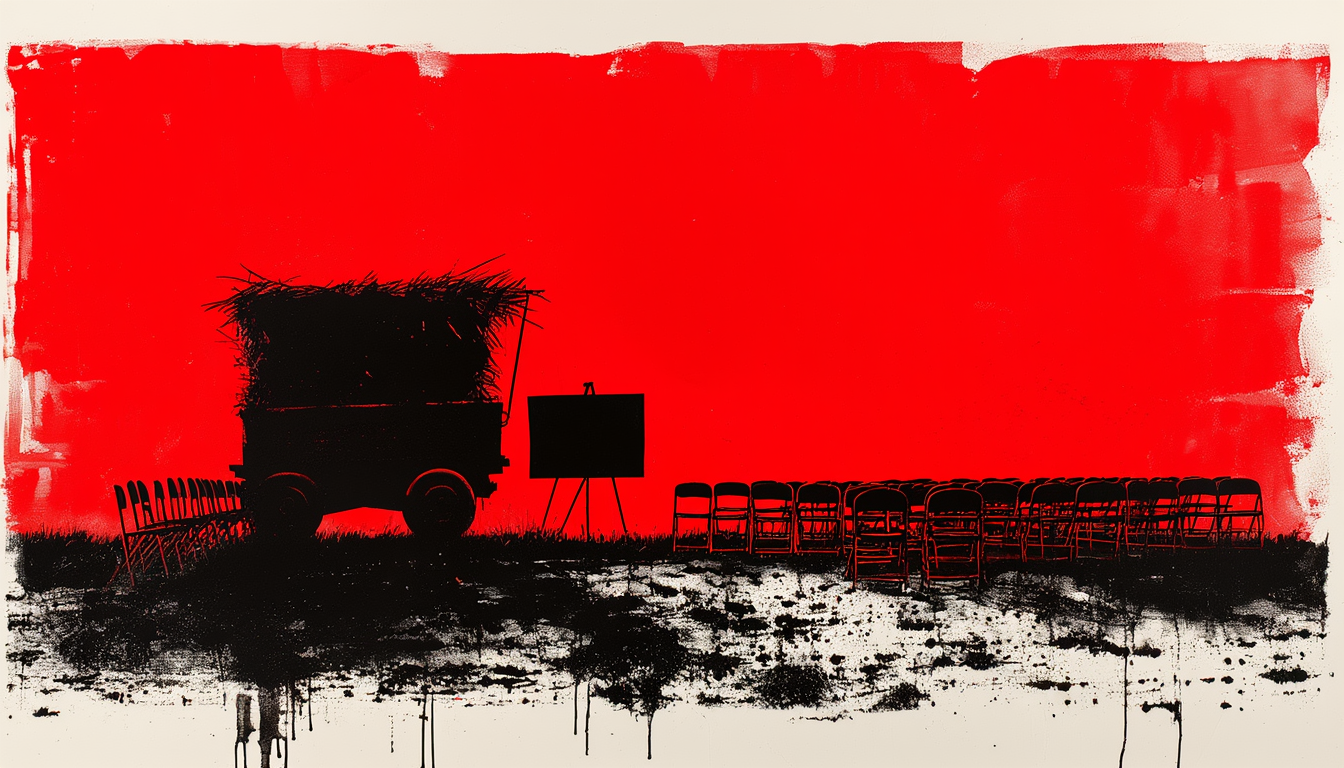
The Ruhlman ground sold in three parcels on a Tuesday in March, 214 acres, wind out of the northwest at fifteen and the ground still wet enough that you pulled a boot crossing it. Arlen Boedeker called the sale off a flatbed wagon. He has been calling farm auctions in Van Wert and Paulding counties for thirty-one years, and he had the plat up on an easel with the parcel lines drawn in grease pencil.
"The third generation sells the ground," he said, while the ring men were still getting set.
He said it the way a man says a delivery date. He knew both surviving Ruhlmans by name and had sold their father's line of equipment in 2019.
This one is a wrong arrow, and the observation behind it is very good.
What would have to be true
For the rule to carry the weight the ring puts on it, the third generation would have to be the cause of something.
The pattern it describes is real and it is not local to Ohio. The Lancashire version was in print by 1842, when William Cooke Taylor recorded "There is but one generation in Lancashire between clog and clog" as an established saying in the manufacturing districts. By February 1868 the Preston Chronicle had it in the form people still use, "There are only three generations from clogs to clogs," and called it a saying prevalent in East Lancashire.1 The American version swapped the clogs for shirtsleeves and kept the count.2 Cotton spinners and grain farmers arrived at the same number without consulting each other.
That is the strongest form of the argument, and it is stronger than it usually gets credited for. A pattern that reproduces at the same interval across unrelated trades and unrelated countries is the kind of thing that normally has something driving it. Saying that nothing is driving it is itself a claim, and it needs a mechanism of its own. The long-wave economic literature takes the regularity seriously for exactly this reason, and so do the readings further out, the ones that treat the interval as maintained rather than merely observed.
So the count needs explaining. It does have an explanation, and the explanation is in the wrong tense.
What the rule is actually measuring
Here is the sentence.
The rule measures how long the people who were present when the ground was bought stay alive and keep making decisions about it.
Run the arithmetic on Boedeker's own case. The elder Ruhlman bought the home eighty in 1954 at thirty-one. His son was six that year, farmed the place until he was seventy-one, and died in 2020. The grandchildren are in their fifties, two of them, one in Indianapolis. The ground came up in 2036. That is eighty-two years from the purchase to the sale, and not one number in it is a property of the soil, the family, or the market. It is a purchase age, a childhood, and two life expectancies laid end to end.
The second thing the rule measures is partition. One man buys a quarter section. He has four children and they have nine between them. The quarter section does not divide. An operating farm is one indivisible, illiquid, heavily depreciating asset that requires a full-time operator, and every generation multiplies the claimants on it without multiplying the asset. Somebody in Indianapolis needs their share in money.
The third thing is the transmission channel. What the founder knew about that ground — which end of the field holds water in April, which tenant pays — moved by talking. Candia and colleagues modeled that channel directly, fitting a biexponential decay to how cultural products leave circulation, and separated a fast-decaying communicative memory sustained by people talking from a slow cultural memory sustained by records. Biographies, the longest-lived category they measured, hold in communicative memory for twenty to thirty years before the record takes over.3 They were measuring papers, patents, songs and athletes, not farm ground, and I would not stretch their numbers onto a family. What transfers is the shape: the spoken channel is the short one, and it empties on a timescale of decades.
I spent a long time believing the rule was about work. That the grandchildren were softer, that the third generation had not adjusted a claim or pulled a calf. I had that from my uncle and I carried it into nineteen years of adjusting, and it is wrong. The families I watched sell included several where the grandchildren farmed well. What they had in common was not character. It was four heirs and one combine.
Against what
The rule gets quoted with numbers attached: thirty percent of family businesses reach the second generation, ten to fifteen percent the third. Those figures should be scored, and when Stamm and Lubinski went looking for what they were scored against, they found a chain of citations pointing at each other rather than at a study. They describe the formula as "unduly presented as a universal law," trace it to circular referencing rather than original research, and argue the whole question has to be rebuilt inside firm demography, where a business dying gets compared against the base rate for businesses dying.4 Firms fail constantly and for reasons that have nothing to do with anybody's grandchildren. Until the comparison is made, the rule's accuracy is unmeasured.
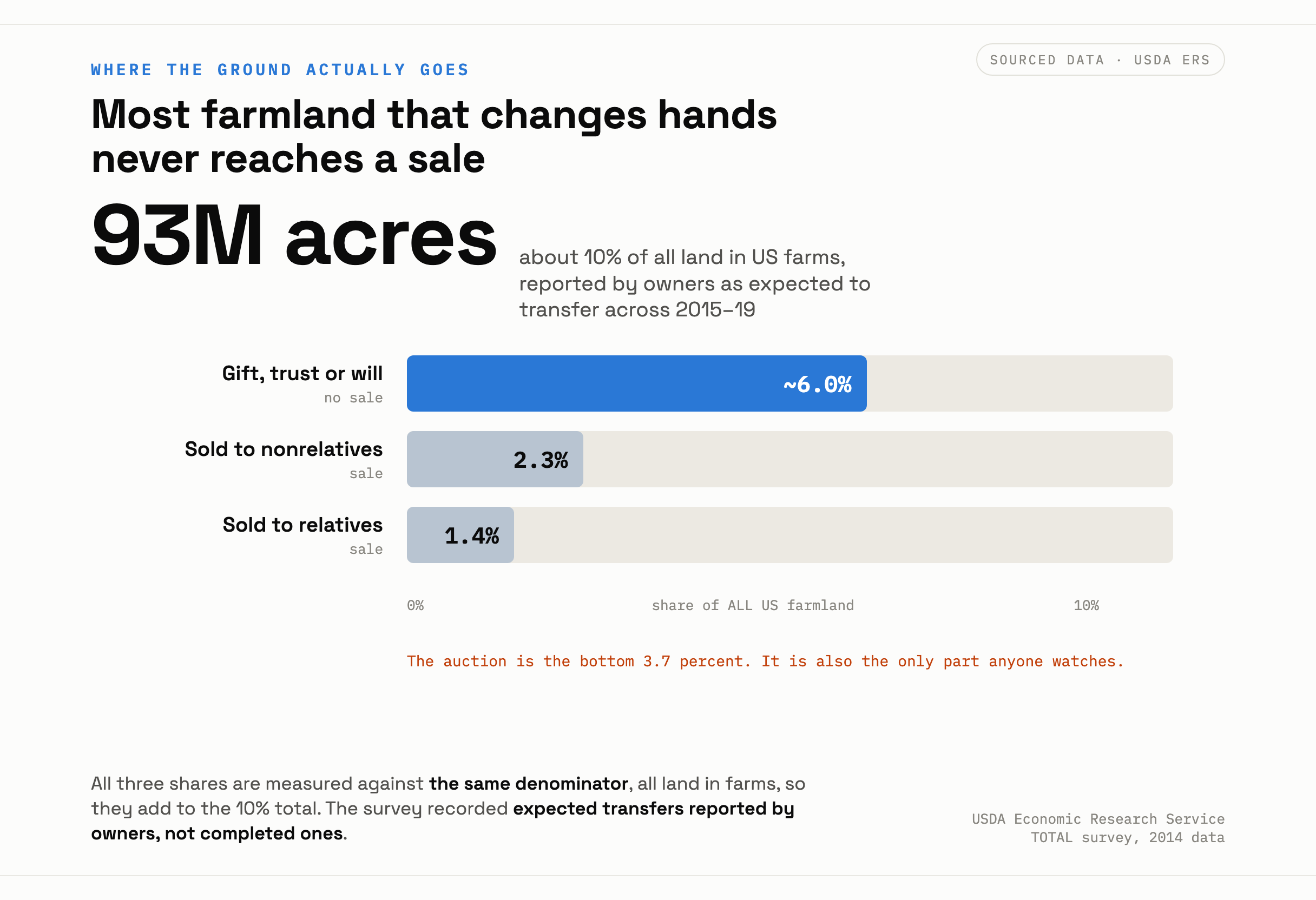
The outcome it names is also the minority one. The USDA's Tenure, Ownership and Transition of Agricultural Land survey put 93 million acres, about ten percent of all land in farms, in line to transfer over 2015 through 2019. Most of that acreage was expected to move by gift, trust or will — roughly six percent of all farmland — against about 2.3 percent sold to nonrelatives and 1.4 percent sold to relatives.5
Land changes hands mostly without a sale. What Boedeker sees is the fraction that reaches a wagon, and he sees all of it, because that fraction is his entire working life.
The same arrow, at national scale
The live version runs on eighty-five years instead of three generations.
Strauss and Howe published Generations in 1991 and The Fourth Turning in 1997, laying out a saeculum of roughly eighty-five years divided into four turnings of about twenty-one — a High, an Awakening, an Unraveling, and a Crisis — and dating the American sequence back to 1584.6 The scheme is in active use. It gets cited by investors and political strategists as a calendar, and the Crisis turning in particular gets treated as a due date.
It has been scored, and it does not do well. Peter Turchin, who works on historical cycles himself and has no reason to dismiss the idea of a cycle, wrote that the theory "forces the historical record to fit a postulated cycle by stretching in some places and cutting off a bit here and there."6 That is the specific failure of a period you have chosen rather than measured.
But the interval is not arbitrary, and this is the part worth having. Eighty-five years is the span over which the adults of the previous crisis stop being available. A person who was twenty in 1945 was one hundred in 2025. Set the clock at any national emergency and eighty-five years later there is nobody in a decision-making seat who was there, nobody at the table who watched a parent come back from it, and the record has to do the work the talking used to do.
Boedeker's ground and Howe's saeculum are the same measurement. Both are counting down the survival of a cohort, and both get read as counting up to an appointment. The figure is stable across trades and across centuries for the plainest possible reason: a human life is about that long, and two of them overlapping are about that long again.
Nobody keeps that interval. It is what is left after the people who were there are gone.
Editor's note. Category: wrong arrow. Filed to the Almanac desk. Arlen Boedeker, the Ruhlman family and the Van Wert County sale are composites, and the account of how the rule was collected is written as such; no dates or acreages in the opening should be read as a specific transaction. The Lancashire and American proverb citations, the collective-memory decay findings, the family-business survival critique, the USDA transfer figures, and the Strauss–Howe scheme and its criticism are real and sourced below. The Candia study measured cultural products, not family knowledge transfer, and is used here for the shape of the decay and not as a measurement of farms.