
You've seen the picture. Somebody posted it with three red circles and the word EXPLAIN. A Madonna, more than five hundred years old, and over her left shoulder, a dark disc in the sky with light coming off it. Beneath it, a man with his hand raised against the glare. Beside him, his dog, staring straight up.
You were told it was a UFO. Then you were told it wasn't, by someone who sounded bored.
Both of them skipped the interesting part. Let's lay the documents out.
The official story
The official story is that there is no story. Every one of these images has a perfectly good explanation, and every explanation is delivered by a different specialist, in a different journal, about a different object. A Florentine panel is a matter for Renaissance art historians. A Serbian fresco belongs to Byzantinists. A German book of omens belongs to the manuscript people. A comet in an embroidery belongs to the astronomers.
Divide the evidence by department, and no one department ever sees the pattern. Keep that in mind.
Exhibit one: Florence, nobody's painting
The panel is called the Madonna with Saint Giovannino. It hangs in the Palazzo Vecchio in Florence, part of a collection the American collector Charles Loeser left to the city in 1928.1 Locals call it the Madonna dell'UFO.
Now ask the first question. Who painted it?
Nobody can tell you. It has been given to Domenico Ghirlandaio, to Jacopo del Sellaio and to Sebastiano Mainardi.2 Five centuries, a museum label, a city full of art historians, and the authorship of the most-shared painting in the building is still an open file.
The sky holds a dark oval rimmed with light. Below it a man shades his eyes, and his dog looks up with its mouth open.3 Higher still sits a cluster of small golden shapes.
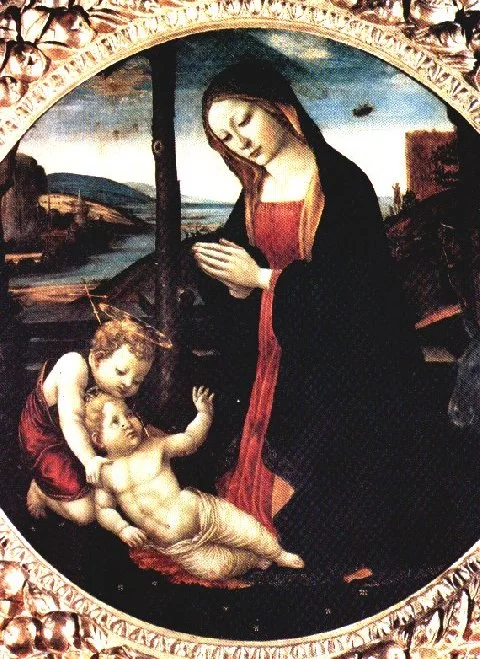
The explanation offered is that this is the annunciation to the shepherds, a stock scene in Nativity backgrounds: the man is a shepherd, and the glowing thing is a cloud of divine light. The dark disc, on this reading, is what is left after most of the original gold-leaf rays wore away from the rim.4
Hold that phrase: what is left. You are looking at the damaged remains of a painted light, and what's left is a hole in the sky.
Exhibit two: two faces at the cross
Go east, to Mtskheta in Georgia. Svetitskhoveli Cathedral takes its name from its relic and its legend: sveti, pillar; tskhoveli, life-giving.5 Tradition holds that a man named Elioz brought Christ's robe home from Jerusalem, that it was buried there, and that a pillar raised over the spot would not be moved by human hands until it moved itself, and began to give off a holy oil.6 The present building went up between 1010 and 1029.7
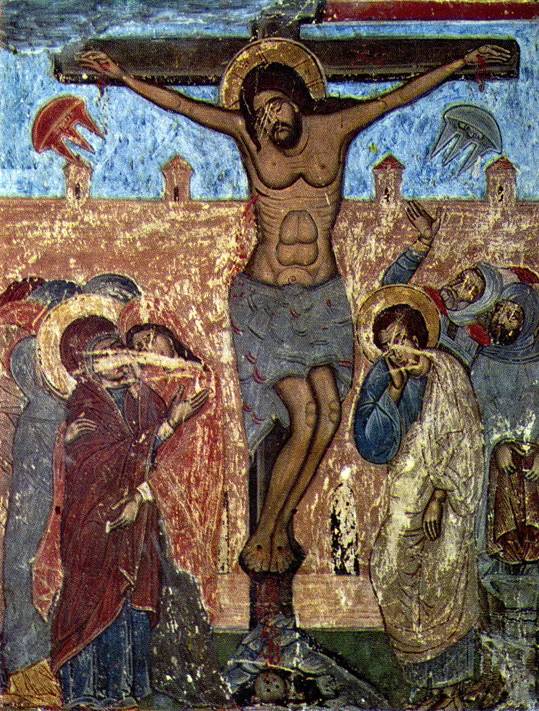
Inside is a crucifixion. Either side of the cross, two pale, rayed shapes float in the sky, each with a face looking out at you. It circulates online as proof that something was watching the crucifixion from above. When was it painted? Popular sources say the seventeenth century. Others say a thousand years ago. The record I can find doesn't settle it.8
Now go to Kosovo, to the monastery of Visoki Dečani, painted in the mid-1340s.9 Same scene. Same two shapes, teardrops trailing rays, a small human figure riding inside each one.
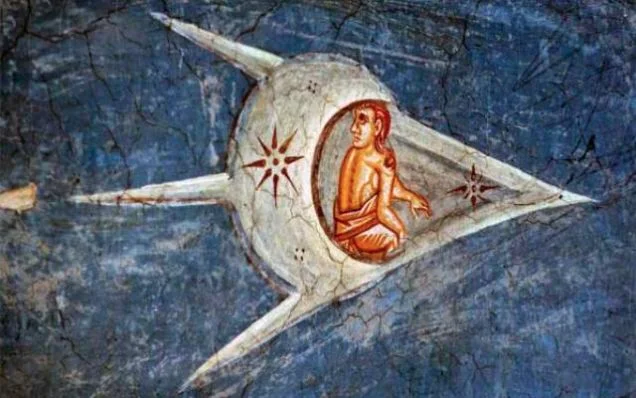
So you have the same objects, at the same point in the same story, on two walls more than a thousand miles apart. Nobody was copying anybody's photograph.
Here's the answer, and it comes from the documents. They are the sun and the moon. Byzantine and Orthodox crucifixions put them above the cross almost without exception, and they give them faces.10 The scholarly reading of the Dečani pair goes further. The figures are personifications, Hellenistic sky-gods folded into Christian art, and they illustrate the Gospel line that the sun was darkened at the sixth hour.11
Read that again. In the original telling, the sky itself showed up as a witness. The painters drew the witnesses.
Exhibit three: the comet that came down
Augsburg, around 1552. Someone assembles a book of signs: floods, monsters, rains of blood, armies in the clouds. It drops out of sight for centuries, surfaces in 2005, and is published in facsimile in 2013. It is now known as the Augsburg Book of Miracles.12
Turn to the entry for 1007. A comet, painted in fire. The caption reads, in translation: In the year A.D. 1007, a wondrous comet appeared. It gave off fire and flames in all directions. As it fell to earth it was seen in Germany and Italy.13
Fell to earth. That's not a modern gloss. It's what the page says.
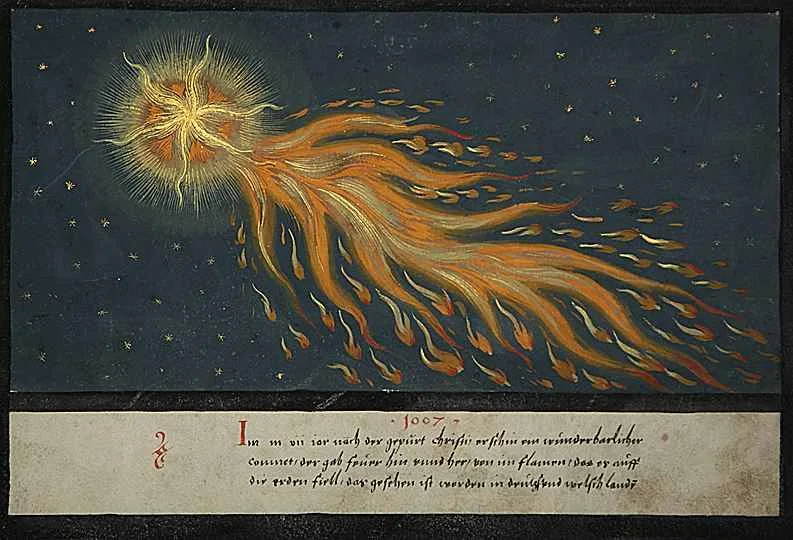
The record also says this: the book was made more than five hundred years after the year it describes. It is a sixteenth-century compiler retelling an eleventh-century sky. It is a copy of a memory, and it was still worth an entire painted page.
Exhibit four: London, right now
The last document is the most famous, and it is on show in London as you read this.
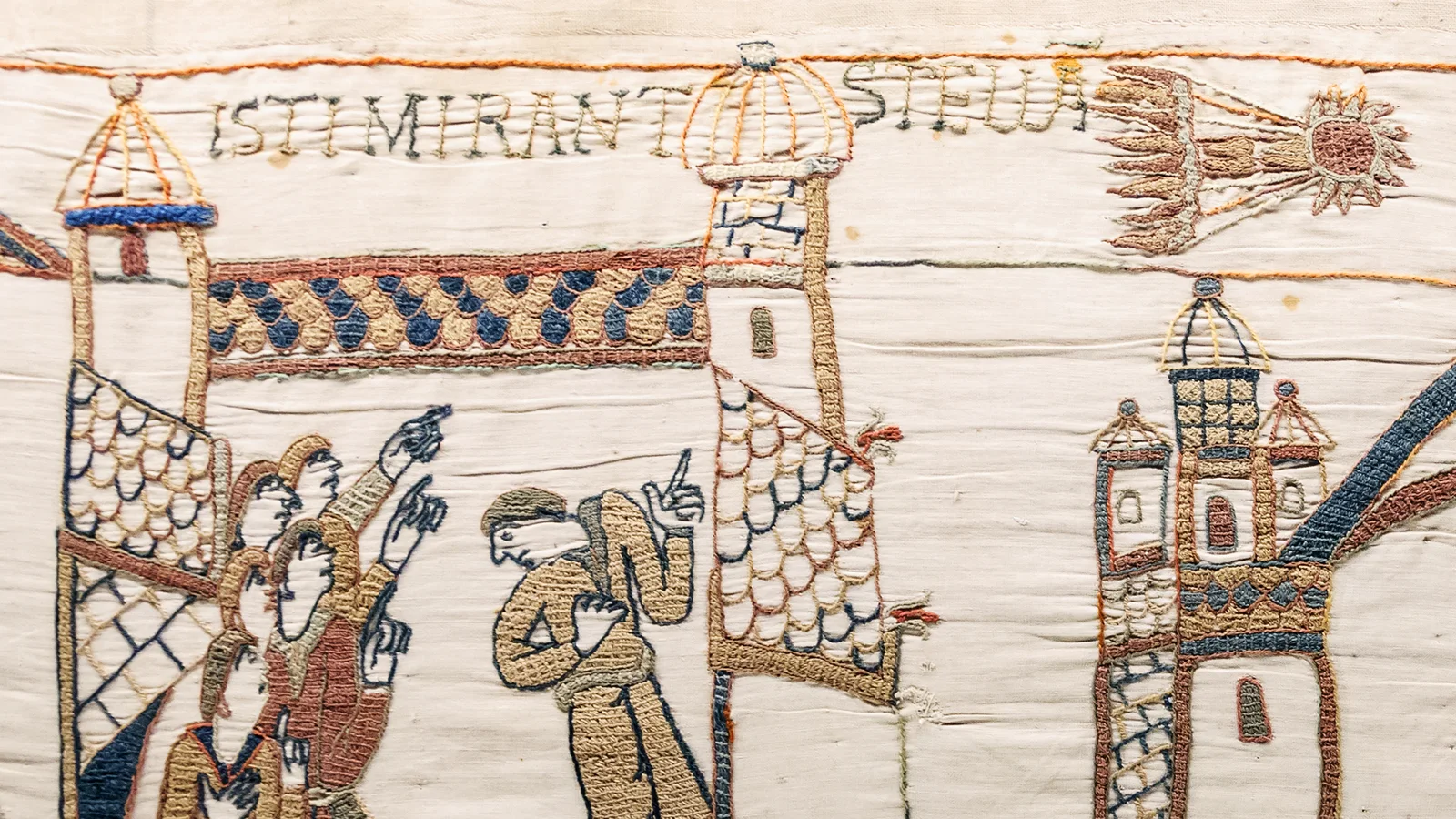
In the Bayeux Tapestry, a cluster of men stand with their arms up, pointing. Above them, a star with a flaming tail. The Latin caption: Isti mirant stella, "These men wonder at the star." It is Halley's comet, which crossed the sky in the spring of 1066.14 By October, England had a new king.
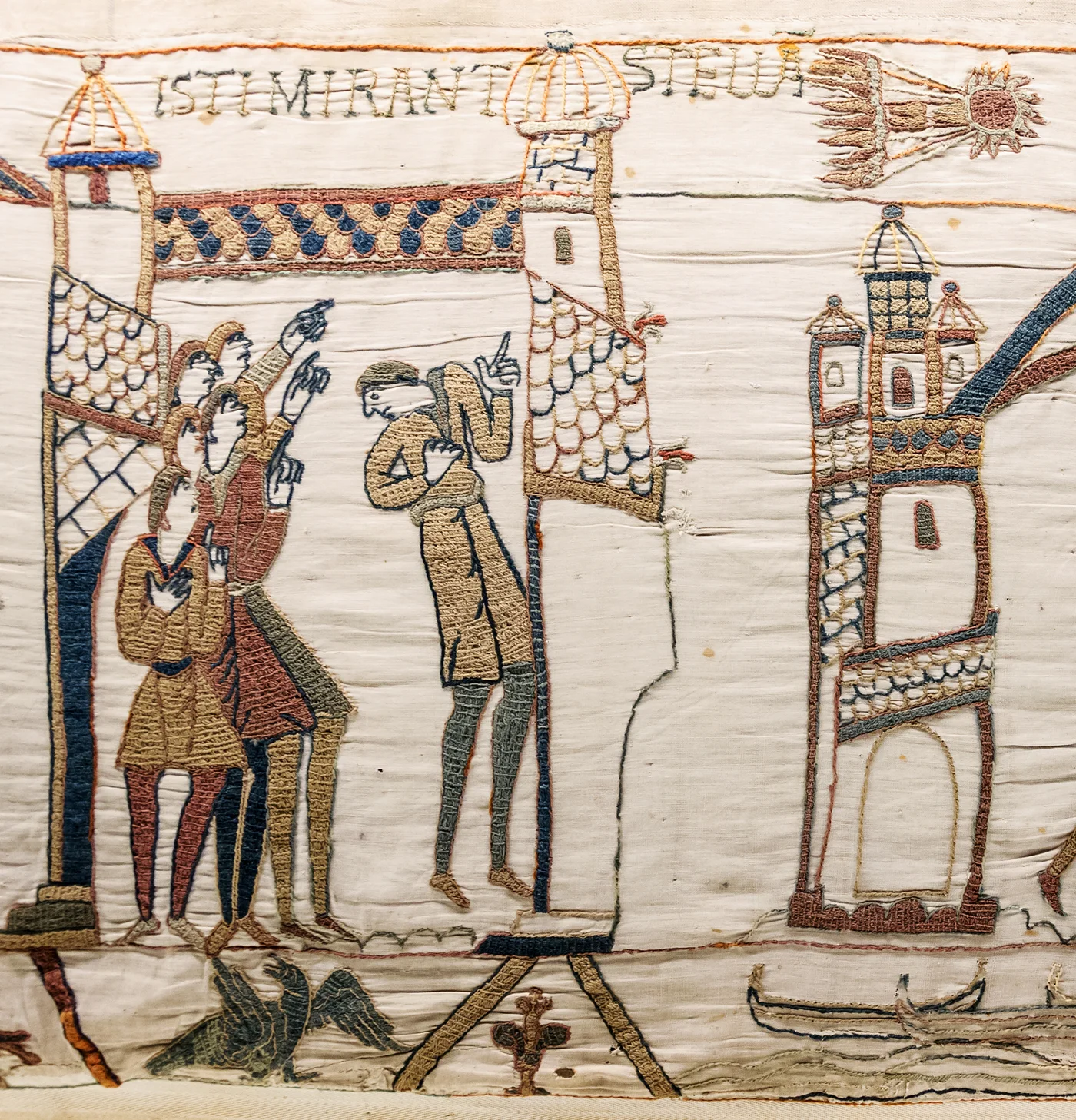
The tapestry has left France and hangs at the British Museum from 10 September 2026 to 11 July 2027.15 Go and stand in front of the men pointing. Then notice that you're doing what they did.
What the record shows
Put the four exhibits on one table.
A dark disc and a man shielding his eyes. Two faces in the sky at the moment of a death. A comet falling on Germany. A comet over a doomed kingdom. Florence, Mtskheta, Dečani, Augsburg, Bayeux. Roughly a thousand years, and every one of them, without exception, explained.
That's the part nobody puts in the caption. The debunkers are right. Every object has a documented identity: a worn-away cloud of glory, the sun and moon as witnesses, a remembered comet, a real one. There's no spacecraft in the record.
But look at what the explanations have in common. In every case, the artist put something in the sky because the sky was testifying. It shone on the shepherds. It went dark for the crucifixion. It sent comets before the year turned bad. For a thousand years, Europeans and their neighbours treated the sky as a witness that could be called, and they painted its testimony with the same care they gave the saints.
The record doesn't say when we stopped reading it that way. The timing of the UFO captions suggests the misreading only had to wait until nobody remembered what the sky had been called to say.16
So the pattern is real. It just isn't the one in the red circles. The same thing was painted overhead for a thousand years, and it was the sky, keeping a record.
Here's the question to pull on. What are we putting over our heads now, and who, five hundred years from here, will be left holding the picture with no caption?