
Write the week down as a list and it looks like a siege.
Thursday into Friday, Microsoft 365 goes dark. In Germany a hotel pool fills with too much chlorine and nobody is told. By Saturday Japan has switched off its flagship supercomputer. La Poste admits that 22 million names and addresses are gone. Monday, America's biggest banks stumble together, and one piece of website code quietly skims cards on 178 organisations' sites. Tuesday, Norway's energy giant reports an attack still in progress, and a flaw in Java puts Jira and Jenkins servers everywhere in reach.
Then the line everyone adds at the end: no authority or company has linked any of it. Coincidence?
You've been told it's a coincidence. You've been told it's a war. Let's do neither. Let's open each file.
The official story
There is one now, and it arrived fast.
On Tuesday 17 November, the US Director of National Intelligence, Jay Clayton, went on CNBC. "This is not a cyberattack, and this is not a coordinated effort by a nation state," he said. "We've looked very closely." His explanation was that many organisations are patching old systems: "it is time for an upgrade across our digital infrastructure."1 The next day, in the Philippines, Secretary of State Marco Rubio went further. There was "zero evidence whatsoever," he said, that any of the incidents were related, and they were "completely unrelated one from another."2
The Homeland Security secretary, Markwayne Mullin, offered a different theory on Fox News. He blamed artificial intelligence ("super intelligence," in the administration's phrase), citing a conversation with an unnamed person in the tech industry.1
That's three senior officials and two explanations, and none of them showed a document.
The American list was also longer than the one going round online: an air traffic shutdown, an airline, Apple, Marriott and the NSA's own network, all in the same five days. Exhibit six opens those files. Some Americans were stockpiling canned food and water, and a Republican congressman, Mike Lawler, demanded the administration brief Congress.3
"We've looked very closely" is a conclusion without the file. So let's open the files the government didn't. Each incident was announced on its own page, in its own language, by its own spokesperson, with its own explanation. Lay those explanations side by side and the week starts to look different.
Exhibit one: the email that didn't arrive
The outage didn't start on Friday the 13th. Microsoft's own service history puts the start of incident EX1550543 at 16:20 UTC on Thursday 12 November, and its preliminary post-incident report says it lasted 23 hours and 50 minutes, with Exchange Online hit hardest. The report names "a latent Windows defect" in a change to its gateway servers, made worse by a surge of traffic after a Teams failover. "The cause was not a cyberattack."4
At the Hotel Ling Bao in Phantasialand, in Brühl, a dosing system was putting too much chlorine into the pool. The fire service's report counted fifteen guests hurt, fourteen lightly and one moderately, and four were taken to hospital. First findings pointed to a technical defect.5 Then the park explained why nobody caught it in time. Its warning system reported abnormal readings by email, and only by email, and during the outage the emails didn't arrive.6

Hold on to that detail, because it's the key to the whole week. Nobody attacked the pool. A safety alarm had been routed through an office email service, and when the email service fell over, the alarm fell over with it.
The same outage reached into another file in this week's list. Optimizely, the company at the centre of Monday's skimmer, posted on its own status page on 12 November that because of the Microsoft 365 outage, support requests emailed to it "may be delayed or may not be delivered."7 That's the only documented thread between two of these events that we found. It's a support inbox, not a backdoor.
Exhibit two: the front door was a status page
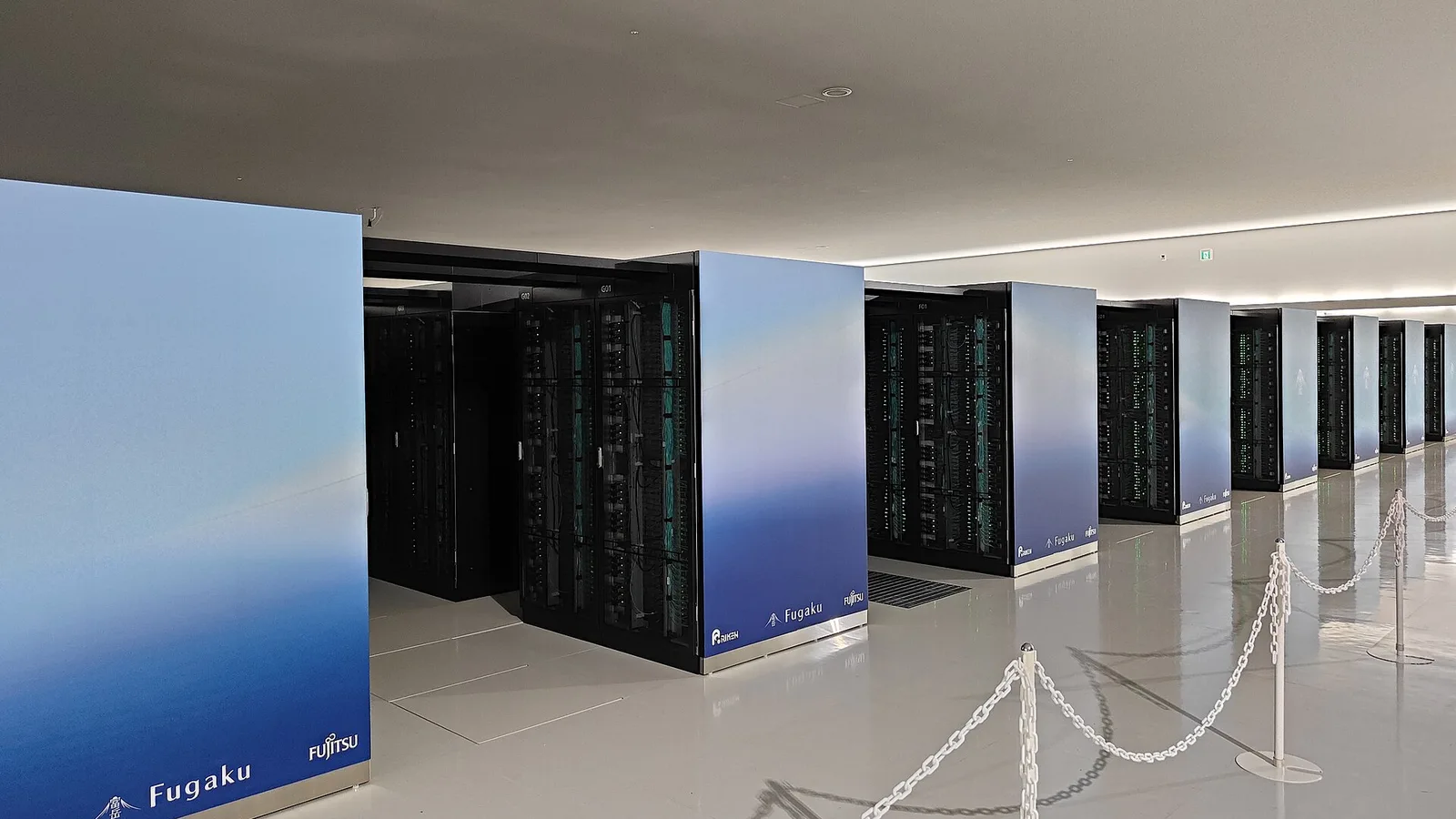
RIKEN's own notice is the document to read here. It says an outside party first got into Fugaku's operations systems on 12 November, with intrusions traced across 10 to 13 November. RIKEN confirmed it at 16:33 on the 13th and halted the machine at 04:30 on the 14th. The way in, RIKEN says, was a webpage on the public internet that showed Fugaku's operating status. And one line in the notice is easy to skip: the maintenance of that operations system was contracted out to an outside company.8
What was exposed matters more than how. Up to 4,222 Fugaku users and 375 users of a second system, RIKYU, 4,597 in all: names, email addresses, user IDs, some research files, and the SSH private keys and access keys that users had stored on Fugaku for logging in to computers elsewhere. RIKEN says the intruder tried some of those keys on other systems. On the 15th it switched off every Fugaku user's login key.8
So one machine held the keys to others. Get into the status page and you're one step from someone else's supercomputer.
Exhibit three: a September breach, a November week
La Poste's figure is real: names, first names and postal addresses of 22 million people, taken from its subsidiary Maileva, which sends post on behalf of other organisations. No bank details, passwords or social security numbers, La Poste says. The CNIL, France's data regulator, has been notified, a complaint has been filed, and Paris prosecutors have opened an investigation.9
But look at the dates, because this is the appendix nobody reads. The attack was in mid-September. Breach-watchers Cyberattaque.org and FrenchBreaches flagged it publicly on 24 September. Some of Maileva's clients were telling their own customers in October and early November: a housing office in Quimper on 9 October, the Hôpital Foch on 6 November. La Poste's own public statement came on the weekend of 14 to 15 November, after the story had reached the press.10 It's in this week's list because of when it was admitted, not when it happened.
And most of the 22 million never dealt with Maileva at all. Their addresses were there because someone who wrote to them used it.11
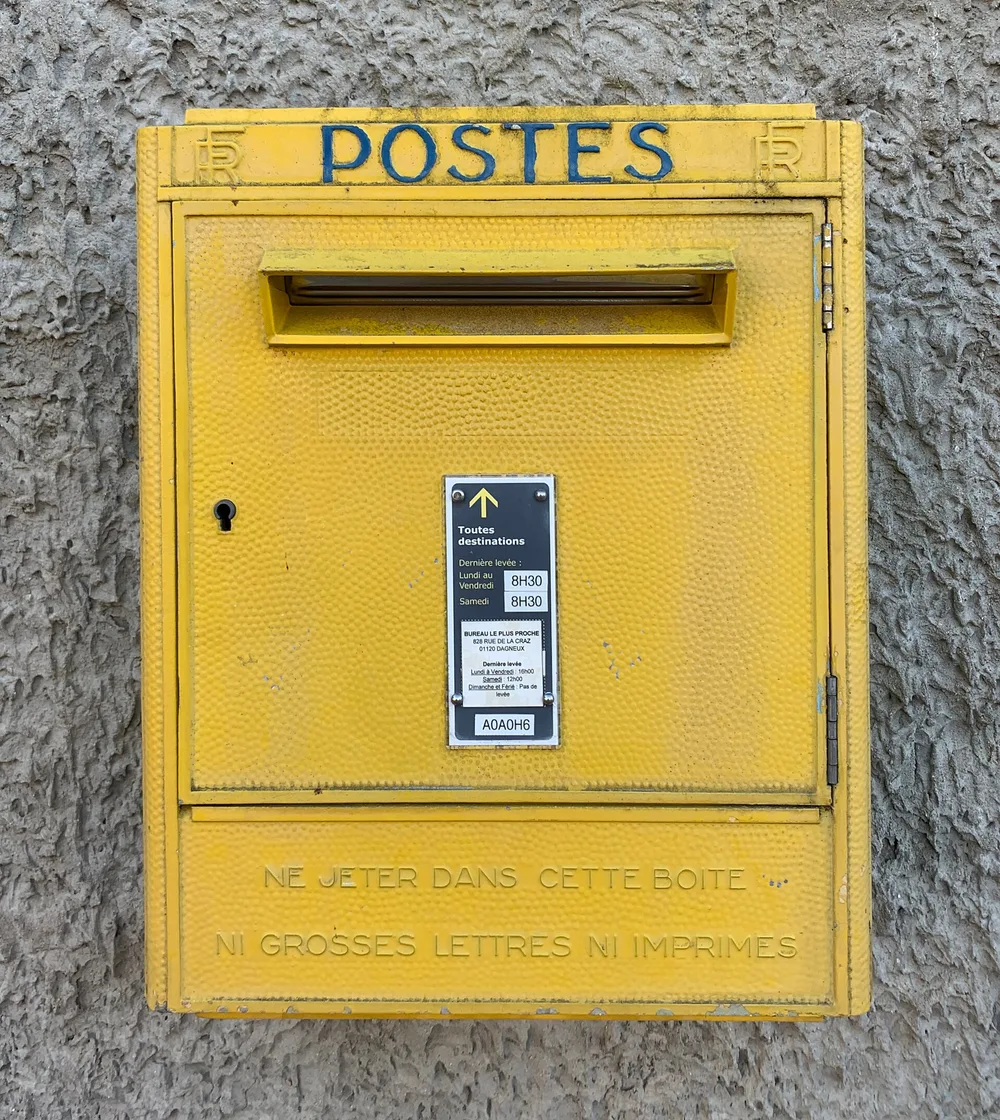
Exhibit four: Monday's two failures
On Monday 16 November, outage trackers lit up for Chase, Wells Fargo, Bank of America, US Bank and Zelle. JPMorgan Chase called it a "temporary issue related to a software bug in on-premise hardware systems," adding: "There is no evidence it is cyber-related." The other banks, it said, were slowed "only to the extent that they were a party to a transaction with us."12 That's how one bank's fault shows up on everyone else's tracker. The FBI said the next day that the outage traced back to a software release, not malicious activity.13
The same day, something that really was an attack. Optimizely, whose website-testing code runs on thousands of company sites, said it had "identified and contained a security incident affecting some Optimizely Web Experimentation customers." Its status page later explained that an unauthorised party exploited "a flaw in the Optimizely Web Experimentation account signup flow" to impersonate users and insert malicious JavaScript into customers' projects. Optimizely says it closed the hole "within three hours of detection," and that fewer than 5% of its customers were hit.14 Researchers at Report URI found it on the sites of 178 organisations, 32 of them in finance or banking. For most of a day, by researchers' counts, the code swapped crypto wallet addresses, ran a card skimmer, and tried to push exploit kits to iPhones. The attacker's wallets took in only about $7,000. One more detail from the reporting: researchers had first seen the same code on Turkish websites in September.15
Nobody broke into 178 websites. One supplier was broken into, and 178 sites ran its code on every page load.
Exhibit five: Tuesday's attack and Tuesday's bug
On the evening of 17 November Equinor said it had detected an attack on certain IT systems. By the next morning it was still working to neutralise it. "Production remains unaffected," it said. "There are no indications that data has been stolen." It is working "in dialogue with national security authorities," and it has named no attacker.16

The same day, the OpenJDK project published a routine vulnerability advisory listing ten fixed flaws. The first, CVE-2026-114938, rated 8.1 out of 10, has a nickname: Java4Shell.17 The researchers behind it describe a memory-corruption flaw in Java's Base64 decoder that they say can allow code execution without a login on default installs of Jira, Jenkins, Confluence, Keycloak and more. As of the 17th, nobody had publicly confirmed it being used in the wild.18 By coincidence of the calendar, Atlassian's regular monthly security bulletin landed the same day, listing dozens of high-severity flaws across Jira and its other products, most of them in third-party components. That bulletin doesn't mention Java4Shell.19
That bug wasn't born on Tuesday. The researchers trace it to Java versions going back to 17.0.6.18 Tuesday is just when the world found out.
And the North Korea thread? A campaign researchers call PolinRider, tied to North Korea, has been rewriting GitHub history with force-pushes and back-dated commits for most of the year. One tracker counts more than 4,000 repositories touched.20 We found no reporting of a distinct new wave this week. It's on the list because it never stopped.
Exhibit six: the American list
The list going round online was mostly European and Asian. The American one ran alongside it.
Friday 13 November: the sky. At about 3:30 p.m. Eastern, the FAA ordered a nationwide ground stop. By the agency's own account, its legacy equipment became unstable when data began flooding its telecoms network "at a rate of 1,000 connection attempts every 4 to 5 seconds." The instability spread to 17 of its 22 en-route control centres. About 3,500 aircraft already in the air landed safely, flights resumed at 8:15 p.m., and operators cancelled some 12,462 flights that day.21
Where did the flood come from? The FAA points to two sites: a radar site in Amarillo, Texas, and a radio site in El Dorado, Arkansas, where its network contractor, L3Harris, had been installing a new router. The fix was to switch off one function on the routers at fault and on more than 60 others of the same Juniper make, and to pause installing them. The FAA says it has "no indication that this was a cyberattack or an outside nefarious actor."21
Now read two of the FAA's answers side by side. Asked whether its upgrades caused this, it says: "No, this is due to the legacy TDM system causing instabilities." Asked why router work was being done in the middle of the day, it calls it "a routine replacement at a remote facility." Transportation Secretary Sean Duffy said the contractor was swapping copper wire for fiber, and that investigators were still working out whether it was "user error, installator error from L3Harris, or did they install a faulty router?"22 A new part went in and the old system fell over. Whether the upgrade "caused" it depends on which half of that sentence you're defending.
Monday 16 November: the gates. United Airlines had what it called a "widespread system outage" that delayed departures. The pilots' union told members it was "affecting multiple pilot facing applications" and that United couldn't give outbound flights their final weights. United said it had "resolved a technology issue that delayed flight departures," and a spokesperson said there was no indication of a cyberattack. It hasn't said what the issue was.23
Tuesday 17 November: the phones, the hotels and the spies. Apple's status page showed outages across the App Store, Apple Music, iCloud Mail and more. A spokesperson said "an internal update caused some outages." Marriott said it had "resolved a technical issue that affected sign-in capabilities," and that its review "found no indication that the disruption was cybersecurity-related." Gmail users reported trouble too, but Google said it wasn't seeing evidence of a broad Gmail outage.24 And CNN, citing six sources, reported that NSANet, the network the National Security Agency uses to share highly classified information internally, was down. The NSA's statement: "temporary degradation during scheduled routine maintenance."25
Tally the American explanations: a contractor's router, an internal update, a technical issue, routine maintenance, and from United, a technology issue it hasn't described. Four of the five describe a change made to their own systems, not something done to them. That's what the DNI meant by "patching." It's also an inference worth stating plainly: on the record so far, the week's biggest danger wasn't an enemy. It was the upgrades.
Exhibit seven: our own count
The last line of the list was a number: an unusual day for hospitals on ransomware leak sites. We pulled the data ourselves from ransomware.live, which logs the victims that gangs post, on 18 November.26
From 1 October to 16 November, healthcare victims posted per day averaged about 4.3. Then came 18 on 10 November, 19 on 16 November, and 19 on 17 November. The 19 on the 17th were posted by nine different groups, and fifteen of them were in the United States. On the 16th, thirteen of the nineteen came from a single group.26
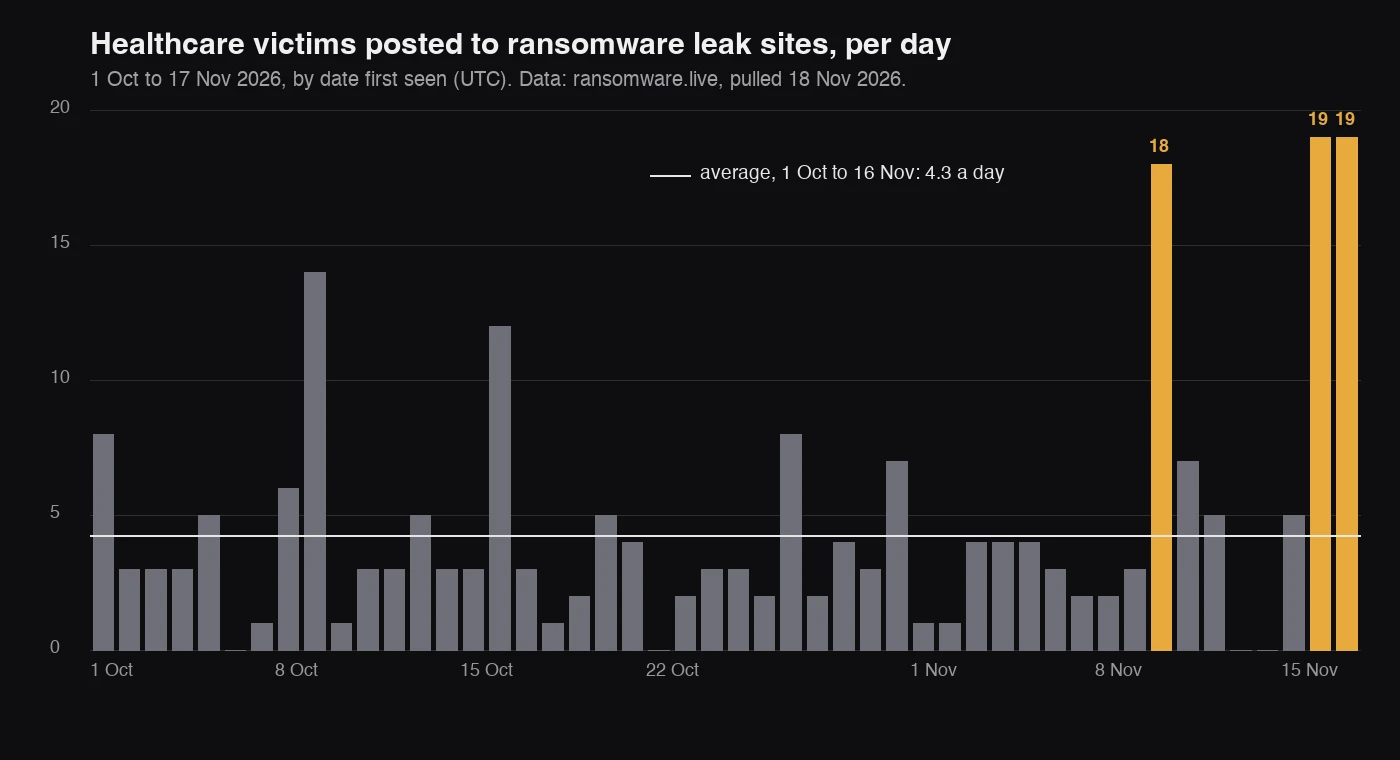
That's a real spike, and the record doesn't explain it. Two things keep it honest. First, a leak-site post isn't an attack date. Gangs usually post a victim after negotiations fail, often weeks after the break-in. Second, the counts move. Sites get backfilled, and an earlier count of the same Tuesday gave 17 victims from 8 groups. Ours is the number on the day we pulled it.
The pattern, plainly
Here's what you have when you lay out the documents.
Two failures their owners say were bugs, not attacks. Five more in America that their owners put down to routers, updates and maintenance. One breach from September, confirmed this week. One flaw years old, disclosed this week. One campaign that's run all year. And three attacks that really did happen this week, at Fugaku, Optimizely and Equinor, with no attacker named and no stated link between them.
The government says "unrelated" and hasn't shown its files. The files we could open mostly agree with it, and that's worth saying plainly on a page like this one. The record doesn't show a hand behind the week. What it shows is a shape, and that's inference, not proof. Again and again, one thing many others depended on gave way:
- a pool's safety alarm that only spoke through office email
- 178 websites running one supplier's code on every page
- researchers' keys to other machines stored on one supercomputer, whose operations system was maintained by an outside contractor
- the addresses of 22 million people sitting with one subcontractor most of them had never heard of
- Jira, Jenkins and Keycloak all resting on the same runtime
- a national air traffic network that wobbled when one new router at a remote site started flooding it
You don't need a conspiracy to break all of that in one week. You need ordinary failures landing on single points that everything else leans on, and a news cycle that announces them together.
So here's the question to pull on. Forget who did all this. Ask what in your own week runs through one door you've never seen, and what happens to you on the day it doesn't open.