

You've probably seen the clip. A former CIA officer leans into the microphone and tells you the secret about secrets: spies hardly ever steal them. They don't crack safes. They find the person who already has the key, work out where that person feels small, and make them feel big. The secrets come later, handed over willingly.
It sounds like a podcast line. It isn't. It's in writing, in the agency's own journal, and anyone can download it.
The official story
You were told that espionage is theft. Break-ins, bugged phones, stolen files.
Here's how the CIA's own journal opens the subject. Ask a clandestine officer what the mission is, the author writes, and the likely answer is "to recruit spies to steal secrets and conduct covert action."1 Look at the order of the verbs. Recruit comes first. The officer doesn't steal anything. Someone else does, and that someone has to be talked into it.
The article is called "An Alternative Framework for Agent Recruitment: From MICE to RASCLS." It ran in Studies in Intelligence, Volume 57, Number 1, in March 2013. Its author, Randy Burkett, was then the CIA's representative on the faculty of the US Naval Postgraduate School.1 It carries the usual line that the views are the author's, not the government's.2 It's also public, and nobody outside the trade seems to read it.
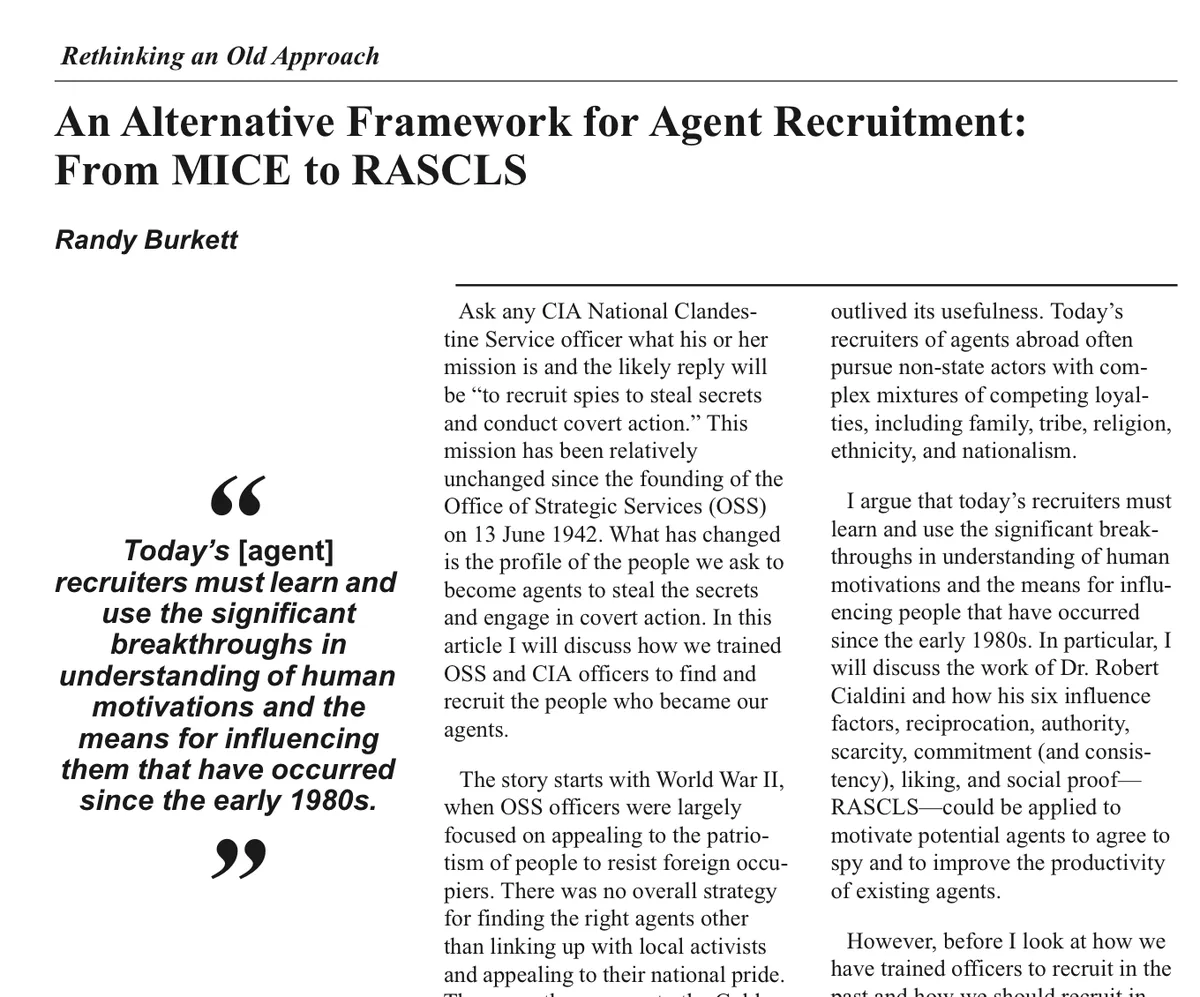
Exhibit one: the four old reasons
For decades the trade explained why people spy with four letters: MICE. Money, Ideology, Coercion or Compromise, Ego.1
Burkett's section on the E is the one to read slowly. Excitement, he says, barely lasts. What keeps an agent producing is "reinforcement of an agent's self-confidence, or ego." Then he lists the people a recruiter is trained to notice: the disgruntled diplomat, the military officer passed over for promotion, the intelligence officer sidelined for drinking, the police official moonlighting as a security guard to pay the bills. Under the old framework, he writes, these people "only need to have egos stroked."3
Burkett doesn't think that's enough. Money alone, he argues, doesn't explain why Aldrich Ames, the CIA officer convicted in 1994 of spying for Moscow, behaved the way he did. Treat a committed agent as hired help, he warns, and you'll lose them.4 What he wants instead is something warmer, and that's the part that should worry you.
Exhibit two: the manual for friendship
Burkett's answer is RASCLS, six principles taken from the psychologist Robert Cialdini's book Influence: reciprocation, authority, scarcity, commitment and consistency, liking, and social proof.1 Three of them do most of the work.
Reciprocation. One of the first lessons a case officer learns, Burkett writes, is "Always provide amenities." Always have food and drink at the meeting. People feel they have to repay what they're given, so the easiest way to start a relationship is "to fill some small need" the target has mentioned: help with a visa, say, or information they want.5
Commitment. Small agreements early can "grow into full recruitments." Get someone to hand over one harmless piece of non-public information, his example is the internal phone directory, and the next request is easier. People want to stay consistent with what they've already done.6
Liking. Here's the passage, word for word. "Flattery is highly recommended, for virtually everyone enjoys being praised." A warm relationship, Burkett goes on, gives the officer insight into the target's "areas of low self-esteem or feelings of being undervalued—key pieces of knowledge for a recruiter." The officer moves from associate to friend, then to sounding board and confidant. The goal is for the target to believe the officer is "perhaps the ONLY person, who truly understands him."7
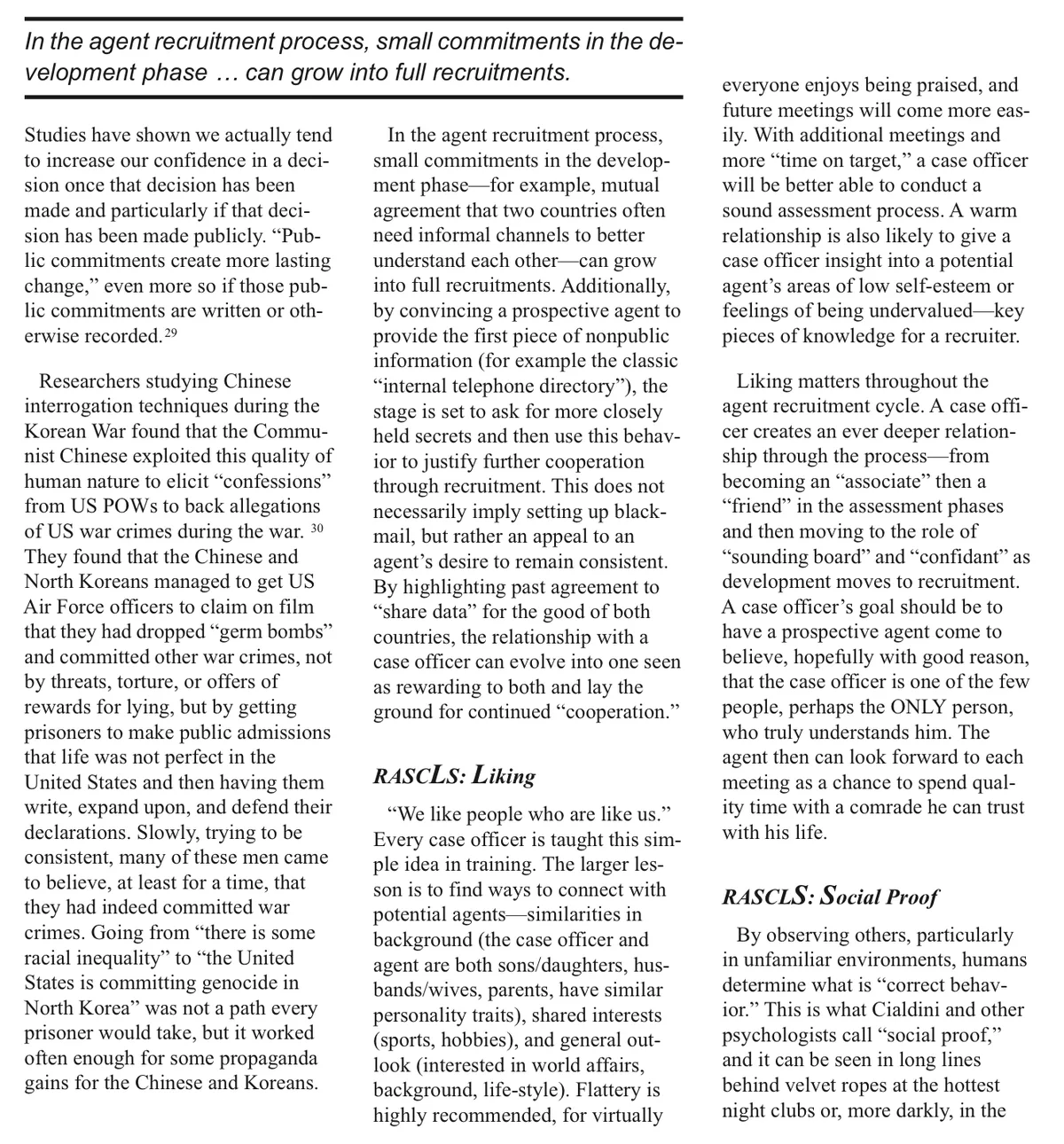
Read that list again without the word "agent." Bring a small gift. Do a small favour. Find what you have in common. Praise them. Listen until you know what hurts. Become the person they can talk to.
That's also how a lot of real friendships start. The steps are the same. The difference is what the friendship is for.
Exhibit three: a hundred and twenty dollars for an essay
Now a case where the steps can be checked against a court record.
Glenn Duffie Shriver was an American student who spent a junior year at East China Normal University in Shanghai. In about 2004 he answered an advert to write a paper on US–China relations over Taiwan and North Korea. A woman calling herself "Amanda" praised the paper and paid him $120.8
That's reciprocation and liking on the first day. The commitment grew from there. Over the next three years, by the published account, his handlers paid him $10,000 and then $20,000 while he took the US Foreign Service exam, and $40,000 when he applied to the CIA's clandestine service. They told him they wanted classified material. He was stopped before he got any. In October 2010 he pleaded guilty to conspiring to pass national defence information, and in January 2011 he was sentenced to four years.8

Shriver said afterwards he had been motivated by greed.8 The record doesn't argue with that. But it didn't start with $70,000. It started with a stranger telling a young man that his essay was good. The FBI thought the pattern was clear enough to turn into a short film, Game of Pawns, and asked students heading abroad to watch it.9
Exhibit four: the message in your inbox
Once this needed a café in Shanghai. Now it needs a profile.
In 2017 Kevin Mallory, a former CIA case officer, was more than $230,000 in debt when he got a LinkedIn message from a man presenting himself as a think-tank recruiter looking for a foreign-policy expert. The FBI says the man was a Chinese intelligence officer. Mallory made two trips to Shanghai, was paid $25,000, and in June 2018 a federal jury convicted him under the Espionage Act. He was sentenced to twenty years.10
In 2021 Britain's security services launched a campaign called "Think Before You Link," warning that they had seen around 10,000 approaches from hostile states on professional networking sites.11 In October 2023, at a Five Eyes summit at Stanford University, MI5's director general Ken McCallum put the UK figure above 20,000 people approached online by suspected Chinese agents, some through LinkedIn.12
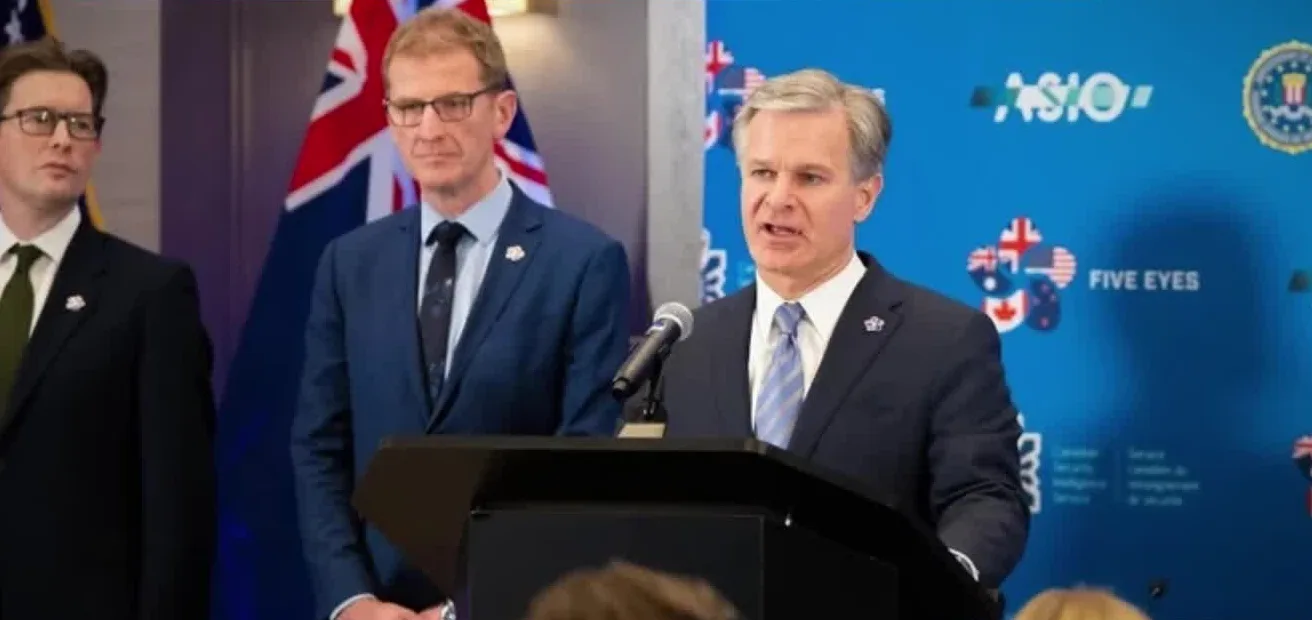
That's the first step of Burkett's cycle, spotting, done at scale. A recruiter can scroll for the passed-over officer and the moonlighting official, because people post their job histories, frustrations and ambitions publicly.
The pattern, plainly
Here's what you have when you lay out the documents.
An intelligence journal that tells its readers, in print, to use praise and favours to find where a target feels undervalued. A student who got $120 and a compliment before he got $70,000. A retired officer in debt who answered a recruiter's message. A security service counting the approaches in the tens of thousands.
None of this is secret. The method was published. What makes it work is that it looks exactly like kindness. The first step is a meal, a favour, a compliment.
Most of the people who make you feel understood mean it. That's why this works on the few who don't.
So here's the question to pull on. Think of the person who knows exactly where you feel undervalued at work. How did they find out, and what have they asked you for since?