
On Sunday 8 November 2026, at 12:47 p.m., about 250 people put their hands on a 110-ton mirror in Millennium Park and pushed.
An anonymous flyer had asked them to. "There is a man trapped inside the bean," it said. "New research shows that there might be latch door under the right side of The Bean. If we move The Bean about seven inches to the left we might be able to access that door and give the man inside The Bean a pickle and other resources."1
The Bean didn't move. You knew that. But you've also seen the clips, and some part of you wondered why this joke won't die. It's been going for more than a year. Let's do what nobody at the push did, and look at what's actually on file about the inside of the Bean.
The official story
The official story is one sentence, and it came from a city alderman's office that was being flooded with phone calls.
"I am happy to confirm that a man has not been trapped inside 'Cloud Gate' (a.k.a 'the Bean') for the past 21 years," Alderman Brendan Reilly wrote in August 2025. He said he enjoys "lighthearted parody as much as the next guy," but the calls were distracting his office from real work.2
He's right. There is no man in the Bean. The group that started this, calling itself the Man in Bean Coalition, has never put a name to itself, and when Block Club Chicago emailed, it declined to answer most questions.2 Its origin story for the man is a joke that accuses a living artist of a crime, so we won't repeat it here.
But notice the shape of the denial: "not trapped inside... for the past 21 years." Nobody was asked about the two years before that. So let's start there.
Exhibit one: there really were people inside
Cloud Gate wasn't poured or cast. It was built from the inside out.
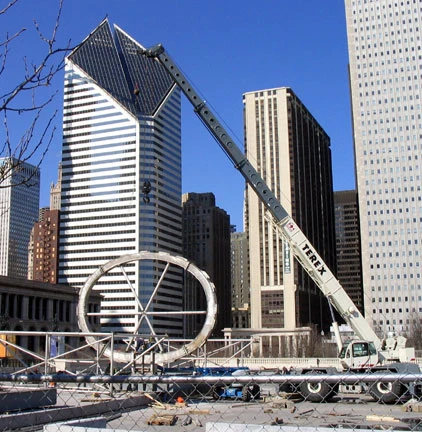
In February 2004, the first pieces went up in Millennium Park: two huge stainless steel rings, one at each end. Crisscrossing pipe trusses were assembled between them.3 A photo from March 2004 shows one of those rings standing on its edge in a fenced-off construction site, with a crane beside it.
Then the shell. From June 2004, crews hung 168 stainless steel plates, each 3/8 of an inch thick and weighing 1,000 to 2,000 pounds, onto that frame. They started with the omphalos, the dimple in the underside, and worked outward from the inside. And to do it, the city put up a large tent around the whole thing "to shield it from public view."3
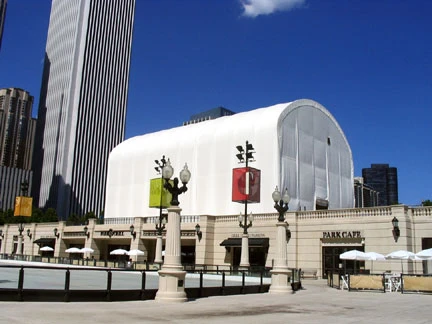
It came out for the park's opening in July 2004, unfinished. Then it went back in. "The shiny 110-ton stainless steel sculpture 'Cloud Gate' disappears from public view in Chicago's Millennium Park next month and won't emerge until Spring," UPI reported in December 2004. A heated tent went up in January 2005, so crews could spend months smoothing and polishing the seams.4 A 24-person crew from Ironworkers Local 63 worked on six levels of scaffolding and on climbing ropes. The tent came down in August 2005. In October the omphalos was closed off for the last section.3
So for the best part of two years, the Bean was a structure people worked inside and under, hidden from the public by a tent. The coalition's joke has a real hiding place to point at. It just has the wrong decade.
Exhibit two: the frame nobody sees
What's in there now? The record gives you two answers.
The encyclopedia version says the trusses were only there for construction and that "the finished sculpture has no inner bracing."3 The engineers who did the structural analysis, Forell/Elsesser, describe it differently. Their project page says Performance Structures designed "the internal frame for staged construction and final installation." It describes "two large internal rings with plate springs mounted to the frame," with the triangular trusses added for stability during construction. The hard problem, they say, was building "flexible connections between the stainless steel shell and internal steel frame," so that the skin could expand and contract with Chicago's weather.5
Put the two together and the most likely answer is this: the scaffolding came out, but a steel frame stayed, two rings and their springs holding up a skin that's allowed to move. That's inference from the two sources, not something either one says outright. And here's the part that keeps the meme alive. There is no public drawing of the inside, no tour, no hatch on any visitor map. The one thing everyone knows about the Bean is what it looks like from outside. The inside is a gap, and people fill gaps with stories.
Exhibit three: who owns the reflection
Now follow the money, because it's the only part of this with real numbers.
Cloud Gate was first estimated at $6 million. By the park's opening in 2004 it was $11.5 million, and by 2006 it was $23 million.3 The usual account is that private donors paid for all of it.3 UPI's 2004 wire copy, though, said "the city spent $11.5 million" on it.4 Those two lines don't match, and we haven't found a public accounting that settles it.
Once it was finished, someone had to own the picture. Kapoor kept the copyright, as artists do. The City of Chicago, according to the attorney who negotiated for it, bought a "perpetual paid-up license to reproduce the artwork for commercial purposes." In the months before March 2005, park security guards ejected a professional photographer who was shooting the Bean, and the park's project director visited a gallery, citing the copyright, to tell it to stop selling Bean postcards. The city first said it was only enforcing permits. Then a local journalist, Ben Joravsky, found that it had been protecting its own exclusive licence to sell Bean photos, with the money going to the park's upkeep. The city suspended the permit policy.6
"We're taxpayers," the gallery owner told the Christian Science Monitor. "We've put up with the [park construction] dirt for six years and now we can't take a picture of what's across the street?"6
Exhibit four: the photos that aren't there
You may have noticed something about this article. There's no photograph of the Bean in it.
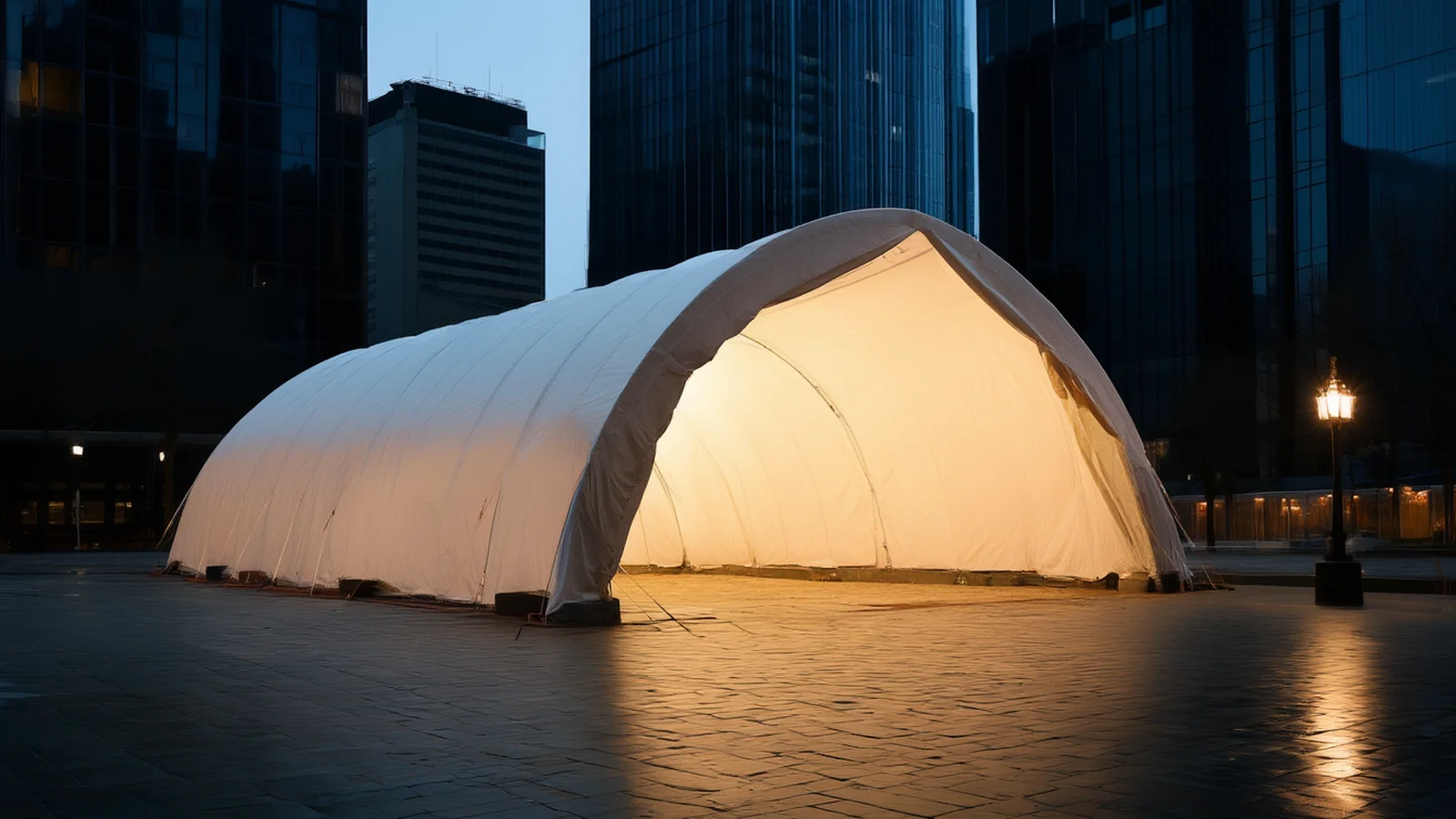
That's not a style choice. Our rule on this section is to use public-domain or openly licensed photographs of the real object. For Cloud Gate, there almost aren't any. The image at the top of this page is a generated illustration of a tent (Illustration: What If? Magazine, generated), not the sculpture. The United States has no "freedom of panorama" exception for sculpture, so a photo of a copyrighted sculpture in a public park is a copy of the sculpture. Wikimedia Commons, the free image library behind Wikipedia, puts a warning on its Cloud Gate category saying exactly that.7
Then it deletes the photos. When we checked on 19 November 2026, Commons listed 60 deletion discussions about Cloud Gate images that ended in deletion, one that ended in a keep, and two still open. One of them covered the whole category.8
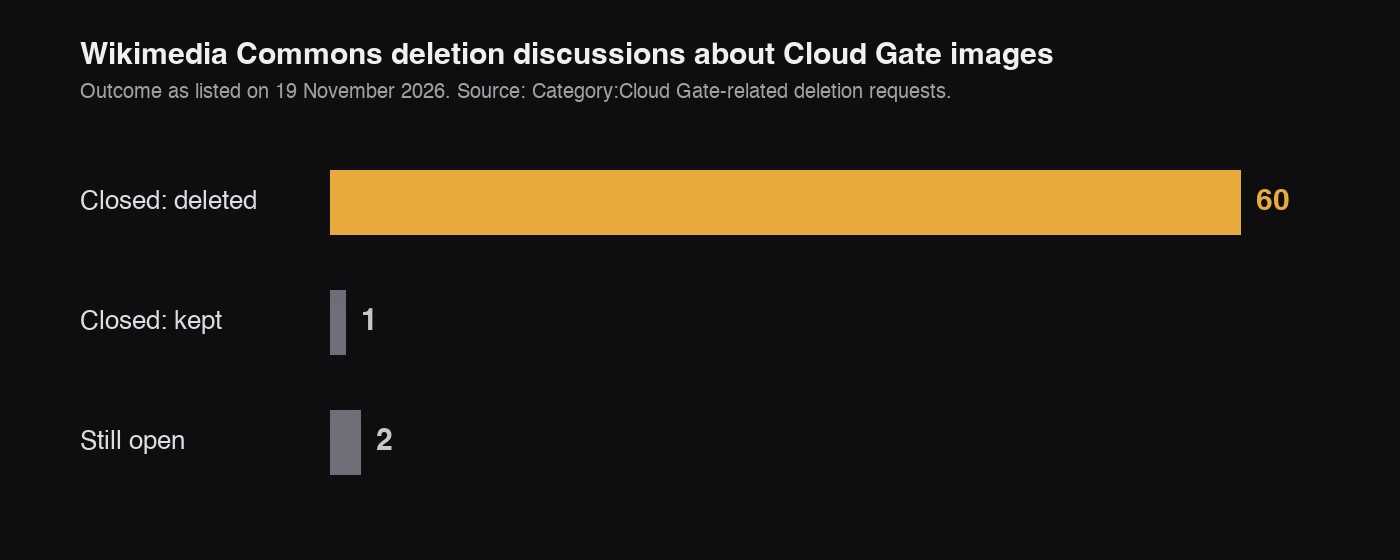
So the most photographed object in Chicago is close to invisible in the world's largest free image archive. You can take a picture of it. You can post it. You can't give it away freely for anyone to reuse, because it isn't yours to give.
And it's been taken out of view more recently than you'd think. From August 2023, the city fenced off the plaza for a rebuild, and the Bean sat behind construction fencing for nearly a year, until it reopened on 23 June 2024.9
The pattern, plainly
Here's what you have when you lay out the documents.
A sculpture built from the inside out, by crews working behind a tent, twice. A steel frame inside that the public has never seen drawn. A budget that nearly quadrupled, with two accounts of who paid. A city that tried to control who could sell its picture. And a free archive that has to delete its photographs.
None of that is a man in a bean. The coalition is a joke, and a good one. But jokes about hidden things stick to objects that have actually been hidden, and owned, and fenced off. The Bean is a mirror. Everyone who visits sees themselves in it. Almost nobody has seen what holds it up, or knows who gets paid when its picture is sold.
So here's the question to pull on. Next time you take a photo of something in a public park, ask whether that picture is really yours.